
Skip to main content Skip to search Skip to main navigation
Experience from countless projects
Let's get started together
We are different. We are better!
Fast and direct contact
Offer
Go to homepage

Bühler Evolution B 420 D successfully relocated from Germany to Korea and Vietnam
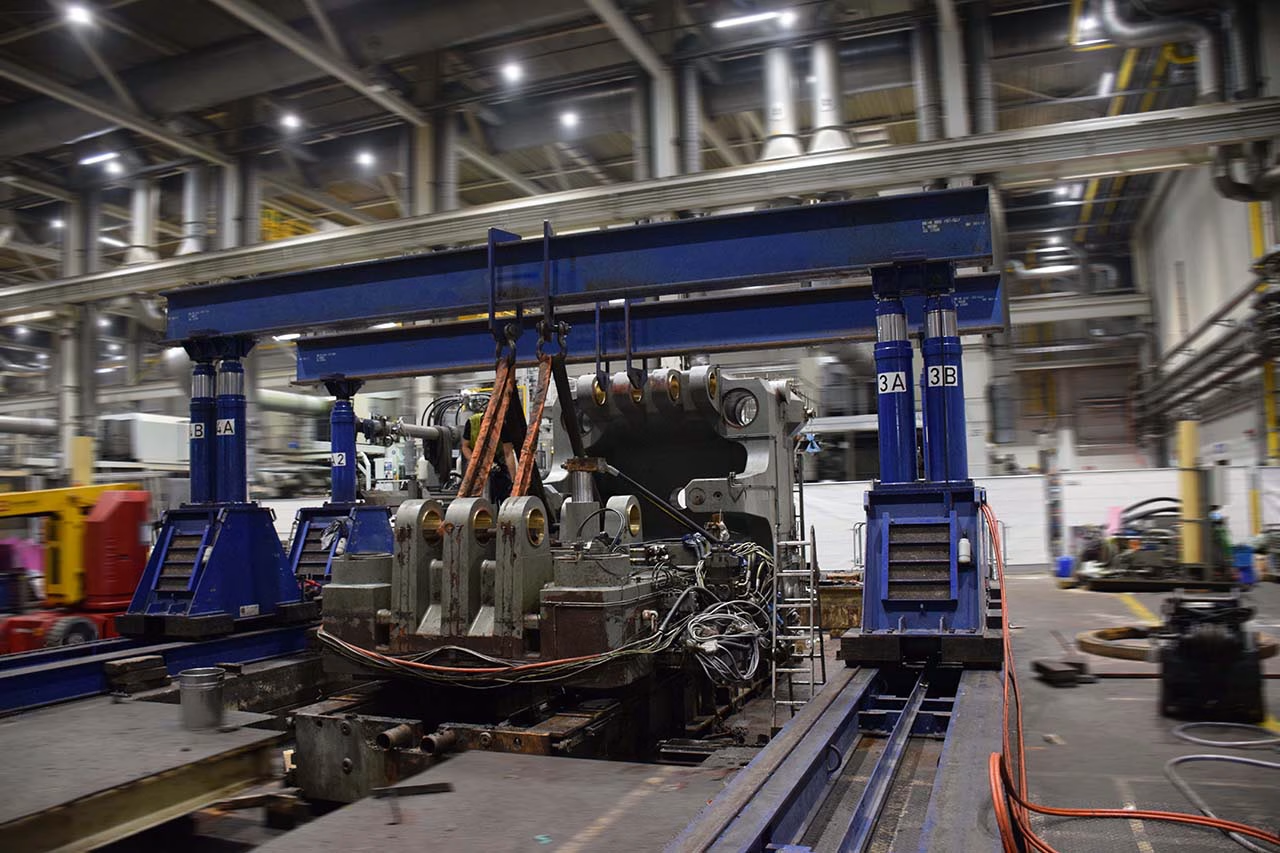
International relocation of two large die casting machines

Two Bühler Evolution B 420 D Die Casting Machines Successfully Relocated from Germany to Korea and Vietnam

In 2020, FISS carried out the dismantling, disassembly, packaging and international relocation of two identical Bühler Evolution B 420 D cold-chamber die casting machines, each with a clamping force of 4,200 t. The two large machines were transported from Germany to Korea and Vietnam.

Machines 2 × Bühler Evolution B 420 D
Clamping force 4,200 t each
Machine weight approx. 270 t
Destinations Korea & Vietnam
Project at a glance

Which Bühler die casting machines were relocated internationally?

FISS handled the relocation of two identical Bühler Evolution B 420 D cold-chamber die casting machines with a clamping force of 4,200 t each.

Since 2004, the machines had been used in multi-shift casting operations for the production of six-cylinder engine blocks. After the sale, they were dismantled, separated into transportable assemblies, documented, packed and shipped to their new production sites in Korea and Vietnam.

Consulting and machinery brokerage

From a German automotive plant to new production sites in Asia

The two Bühler Evolution B 420 D machines had previously been used by a German automotive manufacturer and were to be sold on the international used-machinery market in 2020.

Through FISS's international network, contact was established with an Asian manufacturer looking for suitable die casting cells for the production of aluminium housings for 5G mobile communication networks at its sites in Korea and Vietnam.

01 · Initial situation

Two used large-scale machines

After many years of automotive casting operation, the two identical Bühler machines were to be sold.

02 · Buyer search

Use an international network

FISS supported the search for a suitable buyer for two die casting machines of this size.

03 · New application

Aluminium housings for 5G technology

At their new locations, the machines were intended for the production of aluminium housings.

Project process

From planning to shipment of the large machines

For die casting machines of this size, dismantling, heavy-duty handling, packaging and international logistics must be precisely coordinated.

01

Project planning

Machine weights, dismantling sequence, removal routes and the transport concept were planned in advance.

02

Peripheral equipment

Automation and peripheral equipment that were not part of the agreed scope of supply were dismantled first.

03

Main machines

The Bühler machines were then dismantled into heavy transportable assemblies.

04

Documentation

Components were labelled and photographed, while complex work steps were documented by video.

05

Transport

The assemblies were transported to Asia by truck, special transport and sea freight.

Project dimensions

270 tonnes of machine weight require detailed heavy-duty planning

According to the project report, one Bühler Evolution B 420 D weighs approximately 270,000 kg. Individual assemblies therefore presented significant challenges even during removal from the production hall.

270 t Total weight of one Bühler Evolution B 420 D
73 t Weight of the cylinder platen during removal
100 Ceiling supports used to secure the basement area beneath the transport route
approx. 30 Employees involved at certain stages of dismantling
Machine removal

Secure the basement transport route with 100 ceiling supports

Special challenge: the 73-tonne cylinder platen

A structural solution had to be prepared for the removal of one particularly heavy machine assembly. Because there was a basement area beneath the transport route, the route was secured with a total of 100 ceiling supports.

Weight

Determine heavy component weights early

The weights of the individual assemblies must be known before dismantling so that suitable lifting and transport equipment can be selected.

Building conditions

Check the load capacity of transport routes

Hall floors, access routes and basement areas can be decisive factors when planning heavy-duty machinery removal.

Lifting equipment

Move machine assemblies in a controlled manner

The dimensions of the Bühler B 420 D required coordinated heavy-duty and lifting equipment.

Transport sequence

Coordinate dismantling and removal

The disassembly sequence had to be coordinated with the subsequent movement and loading of the assemblies.

Dismantling

Around 30 employees working in multiple shifts

Dismantling in Germany began in March 2020. At certain stages, around 30 employees were involved. To maintain the project schedule, work was carried out in multiple shifts and also at weekends.

March 2020

Start of dismantling

Work at the German production site began in March 2020.

Multiple shifts

Maintain the project schedule

Dismantling was organised across several work shifts.

Weekends

Work on Saturdays and Sundays

Parts of the dismantling work were also carried out at weekends.

Dismantling sequence

Peripheral equipment and automation first, Bühler machines afterwards

Equipment that was not part of the agreed scope of supply was dismantled first. This was followed by the KUKA spraying robots and the two main machines.

  • KMA exhaust-air systems dismantled
  • WEKO WE 2500 trimming press dismantled
  • Temperature control units removed
  • Dosing furnaces dismantled
  • Ertl rough trimming systems removed
  • Part-marking equipment dismantled
  • KUKA spraying robots dismantled
  • Bühler Evolution B 420 D machines subsequently disassembled
Machine condition

Good maintenance supports long-term value retention

According to the project report, dismantling of the clamping units revealed that important mechanical assemblies were in very good condition.

Clamping platens

Good mechanical condition

The clamping platens were found to be in very good condition during dismantling.

Toggle system

Well-preserved mechanical system

The toggle system was also assessed positively during disassembly.

Guide columns

Regular maintenance pays off

The condition of the guide columns highlighted the value of regular maintenance and previous modernisation work.

Documentation

Label components, take photographs and record complex steps on video

Detailed documentation was particularly important because technicians from the future operator were unable to attend the dismantling site due to the COVID-19 restrictions in place at the time.

  • Label all dismantled parts
  • Photograph machine components
  • Document connections and interfaces
  • Record complex dismantling steps on video
  • Assign assemblies in a structured manner
  • Document the dismantling sequence clearly
  • Keep the customer informed about project progress
  • Support reassembly with technical documentation
International logistics

Eight open-top containers and five special cargo units per machine

After dismantling was completed, the assemblies were shipped to Asia via German seaports.

8

Open-top containers

Eight 40-foot open-top containers were used for each die casting machine.

5

Special cargo units

In addition, five large special cargo units were transported for each machine.

65 t

Heaviest transport component

At the destination, a component weighing approximately 65 tonnes had to be moved.

≈6

Weeks at sea

The shipped components were in transit for around six weeks.

2

Destinations

The machines were intended for production sites in Korea and Vietnam.

Transport to Korea

By truck and special transport to the port, then by sea

The first machine was transported by standard trucks and special transport to Hamburg and Bremerhaven and shipped from there to Korea.

Road transport

Move machine assemblies to the seaport

Depending on dimensions and weight, both standard transport and special transport were used.

Sea freight

Combine containers and RoRo transport

Depending on the individual assembly, open-top containers, crates and RoRo transport were used.

Transport to Vietnam

Second machine temporarily stored before final delivery

The second Bühler Evolution B 420 D was initially placed in temporary storage near Landshut and was later successfully delivered to its new location in Vietnam.

Heavy-duty transport at destination

Consider different transport regulations

A machinery relocation project does not end when the equipment reaches the destination country. The onward transport from the port to the new production site must also be coordinated with local regulations, road conditions and permitted axle loads.

In this project, a component weighing approximately 65 tonnes placed particularly high demands on transport planning in Korea and Vietnam.

Reassembly and commissioning

Technical support from Germany

FISS was originally expected to support reassembly at the destination. Due to the COVID-19 restrictions in place at the time and for cost reasons, the customer ultimately decided to carry out assembly and commissioning using its own resources.

Project documentation

Reuse information from dismantling

Labels, photographs and video recordings support the identification of components during reassembly.

Remote support

Technical assistance from Germany

FISS supported the customer technically from Germany during assembly and commissioning.

What the project demonstrates

Relocating large machinery involves more than transport alone

For a die casting machine weighing several hundred tonnes, detailed project planning is essential to ensure that dismantling, removal, packaging and transport work together smoothly.

Dismantling

Separate assemblies into transportable units

The dismantling sequence must already take component weights, removal routes and subsequent transport dimensions into account.

Documentation

Prepare for reassembly

Structured labelling makes subsequent assembly at the new production site easier.

Heavy-duty logistics

Adapt the transport concept to each assembly

Container transport, special transport and RoRo can all be combined within a single project.

International planning

Consider local regulations

Transport requirements can differ significantly between the country of origin and the destination country.

The FISS advantage

International relocation of die casting machines and foundry equipment

FISS supports companies with the sale, dismantling, packaging, transport and recommissioning of used die casting machines and complete foundry systems.

  • Long-standing experience with die casting machines
  • International machinery brokerage
  • Technical project planning
  • Planning heavy-duty removal routes
  • Mechanical and electrical dismantling
  • Disassembly of large clamping units
  • Labelling and documentation
  • Professional machinery packaging
  • Coordination of special transport
  • International sea freight
  • Temporary storage according to project requirements
  • Support with reassembly and commissioning
Frequently asked questions

Questions about the relocation of the Bühler Evolution B 420 D

Which die casting machines were relocated?
Two identical Bühler Evolution B 420 D cold-chamber die casting machines.
What clamping force do the Bühler Evolution B 420 D machines have?
Each of the two machines has a clamping force of 4,200 tonnes.
How much does a Bühler Evolution B 420 D weigh?
The project report states a total weight of approximately 270,000 kg per machine.
What were the machines previously used for?
Since 2004, they had been used in multi-shift casting operations for the production of six-cylinder engine blocks.
Where were the machines transported?
One machine was relocated to Korea and the second to Vietnam.
What new application was planned for the machines?
The buyer planned to use the machines for the production of aluminium housings for 5G mobile communication networks.
How many employees were involved in dismantling?
Around 30 employees were involved at certain stages of the dismantling work.
What was the main challenge during machine removal?
To move the 73-tonne cylinder platen, a transport route above a basement area had to be secured using 100 ceiling supports.
How was the dismantling documented?
Components were labelled and photographed. Complex work steps were additionally documented by video.
How many containers were required?
Eight 40-foot open-top containers and five additional special cargo units were shipped for each die casting machine.
How long did the sea transport take?
According to the project report, the sea journey took around six weeks.
Did FISS also carry out the reassembly?
Reassembly was originally planned. Due to the conditions at the time, however, the customer decided to carry out assembly and commissioning independently. FISS provided technical support from Germany.
Can FISS also relocate very large die casting machines internationally?
Yes. Depending on the project, FISS can support planning, dismantling, documentation, packaging, loading, heavy-duty transport, sea freight, reassembly and commissioning.
Relocate a die casting machine internationally

Are you planning the dismantling and international relocation of a die casting machine or die casting cell?

Send FISS the manufacturer, model, year of manufacture, clamping force, machine weight, current location, destination, scope of equipment, available peripheral equipment, technical documentation and photos. Our team can support you with project planning, dismantling, documentation, packaging, heavy-duty transport, sea freight and recommissioning.

Telephone: +49 (0)7181 60696-0   ·   Email: info@fiss-machines.com
