
Skip to main content Skip to search Skip to main navigation
Experience from countless projects
Let's get started together
We are different. We are better!
Fast and direct contact
Offer
Go to homepage

Filter products

Extractor Units

Used Extractor Units for Hot Chamber Die Casting Machines
The die opens. The extractor unit must enter the machine area with precision.

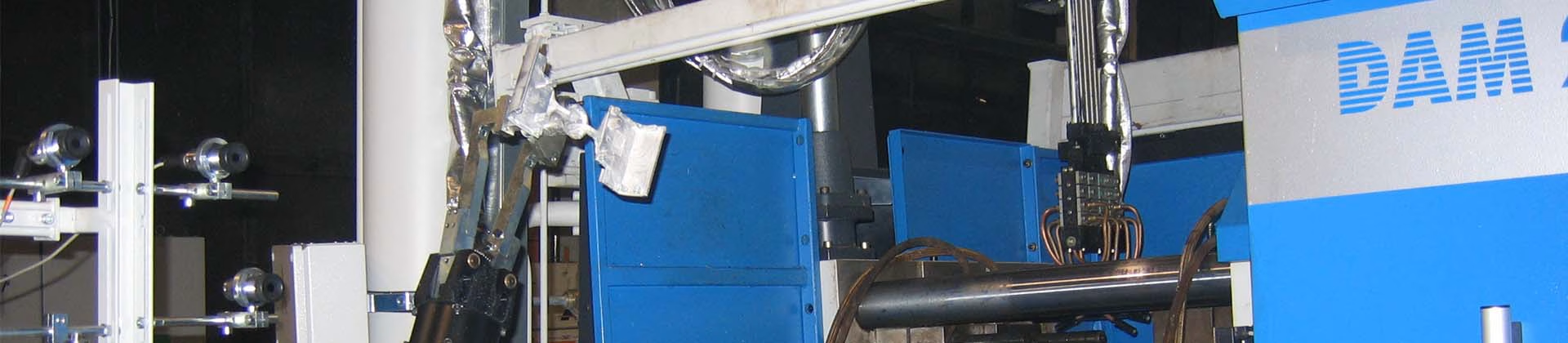
Extractor units remove zinc or magnesium die castings after the hot chamber die casting machine has opened. They grip the casting or complete casting cluster, remove it from the die area in a controlled manner and transfer it to a separating unit, conveyor system, inspection station or container.

The movement sequence of automatic component extraction

An extractor unit performs several precisely coordinated movements. Each phase requires a clear machine release signal and a controlled end position.

Wait
Remain ready outside the die area The unit remains in a safe starting position while the die casting machine performs the shot and solidification phase.
Required release Die fully opened, ejector position reached and movement area released for extraction.
Enter
Move the gripper to the defined pickup point Stroke, insertion depth and orientation must allow the gripper to reach the casting cluster without touching die halves, tie bars or other automation equipment.
Collision-free path The actual die geometry and all components installed within the machine area must be considered when planning the movement.
Grip
Secure the casting or casting cluster reproducibly The gripper closes around a suitable contour and holds the component during removal, return movement and subsequent transfer.
Grip confirmation An end position, gripping-pressure signal or suitable sensor confirms that the part has been securely received before the return movement begins.
Extract
Release the part from the die and ejector area The movement direction and speed must prevent the part from becoming jammed, catching on contours or falling uncontrollably from the gripper.
Defined return movement The machine may release the next process stage only after the component has safely left the die area.
Transfer
Place the component at the downstream station Depending on the system concept, the part is transferred to a separating unit, chute, conveyor belt, weight sensing device or collection container.
Downstream equipment release The target position must be ready and clear before the gripper opens or deposits the component.

The critical movement area lies between the die and the safe transfer zone

The extractor unit must enter sufficiently far into the open machine and then quickly return to a safe area. The complete path is limited by the die, tie bars, spraying equipment and machine enclosure.

Die area Receive the component A restricted movement area containing die contours, ejectors and hot components. The position and gripping angle must be precise.
Movement corridor Return without collisions The gripped component changes the required clearance. Not only the gripper but also the complete casting cluster must be able to leave the machine area safely.
Safe zone Transfer the component Outside the die, the component is transferred to the downstream parts flow or a defined deposit position.
Schematic representation: The actual movement corridor is defined according to the die, machine, gripper, casting cluster and existing peripheral equipment.

The gripper is the direct interface to the casting

An existing extractor unit may operate mechanically and still be unsuitable for a new component. The gripper frequently determines whether the unit can actually be reused.

Shape

The gripping contour must provide a clearly defined component position

Gripper jaws, fingers, stops and supports should grip the casting at sufficiently stable areas. The position must remain reproducible despite normal dimensional and process variations.

Hold

The holding force must match the component weight and movement

Acceleration, changes of direction and possible adhesion forces within the die influence the load on the gripper. At the same time, the gripping force must not unnecessarily deform sensitive contours.

Contact

Hot surfaces and sprue contours place stress on the gripper

Gripping surfaces, mounting components and sensors must be suitable for repeated contact with warm castings and potentially sharp-edged sprue areas.

Which data determine technical suitability?

The manufacturer and year of manufacture alone are not sufficient when selecting a used extractor unit. The actual movement data and integration into the existing hot chamber die casting cell are decisive.

Conveyed component
Casting or complete casting cluster Dimensions, weight, centre of gravity, temperature and gripping contour determine the load capacity, gripper design and required movement clearance.
Machine area
Opening width and insertion depth The gripper must reach the pickup point and subsequently guide the complete casting cluster out of the die area without collisions.
Movement
Stroke lengths and axis arrangement Horizontal stroke, vertical movement, rotation or additional travel paths must match the planned extraction and transfer point.
Performance
Load capacity and acceleration The gripper, casting and possible sprue residues form the actual moving mass. The drive, guides and braking behaviour must be designed accordingly.
Production
Available cycle time Entry, gripping, return movement, transfer and return to the starting position must take place within the intended machine cycle.
Installation
Mounting and space requirements Machine mounting, floor stand, enclosure, maintenance access and movement area must be compatible with the existing system layout.
Energy supply
Pneumatic or electric drive Operating pressure, connected load, motors, gearboxes, speed control and available utilities must be checked.
Communication
Control system and machine interface Die-open signal, extraction release, grip confirmation, end positions, fault messages and the safety circuit must be clearly coordinated.

The extractor unit operates within a limited time window

Extraction begins only after the die has opened safely and must be completed before the next machine cycle can be released.

The fastest individual movement is not what matters. The complete, safe sequence is decisive.
Machine Open the die The die and ejectors reach their released positions.
Extraction Enter the machine area The gripper reaches the intended pickup point.
Component contact Grip and release The casting is secured and removed from the die area.
Downstream process Transfer The component reaches the next station or deposit position.
Release Confirm home position The machine area is clear for the next casting cycle.

Where does extraction end and the downstream process begin?

The deposit position of the extractor unit must already match the next station. Component orientation, drop height and release signals influence the complete material flow.

Hot Chamber Automation Overview of material supply, die preparation, extraction, separation, transport and inspection. View overview
Spraying Machines Die spraying and component extraction frequently use the same open die area and require a clearly coordinated sequence. View category
Separating Units Receive complete casting clusters and separate castings from sprues and overflows. View category
Conveyor Belts Transfer extracted or previously separated components in a controlled manner to the next processing or inspection station. View category
Weight Sensing Devices Check the weight of individual castings within the automated material flow. View category
Hot Chamber Die Casting Machines Used machines and complete hot chamber die casting cells for zinc and magnesium applications. View category

Technical condition inspection of a used extractor unit

In addition to the basic movement function, the mechanical system, gripper, drive, sensors, control system and actual scope of supply should be documented.

Grip
Gripper and component pickup Inspect gripper jaws, fingers, stops, joints and mounting components for wear, deformation, play and suitability for the new casting.
Axis
Guides and movement axes Check linear guides, shafts, rollers, bearings and carriages for smooth operation, wear, lubrication and sufficient rigidity.
Drv
Drive and power transmission Test motors, gearboxes, cylinders, valves, chains, belts, couplings and brakes under realistic movement conditions.
Pos
End positions and sensors Check proximity switches, limit switches, grip confirmation, position sensors and mechanical stops for correct function and repeatable switching points.
Ctl
Control system and operation Record the electrical cabinet, PLC, operator panel, programmes, electrical diagrams, cables and connectors completely.
Safe
Safety equipment Assess safety guards, enclosures, doors, interlocks, emergency stop and the safe shutdown of all movements.
Base
Mounting and machine connection Compare flange dimensions, base frame, supporting surfaces, stands and mounting points with the intended hot chamber machine.
Docs
Documentation and scope of supply Clearly identify the gripper, control system, cables, pneumatic equipment, safety systems, spare parts, circuit diagrams and operating documentation.

Machine communication secures the movement sequence

The extractor unit and die casting machine must not operate independently of one another. Release signals, end positions and fault messages form a shared sequence and safety logic.

Die fully opened The extractor unit may enter the machine area only after the die movement has ended and the intended opening position has been confirmed.
Ejector position reached The component must be in a defined position so that the gripper can reach the intended pickup point reproducibly.
Gripper closed Before the return movement begins, confirmation should be provided that the gripper or component pickup has reached its intended end position.
Machine area clear The die casting machine may release the next movement stage only after the extractor unit, gripper and casting have left the die area.
Downstream station ready The separating unit, conveyor belt, weight sensing device or container must be able to receive the transfer before the component is released.
Fault and safe home position If a component is missing, an axis is blocked or an end position remains unconfirmed, the process must stop in a controlled manner and reach a safe condition.

Refurbishment and adaptation to a new die casting cell

Depending on their condition, used extractor units can be mechanically inspected, refurbished and adapted to a new casting, die or system layout.

An extractor unit is only suitable when the gripper, movement, transfer and machine control system work together.
Mechanical refurbishment Inspect or replace guides, bearings, joints, drives, gearboxes, cylinders and mounting components.
Gripper adaptation Adapt gripper fingers, jaws, stops and supports to the contour, weight and centre of gravity of the new casting.
Movement-path adjustment Adapt the insertion depth, stroke, vertical position and transfer point to the die, machine and downstream peripheral equipment.
Sensors and electrical equipment Inspect end positions, grip confirmation, cables, plug connections and electrical components and replace them where necessary.
Control-system integration Reconfigure machine releases, movement sequences, fault messages and safety functions for the new hot chamber system.

Buy or sell used extractor units

FISS supports the search for a suitable extractor unit and its technical assignment based on casting dimensions, weight, gripping point, opening width, stroke lengths, cycle time, transfer position and interface to the hot chamber die casting machine. If no suitable used unit is currently listed, FISS can search its international network for an appropriate solution or offer a factory-new system depending on the project.

When selling equipment, FISS supports condition assessment, technical documentation and international marketing of individual extractor units and complete hot chamber die casting cells. In addition to brokerage and international marketing, direct purchase by FISS may also be an option depending on the project.