




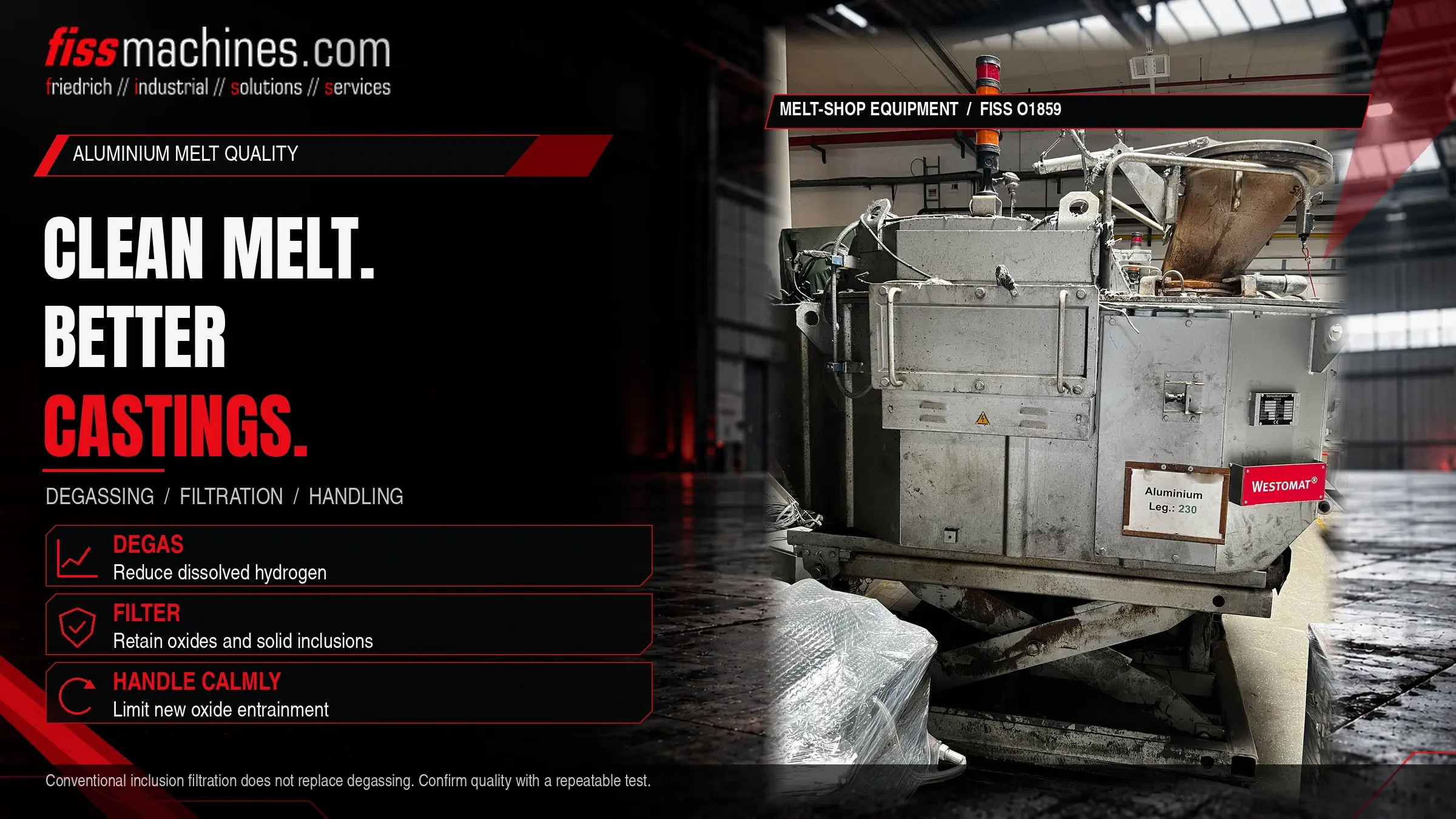
Aluminium Melt Quality: Degassing, Filtration and Oxides
A die casting machine can only cast what the melt shop delivers. Dissolved hydrogen, oxide films and other inclusions travel with the metal into the shot sleeve and end up in the casting. Clean, well-treated melt is therefore a prerequisite for low scrap rates, leak-tight parts and reliable machining, heat treatment or welding.
What Determines Aluminium Melt Quality?
Three factors dominate: dissolved hydrogen, which can form gas pores during solidification; oxides and inclusions, which weaken the casting and disturb flow; and temperature control, which affects both. Degassing with inert gas lowers the hydrogen content, filtration retains oxides and particles, and careful handling prevents new contamination.
Melt quality should be measured, not assumed. Simple shop-floor tests make changes visible before they show up as scrap.
Hydrogen: The Invisible Contaminant
Hydrogen is the only gas that dissolves in appreciable quantities in molten aluminium. Its solubility is much higher in the liquid than in the solid metal and increases with temperature. During solidification, the excess hydrogen is rejected and can form pores.
The main source is moisture. Water vapour reacts with molten aluminium, forming oxide and releasing hydrogen into the melt. Moisture comes from humid air, damp or contaminated charge material, insufficiently dried tools, ladles and refractory linings, and from combustion gases in fuel-fired furnaces.
In high-pressure die casting, much of the porosity is caused by entrapped air and solidification shrinkage rather than hydrogen. Dissolved gas still matters, particularly for parts that are heat treated, welded or must be pressure-tight, where small gas pores can cause blistering or leaks.
Oxides, Dross and Other Inclusions
Molten aluminium is instantly covered by a thin oxide skin. As long as it stays on the surface it is harmless. When the surface is broken by turbulent pouring, a large drop height or stirring, oxide films are folded into the melt. These films can act as cracks in the casting and as nuclei for pores.
| Contaminant | Typical Source | Countermeasure |
|---|---|---|
| Dissolved hydrogen | Moisture from air, charge, tools, refractory, combustion | Dry charge and tools, inert-gas degassing, controlled temperature |
| Oxide films | Turbulent transfer, high drop height, oxidised returns | Calm transfer, short drop heights, skimming, filtration |
| Refractory particles | Worn or damaged furnace and ladle linings | Lining maintenance, filtration |
| Sludge (intermetallic phases) | High iron, manganese and chromium content combined with low holding temperature | Alloy control, holding temperature suited to the alloy, regular furnace cleaning |
For sludge, an empirical sludge factor is frequently used as an indicator: Fe + 2 × Mn + 3 × Cr, each in weight percent. The critical value depends on the holding temperature and should be agreed with the alloy supplier.
Degassing: Removing Hydrogen with Inert Gas
The most common method in aluminium foundries is rotary degassing. A rotating graphite impeller disperses an inert gas, usually argon or nitrogen, into fine bubbles. Hydrogen diffuses from the melt into the bubbles and leaves with them at the surface. Rising bubbles also carry oxides upwards, where they can be skimmed off with the dross.
Prepare
Preheat rotor and shaft, check rotor wear and set the melt to treatment temperature.
Treat
Run the defined gas flow, rotor speed and duration; avoid a vortex that draws oxides into the melt.
Skim and Verify
Remove dross carefully and confirm the result with a melt quality test.
Use Promptly
Treated melt can pick up hydrogen again over time, especially in humid conditions.
Where degassing takes place depends on the melt shop layout: in a transfer ladle, in a separate treatment station or in the furnace. The roles of the different furnace types are explained in our article Dosing, Melting or Holding Furnace?
Filtration: Retaining Oxides and Particles
Filters mechanically retain oxide films and solid particles. Ceramic foam filters, classified by pore size, are widely used in launders, at furnace outlets or in dosing furnaces. A finer filter retains smaller inclusions but offers more flow resistance and clogs sooner, so filter selection must match throughput and changing intervals.
Filtration does not remove dissolved hydrogen, and degassing alone does not remove all inclusions. The two treatments complement each other. Both are only effective if the metal is not contaminated again afterwards, for example by turbulent ladling into the shot sleeve. The effect of filling conditions on porosity is covered in our article on mold filling and vacuum.
How Melt Quality Is Tested
Reduced Pressure Test
One sample solidifies at atmospheric pressure, a second under a defined vacuum. Gas and oxides cause the vacuum sample to form more pores and therefore have a lower density. The density index compares both values.
Inclusion Tests
Fracture tests on simple samples make oxide films visible on the fracture surface. For more detailed analysis, laboratory methods quantify inclusions in a filtered metal sample.
Density index [%] = (ρatm − ρvac) / ρatm × 100
ρatm = density of the sample solidified at atmospheric pressure, ρvac = density of the sample solidified under reduced pressure, both in g/cm³. Results are only comparable with identical sample size, pressure and procedure.
Melt Quality Checklist for Daily Operation
- Charge material and returns dry, clean and stored under cover
- Ladles, tools and skimmers coated and preheated before contact with melt
- Furnace and ladle linings inspected for damage and build-up
- Melt temperature within the defined window for alloy and process
- Degassing parameters documented and rotor condition checked
- Dross removed carefully without stirring oxides back into the melt
- Filters selected for throughput and changed at defined intervals
- Transfer and ladling with low turbulence and short drop heights
- Density index or comparable test performed and recorded regularly
Frequently Asked Questions
Is degassing necessary in high-pressure die casting?
It depends on the part requirements. For parts that are heat treated, welded or must be pressure-tight, controlled hydrogen content and clean melt are generally important. The required level should be defined per product.
Does filtration replace degassing?
No. Filters retain solid inclusions and oxide films but do not remove dissolved hydrogen. Degassing and filtration address different problems.
Why does melt quality vary with the weather?
Humidity is a source of hydrogen. On humid days, the melt can pick up more hydrogen through contact with air, tools and materials, which is why regular testing is useful.
Does a higher melt temperature improve quality?
Not automatically. Higher temperatures increase hydrogen solubility and oxidation. The temperature should be as high as the process requires, but not higher.
FISS Offers Used Melting, Holding and Dosing Furnaces.
Consistent melt quality starts with suitable furnace technology. FISS offers used furnaces for foundries and die casting and can help assess which equipment fits your alloy, throughput and cell layout.
