




Cold Chamber or Hot Chamber? Which Die Casting Machine Is Right for Your Application?
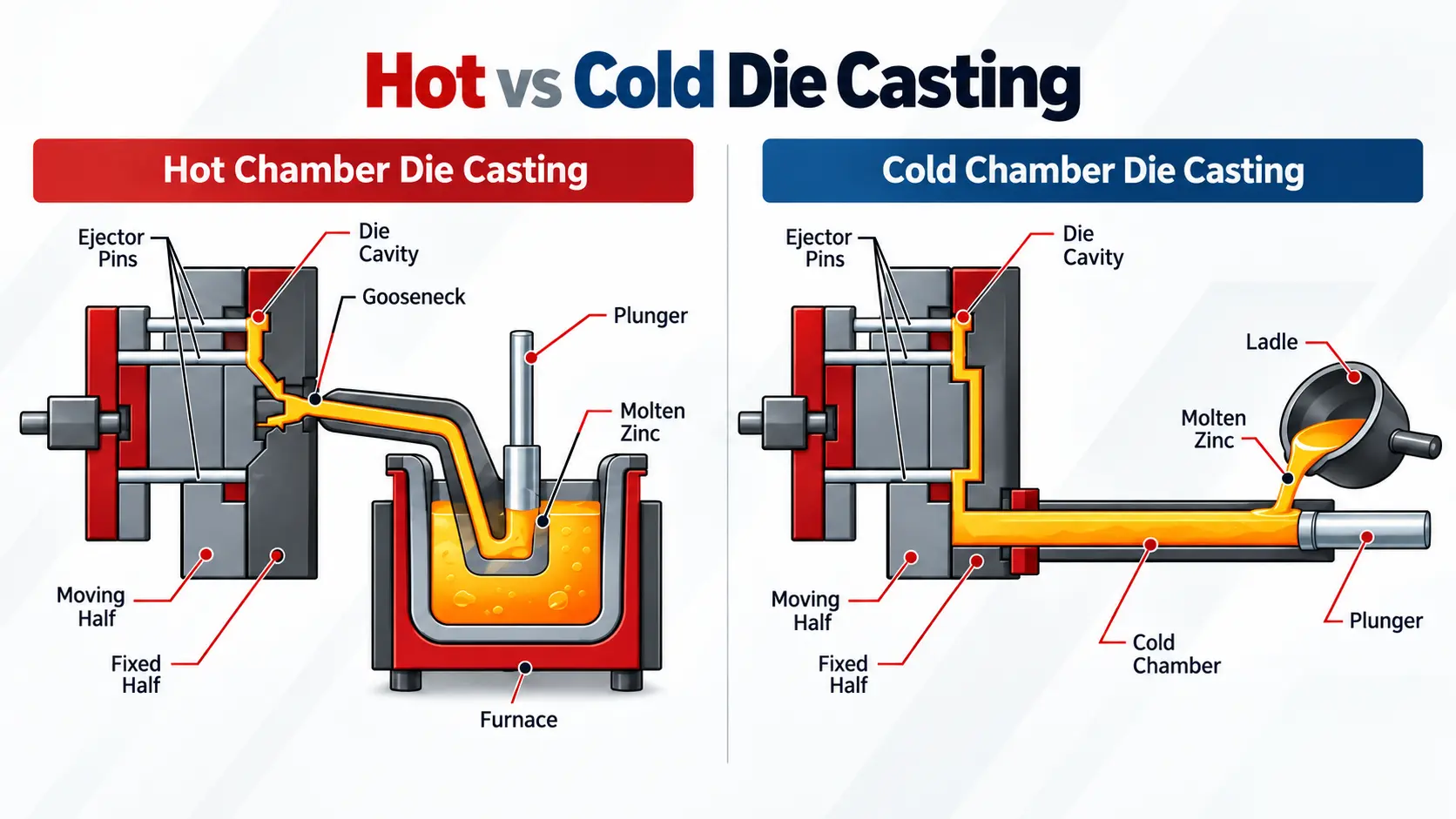
Cold chamber and hot chamber are two fundamental die casting processes. The main difference lies in how the molten metal reaches the shot unit. In practice, this design difference determines the suitable materials, cycle time, peripheral equipment and ultimately which die casting machine is best suited to a particular production application.
What Is the Difference Between Cold Chamber and Hot Chamber Die Casting?
In hot chamber die casting, the shot unit is directly connected to the molten metal in the furnace. After each shot, the shot chamber can refill with molten metal without requiring a separate transfer to the machine. The process is mainly used for zinc and certain magnesium alloys.
In cold chamber die casting, the molten metal is prepared outside the shot unit and dosed into the shot chamber for each casting cycle. This process is particularly important for aluminium die casting.
The Key Difference Occurs Before the Actual Casting Process
Die casting always follows the same basic principle: molten metal is introduced into a closed permanent metal die, solidifies inside the die and is then removed as a cast component. High filling speeds and high pressures make the process particularly suitable for precise, thin-walled components manufactured in large production volumes.
Cold chamber and hot chamber therefore differ less in their objective than in how the molten metal reaches the die. The key question is: Where is the molten metal located and how does it reach the shot chamber?

Short Transfer Paths Between Molten Metal and Die
In the hot chamber process, the shot chamber is positioned directly in or adjacent to the heated molten metal bath. When the plunger retracts after a casting cycle, molten metal can flow back into the shot area. During the next shot, the molten metal is forced through the gooseneck and nozzle into the closed die.
There is no need to transfer a separate quantity of molten metal from an external furnace into a horizontal shot chamber. This reduces auxiliary cycle time. Hot chamber machines can therefore achieve very short production cycles, particularly when suitable alloys are processed at high production volumes.
The classic application is zinc die casting. Certain magnesium alloys can also be processed on specially designed hot chamber machines.
Current machines are available from FISS under used hot chamber die casting machines .
Separate Melt Preparation for Aluminium and Large Die Casting Cells
In a cold chamber die casting machine, the main components of the shot unit are located outside the molten metal. The metal is melted or kept at temperature in a separate furnace and then transferred into the shot chamber for each casting cycle.
The molten metal can be supplied, for example, by a dosing furnace , a metal dosing system or another automated feeding system. The plunger then moves the molten metal through the gating system into the closed die.
This machine concept is particularly important in aluminium die casting. Cold chamber machines are frequently integrated into extensive automated die casting cells in which the machine, metal supply, die spraying, part removal, temperature control and downstream processing are coordinated as a complete production system.
Suitable machines can be found under used cold chamber die casting machines .
Cold Chamber and Hot Chamber at a Glance
| Criterion | Hot Chamber | Cold Chamber |
|---|---|---|
| Shot unit | Directly connected to the molten metal in the furnace system. | Located outside the molten metal. |
| Metal supply | The shot chamber can refill directly from the molten metal bath. | Molten metal is separately dosed into the shot chamber for each shot. |
| Typical materials | Mainly zinc, as well as certain magnesium and other low-melting alloys. | Mainly aluminium, as well as magnesium, copper and other suitable alloys depending on the process. |
| Cycle time | Generally shorter because no separate transfer of molten metal to the shot chamber is required. | Includes an additional process step for dosing the molten metal. |
| Typical peripheral equipment | Furnace or metal bath, spraying equipment, extraction, temperature control, conveying and separation systems. | Dosing furnace or metal dosing system, spray unit, robot, temperature control, cooling and often a trimming press. |
| Typical production environment | High-cycle series production, particularly for zinc die casting. | Aluminium die casting cells ranging from stand-alone machines to fully automated production cells. |
Which Material Is Processed with Which Die Casting Method?
In many projects, the material already indicates the most likely process. However, an alloy should not be assessed solely by its base metal. Composition, processing temperature, component design and production requirements must always be considered together.
The most important industrial application of cold chamber die casting.
Very well suited to high-cycle hot chamber series production.
Depending on the alloy, component and process, both hot chamber and cold chamber solutions are possible.
The cold chamber process can be used for suitable copper alloys.
Both Processes Require More Than Just a Shot Unit
Regardless of the process, a die casting machine essentially consists of two main functional areas: the clamping unit and the shot unit.
The clamping unit opens and closes the die and must keep it securely closed during the casting process. The shot unit moves the molten metal into the die at the required speed and generates the pressure required for the process.
Additional systems include the ejector unit, core pulls, machine drive and control system. In an industrial production cell, this system is often expanded with die spraying equipment, robots, temperature control, metal supply, conveying equipment and downstream processing.
Relevant equipment is also available from FISS in the areas of automation for cold chamber die casting and automation for hot chamber die casting .
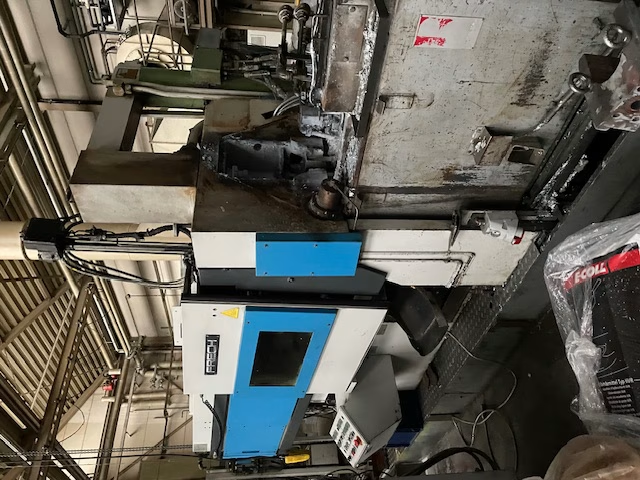
Practical Example of a Hot Chamber Die Casting Machine
Technical diagrams explain the process principle. Looking at a real used machine also shows how this technology is implemented in an industrial production environment.
The Right Sequence: Process First, Then the Machine
A common shortcut when searching for a used machine is to define the required clamping force and then look for a suitable model. This is not sufficient for a reliable technical selection.
Define the Material and Process
Aluminium typically leads to the cold chamber process, while zinc usually leads to the hot chamber process. For magnesium, the specific process must be evaluated more closely.
Check the Component and Die
Casting weight, projected area, die dimensions, wall thickness and quality requirements all have a major influence on the technical machine specification.
Match the Machine Parameters
Only at this stage should clamping force, shot unit, die space, platen dimensions, tie-bar spacing, control system and other machine parameters be evaluated.
Consider the Complete Die Casting Cell
Metal supply, spraying, extraction, temperature control, cooling, conveying and trimming all influence whether a machine can be productively integrated into the planned production process.
What Should You Check When Buying a Used Die Casting Machine?
Once the appropriate process has been identified, the actual machine evaluation begins. Manufacturer and year of manufacture provide useful initial information, but they do not determine whether a machine is suitable for the planned production process.
- Suitable clamping force for the component and die
- Shot unit, shot weight and shot chamber configuration
- Die dimensions, platen dimensions and available die space
- Condition of the clamping unit, hydraulics and shot unit
- Control system, software version and interfaces
- Ejector and core pull systems
- Furnace, dosing system and metal supply
- Die spraying, extraction, temperature control and trimming
- Documentation and known maintenance or overhaul history
- Dismantling, transport and recommissioning requirements
Especially with larger cold chamber cells, it is important to evaluate the complete system. A main machine may be technically suitable but economically unattractive if essential peripheral equipment is missing or existing components do not match the intended production process.
An overview of currently available used die casting machines can be found directly at FISS.
Three Typical Starting Situations
Aluminium Housing in Series Production
For aluminium, the selection typically leads to the cold chamber process. The die, clamping force, shot unit, shot weight and required automation must then be defined.
Zinc Component with High Production Volumes
For typical zinc die cast components, the hot chamber process is often the most appropriate solution. The direct connection to the molten metal enables short process routes and high production rates.
An Existing Die Must Continue to Be Used
In this case, distinguishing between hot chamber and cold chamber is not enough. Die dimensions, clamping force, shot unit, interfaces and peripheral equipment must be matched to the specific used machine.
The Material Indicates the Direction – the Application Determines the Machine
The technical difference between cold chamber and hot chamber die casting is straightforward: in a hot chamber machine, the shot unit is directly connected to the molten metal. In the cold chamber process, the molten metal is prepared outside the shot unit and separately dosed for each shot.
This results in typical areas of application: aluminium is predominantly processed using the cold chamber method, while zinc is predominantly processed using the hot chamber method. Magnesium can be processed using either machine concept, depending on the alloy and process.
However, this distinction is only the starting point when selecting a specific used die casting machine. The decisive factor is whether the machine, die, shot unit and automation form a suitable overall system for the intended production.
Questions About Cold Chamber and Hot Chamber Die Casting
What Is the Main Difference Between Cold Chamber and Hot Chamber Die Casting?
In the hot chamber process, the shot unit is directly connected to the molten metal. In the cold chamber process, the molten metal is prepared separately and dosed into the shot chamber for each casting cycle.
Is Aluminium Cast Using the Cold Chamber or Hot Chamber Process?
Aluminium is typically processed using cold chamber die casting machines. The molten aluminium is prepared outside the shot unit and then dosed into the shot chamber.
Which Process Is Used for Zinc Die Casting?
Zinc die casting is predominantly carried out using the hot chamber process. The shot unit is directly connected to the molten metal, allowing very short process routes.
Can Magnesium Be Processed Using Both Hot and Cold Chamber Machines?
Yes. Depending on the alloy, component and production process, magnesium can be processed using either hot chamber or cold chamber die casting machines.
Is Hot Chamber Die Casting Always Faster?
The hot chamber principle eliminates the separate transfer of molten metal and can therefore reduce auxiliary cycle time. However, the actual cycle time also depends on the component, die, solidification, spraying process, extraction and automation.
Is Clamping Force Enough to Select a Die Casting Machine?
No. The shot unit, shot weight, die dimensions, die space, platen dimensions, control system, peripheral equipment and technical condition must also match the intended production process.
What If FISS Does Not Currently List a Suitable Machine?
In this case, FISS can carry out a targeted search for a suitable machine. Technical requirements, preferred machine type, manufacturer preferences and project schedule can be defined as a search profile.
You Know the Application – FISS Finds the Right Machine.
If no suitable die casting machine is currently available from stock, FISS can specifically search for suitable used machines and complete die casting cells. The more precisely the material, die and production requirements are defined, the more targeted the technical machine selection can be.
Source
Bührig-Polaczek, A.; Michaeli, W.; Spur, G. (eds.): Handbuch Urformen, Carl Hanser Verlag, Chapter 1.6.4 “Druckgießen” (Die Casting).
