




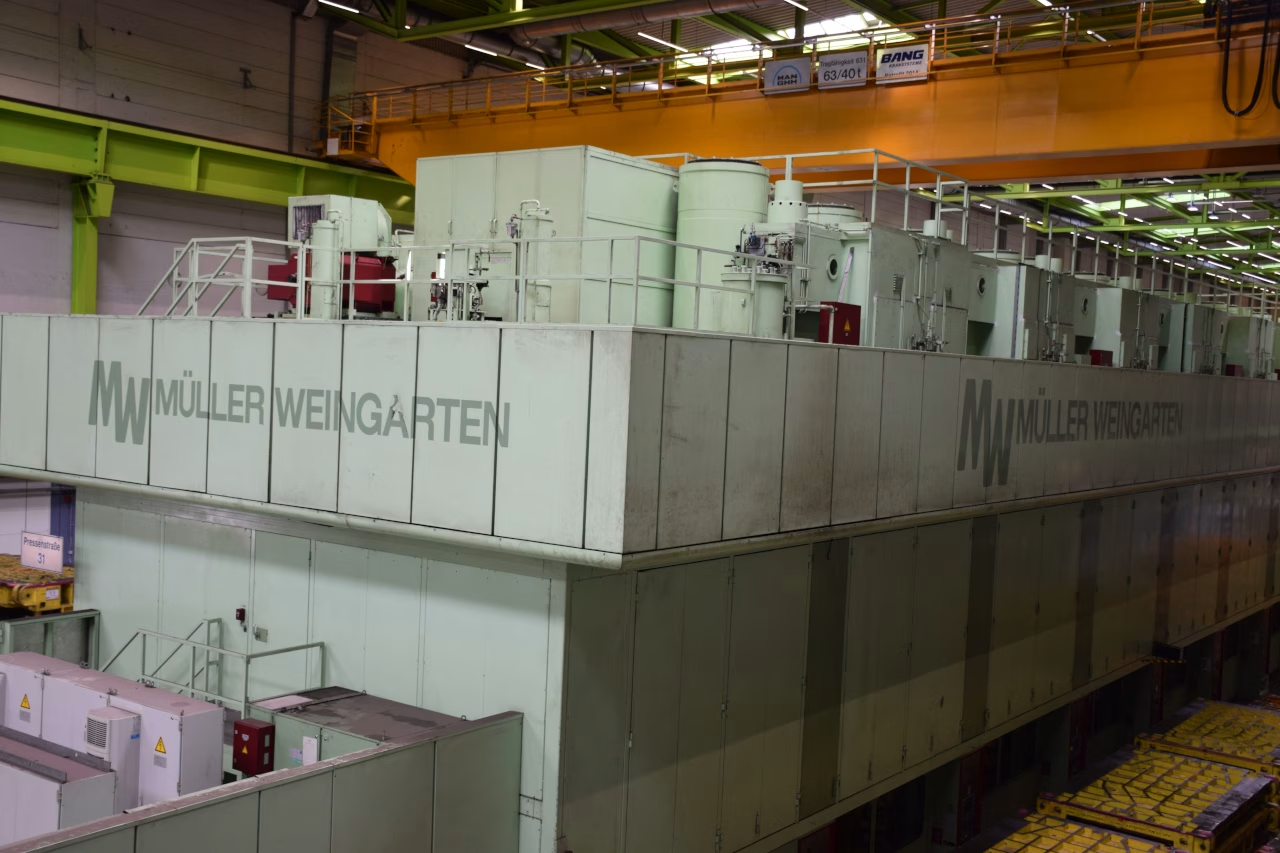
Dismantling and Transport of the Müller-Weingarten S 7300.06.260 Press Line
FISS successfully completed the dismantling and loading of a Müller-Weingarten S 7300.06.260 press line. The complex heavy-load project included the complete disassembly, packaging and multi-stage transport of the equipment.
Which press line was dismantled in the press shop?
The equipment dismantled was a Müller-Weingarten S 7300.06.260 press line. Due to the size and high weight of individual assemblies, the project required careful planning, specialist equipment and cooperation between several technical disciplines.
The complete dismantling process took six months. Handling the press crown, which weighed up to 250 tonnes, was particularly demanding.
Precise planning for a complete press line
Dismantling a press line is significantly different from dismantling an individual machine. Numerous mechanical, electrical and logistical operations must be completed in a defined sequence.
At the same time, heavy and oversized components must be moved safely, protected, loaded and distributed across different transport systems.
Coordination of all work stages
Dismantling, lifting technology, packaging and transport were planned as one integrated project.
Interdisciplinary project team
Supervisors, electrical engineers, mechanics and packaging specialists worked closely together.
Transport in several stages
The large components were first transported by heavy-load vehicle and then by ship.
Which specialists were involved in the dismantling project?
Safely dismantling a press line requires specialists for different technical and organisational tasks.
Supervision and coordination
The responsible supervisors coordinated work sequences, specialist departments and project deadlines.
- Coordination of work stages
- Coordination of specialist personnel
- Monitoring of project progress
- Support for safety planning
Electrical engineers
Electrical systems and connections had to be disconnected in a controlled manner and prepared for transport.
- Disconnection of electrical connections
- Handling of technical interfaces
- Preparation of electrical components
- Coordination with the mechanical team
Experienced mechanics
Mechanical assemblies were disconnected, secured and moved in the planned sequence.
- Dismantling of heavy assemblies
- Preparation of lifting operations
- Securing of moving components
- Support during loading
Packaging specialists
Dismantled components were protected according to their size, weight and transport route.
- Protection of sensitive components
- Transport-appropriate packaging
- Securing of individual assemblies
- Preparation for road and ship transport
Heavy-lift specialists
The particularly heavy components were safely lifted using suitable specialist equipment.
- Planning of lifting points
- Use of a lifting beam system
- Controlled lifting
- Safe positioning
Coordination of the transport stages
Road and ship transport had to be coordinated both technically and in terms of scheduling.
- Planning of heavy-load transport
- Transport to the Neckar region
- Transshipment for ship transport
- Coordination of onward transportation
From equipment assessment to ship transport
The complete relocation was carried out in coordinated dismantling, lifting, packaging and transport phases.
Project planning
The equipment scope, dismantling sequence and required specialist equipment were defined.
Dismantling
The individual components of the press line were carefully dismantled over a period of six months.
Heavy lifting
The press crown and other large components were lifted using a special lifting beam system.
Road transport
The largest components were transported to the Neckar region using heavy-load vehicles.
Ship transport
After transshipment, the machine components were transported by ship to their final destination.
Key figures for the press line relocation
The project duration, component weight and transport route demonstrate the scale of the project.
Dismantling period
The complete dismantling of the press line took a total of six months.
Maximum component weight
The press crown weighed up to 250 tonnes.
Transport concept
The large components were transported first by road and then by ship.
Safe lifting of the press crown weighing up to 250 tonnes
The press crown was one of the most technically demanding components of the project. Its weight made conventional handling impossible.
A special lifting beam system was therefore used for the controlled lift. It distributed the load across suitable lifting points and supported the safe movement of the large component.
Coordinated lifting points
The position, weight and centre of gravity had to be considered before the lift.
Lifting beam system
The lifting beam supported controlled load distribution while the press crown was lifted.
Controlled movement
The lifting operation was carefully coordinated to protect personnel and equipment components.
Why did the complete dismantling take six months?
A press line consists of numerous interconnected assemblies, supply lines and control components. These must be disconnected in a controlled manner and divided into transportable units.
- Assessment of the complete equipment scope
- Definition of a safe dismantling sequence
- Disconnection of electrical systems
- Dismantling of mechanical connections
- Preparation of heavy assemblies for lifting
- Protection of sensitive machine components
- Transport-compatible dismantling of the press line
- Coordination of multiple specialist departments
- Packaging of the dismantled components
- Coordination with heavy-load logistics
From the press shop via the Neckar region to the destination
After dismantling, the press line was transported in several stages. Particularly large components required heavy-load vehicles.
The largest parts were first transported to the Neckar region. From there, onward transport to the final destination was carried out by ship.
Loading in the press shop
The prepared components were loaded onto the designated heavy-load vehicles in a controlled manner.
Heavy-load transport to the Neckar region
The large components were transported by road to the designated transshipment point.
Transshipment of the components
At the waterway, the machine components had to be prepared for the next transport stage.
Onward transport by ship
The press components were transported by water to the final destination.
Protecting the press components during every transport stage
The packaging had to be suitable for both road transport and the subsequent ship transport.
Protection against external influences
Electrical and mechanical components had to be protected against stress during transshipment and transport.
Securing heavy assemblies
The press crown and other large assemblies were secured against unintended movement.
Preparation for road and ship transport
The packaging was adapted to the different requirements of the transport stages.
What was essential for the successful press line relocation?
The project required a combination of technical precision, careful coordination and close teamwork.
Detailed planning
The individual work and transport phases had to be coordinated at an early stage.
Experienced specialists
Different specialists handled the mechanical, electrical and logistical tasks.
Suitable lifting technology
Specialist equipment enabled controlled handling of the particularly heavy components.
Coordinated logistics
Road and ship transport were organised as one integrated transport chain.
Dismantling and heavy-load transport of complex industrial equipment
FISS supports companies with the dismantling, packaging, loading and international relocation of heavy machinery and complete production systems.
- Long-standing experience with industrial equipment
- Project planning for complex dismantling projects
- Coordination of different specialist departments
- Mechanical and electrical dismantling
- Planning of demanding heavy-lift operations
- Use of suitable specialist equipment
- Professional machine packaging
- Loading of heavy and oversized components
- Coordination of road and ship transport
- One contact for the complete project
Further services for presses and equipment relocations
Buy used presses
Available mechanical and hydraulic presses, press lines and other forming equipment.
DismantlingProfessional dismantling of industrial equipment
Structured mechanical and electrical dismantling of individual machines and complete production lines.
TransportInternational heavy-load logistics
Loading planning and coordinated road, heavy-load and international machinery transport.
Questions about the Müller-Weingarten S 7300.06.260 press line
Which press line was dismantled?
How long did the dismantling take?
Which specialists were involved in the project?
How heavy was the press crown?
How was the press crown lifted?
How were the large components transported?
How was the onward transport carried out?
Why was specialist equipment required?
Does FISS also handle complete press relocation projects?
Are you planning the dismantling or international relocation of a heavy press or production line?
Send FISS the manufacturer, model, equipment scope, machine weights, dimensions, current location, destination, technical documentation and available photos. Our team will review the requirements and support you with project planning, dismantling, lifting technology, packaging, loading and transport.
Telephone: +49 (0)7181 60696-0 · Email: info@fiss-machines.com
.JPG?ts=1688376931)
.JPG?ts=1688373197)
.JPG?ts=1688373198)
.JPG?ts=1688373198)
.JPG?ts=1688373197)
.JPG?ts=1688373198)
.JPG?ts=1688373197)
.JPG?ts=1688373198)
