




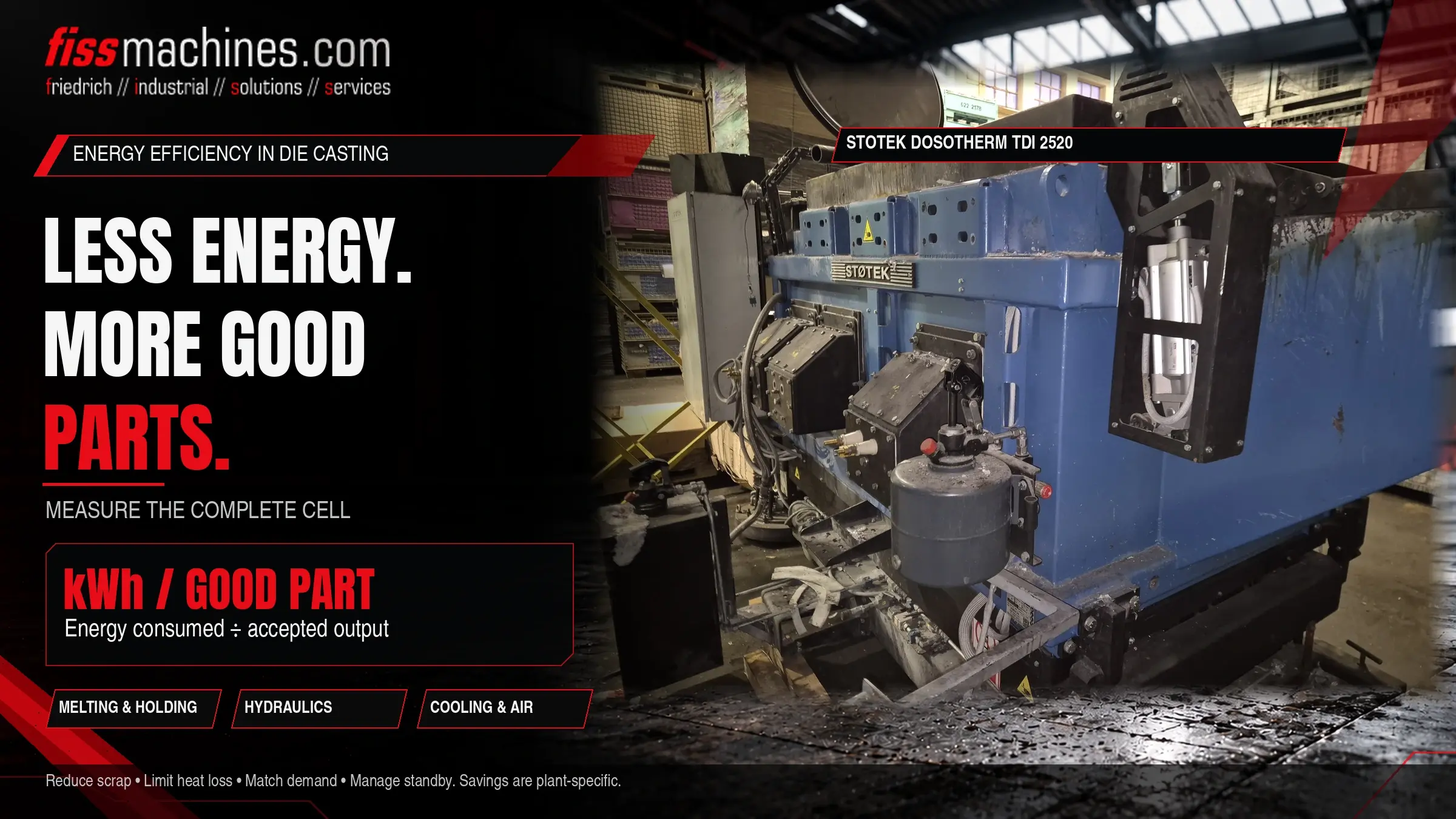
Energy Efficiency in Die Casting: Where Energy Is Used and Where It Can Be Saved
Energy is one of the largest cost items in a die casting foundry, and it is spread over many consumers: furnaces, machine hydraulics, temperature control units, compressors and extraction systems. Saving effectively means knowing where energy is actually used – and recognising that every scrapped part has consumed the full amount of energy.
Where Can Die Casters Save the Most Energy?
The largest lever is usually the metal: melting and holding require most of the energy, so every kilogram of runners, overflows and scrap that is remelted counts. Further levers are machine hydraulics with demand-based drives, thermal management of dies and furnaces, compressed air and consistent standby management.
Measuring comes first: a key figure such as energy per good part shows which measures actually have an effect.
Where Energy Goes in a Die Casting Cell
A brochure of the US Department of Energy on the metal casting industry attributes 55 % of energy use to melting. The figure is older and covers the whole casting industry, but it confirms what die casters see in their own plants: thermal processes dominate.
Melting and Holding
Melting furnaces, holding and dosing furnaces, ladle transport. Energy is needed continuously, including during breaks.
Machine Hydraulics
Pumps for clamping, shot end, ejectors and cores. With constant-speed pumps, a large part runs without useful work.
Temperature Control and Air
Die temperature control units, cooling, compressed air for spraying and blowing, extraction and conveying.
First Measure, Then Decide
Without data, saving measures remain guesswork. In many plants, energy is only recorded at the main meter. Sub-meters at furnaces, machines and compressors make the distribution visible.
- Energy per good part or per kilogram of good castings as the central key figure
- Base load during breaks, weekends and die changes
- Comparison of identical machines or shifts
- Recording of scrap and returns in kilograms, not only in pieces
A systematic framework for this is provided by energy management systems according to ISO 50001.
Less Metal in Circulation, Less Heat Loss
Every kilogram of metal that does not end up in a good part has to be melted again. The yield – the ratio of good casting weight to poured metal – is therefore an energy key figure. Optimised gating and overflows, stable processes and low scrap rates reduce the amount of returns.
- Keep furnace lids and doors closed and seals intact
- Check insulation and refractory lining regularly – hot spots on the shell indicate losses
- Do not set holding temperatures higher than the process requires
- Avoid long holding times and unnecessary ladle transport
- Match furnace size and melting capacity to actual demand
Which furnace type fits which task is described in Dosing Furnace, Melting Furnace or Holding Furnace?. Used furnaces are available under furnaces.
Hydraulics: Supply Flow Only When It Is Needed
On older die casting machines, constant-speed motors often drive the pumps permanently, even when the machine is waiting for spraying, part removal or the next shot. Drives with variable speed adapt the flow to actual demand.
Bühler, for example, offers a ServoDrive upgrade for its Carat and Ecoline series – a frequency-controlled motor combined with a multi-stage fixed displacement pump – and states that it can save more than 40 % of the machine’s electrical energy consumption. Such figures are manufacturer statements; the actual saving depends on the machine, cycle and share of waiting times.
Die Temperature Control, Spraying and Cooling
The die has to be kept within a temperature window: heated at the start, cooled during production. Temperature control units, insulated lines and a well-designed die cooling system keep this balance with less energy. Spraying also cools the die – an excessive spray quantity costs release agent, compressed air and often additional heating energy.
Background on these topics can be found in Temperature Control in Die Casting and Die Spraying in Die Casting.
Compressed Air: Expensive and Often Leaking
Compressed air is one of the most expensive forms of energy in a plant. According to the Compressed Air Challenge fact sheet on leaks, leaks can waste 20–30 % of compressor output; a plant that has not been well maintained will likely have a leak rate of around 20 % of total production capacity, while in a well-maintained system it should be less than 10 %.
- Regular leak detection, e.g. with ultrasonic devices, and prompt repair
- Check whether blow-off functions can be shortened or replaced
- Do not set the network pressure higher than the most demanding consumer requires
- Shut off supply to cells that are not in production
Used Machines and Modernisation
Energy efficiency is not only a question of the newest machine. Producing a new machine also consumes energy and raw materials; continuing to use a machine that is in good condition avoids this. With an overhaul, older machines can be upgraded, for example with demand-based drives, where the manufacturer offers this.
More on the role of used machines in sustainable production on the page Sustainable Alternative.
Stable Processes Are the Best Energy Measure
In die casting, energy efficiency starts with the metal: low scrap, good yield and well-insulated furnaces have the greatest effect. Demand-based hydraulics, consistent standby management, good thermal management and a tight compressed air network add to this. Those who measure energy per good part can prioritise measures and verify their effect.
Questions About Energy Efficiency in Die Casting
What Uses the Most Energy in a Die Casting Foundry?
As a rule, melting and holding the metal. A US Department of Energy publication on the casting industry attributes 55 % of energy use to melting. The exact distribution depends on the plant.
Is a Servo Drive Retrofit Worthwhile?
It depends on the machine and the operating profile. The higher the share of waiting and holding times in the cycle, the greater the potential. Measuring consumption before and after provides a reliable basis for the decision.
How Can Energy per Part Be Measured?
With sub-meters at furnaces, machines and compressors, combined with production data. The energy consumption over a period is divided by the number or weight of good parts produced.
Are Used Die Casting Machines Less Energy-Efficient?
Not necessarily. Drive technology, condition and process stability matter more than age. A well-maintained used machine can be efficient, especially if it is modernised during an overhaul.
Machines and Furnaces with Checked Condition.
FISS supplies used die casting machines, furnaces and peripheral equipment and advises on the selection of a cell that fits your production – including overhaul and commissioning.
Sources
U.S. Department of Energy, Office of Industrial Technologies: Metal Casting – Industry of the Future (brochure, around 2000) – energy use in metal casting: melting 55 %, moldmaking 12 %, heat treatment 6 %.
Bühler Group: ServoDrive upgrade – frequency-controlled motor with multi-stage fixed displacement pump, manufacturer statement “more than 40 %” electrical energy saving, Carat and Ecoline series, buhlergroup.com.
Compressed Air Challenge: Fact Sheet #7 – Compressed Air System Leaks (updated 2026), from the DOE Sourcebook for Industry.
ISO 50001 – Energy management systems: requirements with guidance for use.
FISS Machines: Sustainable Alternative, fiss-machines.com, accessed 29 October 2026.
