




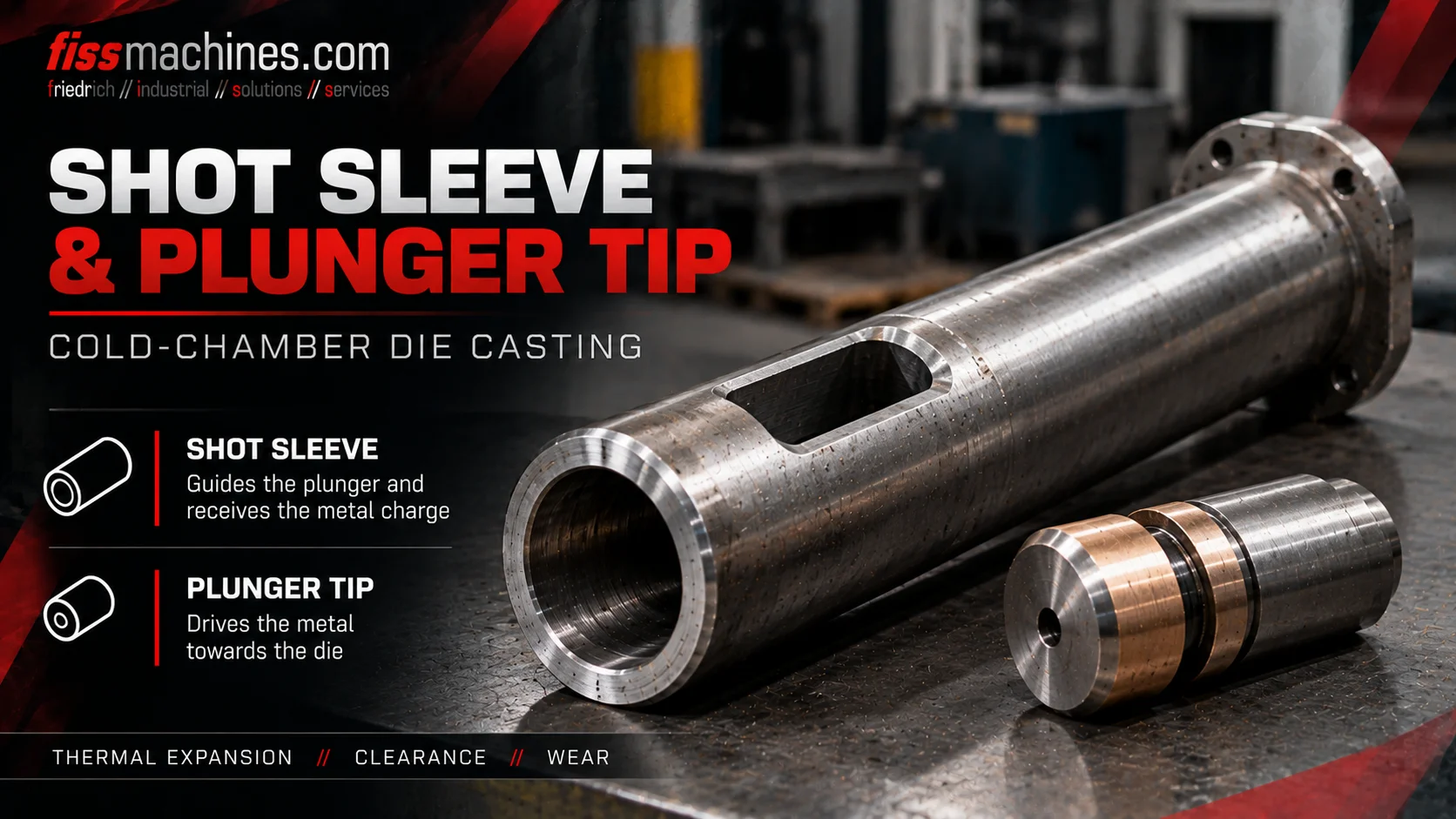
Shot Sleeves and Plungers in Cold-Chamber Die Casting: Function and Wear
In cold-chamber high-pressure die casting, molten metal is introduced into a shot sleeve before a plunger forces it through the runner and gate system into the closed die. Although the shot sleeve and plunger tip are comparatively small components beside the locking unit, their thermal, mechanical and tribological condition can influence filling behavior, cycle stability and maintenance costs.
What do the shot sleeve and plunger do?
The shot sleeve receives a measured amount of molten metal, while the plunger and plunger tip displace it toward the die. The process typically includes a controlled initial movement, a fast filling stroke and a pressure-intensification phase. Wear, excessive clearance or unsuitable lubrication can interfere with this sequence.
Shot sleeve, plunger tip and drive: what belongs together?
A typical horizontal cold-chamber injection system includes a shot sleeve mounted at the die or fixed-platen side, a filling or pouring opening, a plunger tip, a plunger rod and an injection drive. The sleeve connects the metal-introduction region with the die runner system.
The plunger tip moves inside the sleeve with a deliberately controlled clearance. Its construction and materials must withstand contact with hot metal and repeated acceleration. Depending on the manufacturer, the tip may use a sealing or wear-ring concept and dedicated lubrication or cooling.
A shot sleeve should never be assessed on diameter alone. Length, inner geometry, mounting, inlet position, tip design, thermal behavior and the machine's injection profile must form a compatible system.
Guides the melt
Receives molten metal and forms the guiding cylinder for the advancing plunger.
Displaces the metal
Transfers injection movement to the metal while working with controlled clearance.
Controls the stroke
Provides speed and pressure according to the machine and process settings.
The three important stages of a cold-chamber injection cycle
In the first movement phase, the plunger advances in a controlled manner. The objective is to displace the metal without creating unnecessary overturning waves that trap air. The chosen slow-shot profile must match the fill level and geometry of the sleeve.
During the next phase, the injection system accelerates to fill the die cavity within the required time. The transition from slow to fast shot must be coordinated with the runner and gate design, casting geometry and thermal conditions.
After filling, the pressure system applies an intensification or holding phase as specified by the casting process. This pressure behavior affects feeding during the early stages of solidification, but it cannot remove every gas inclusion or correct a poorly designed flow path.
| Process stage | Primary objective | Typical risk |
|---|---|---|
| Controlled initial stroke | Advance melt while limiting air entrapment | Breaking waves or premature air entrainment |
| Fast filling stroke | Fill cavity at the required rate | Cold laps, erosion or air entrapment from poor settings |
| Pressure intensification | Apply the required post-filling pressure | Insufficient pressure transmission or pressure peaks |
Common signs of shot-sleeve and plunger wear
Every cycle combines high thermal gradients, metal contact, friction and repeated mechanical loading. The shot sleeve may show scoring, localized erosion, adhesion deposits or dimensional changes. Plunger tips and sealing elements may wear or become damaged.
Excessive clearance can allow metal to pass around the plunger tip; depending on the system, this may contribute to deposits, sticking, instability or metal leakage. Conversely, insufficient operating clearance caused by wrong parts or thermal expansion can lead to seizure.
A change in the injection pressure curve, unusual stroke friction or repeatable leakage is a reason to investigate. These symptoms are not a standalone diagnosis: hydraulic condition, lubrication, temperature and shot parameters must also be considered.
Scoring and deposits
Inspect the bore for localized damage and excessive material build-up.
Wear and leakage
Evaluate the fitted clearance and sealing elements as specified by the manufacturer.
Increased resistance
Correlate force or pressure curves with mechanical inspection and process data.
Why lubrication and temperature management matter
The sliding interface between plunger tip and shot sleeve requires a suitable operating concept. Lubrication type, quantity and location must follow the machine or component manufacturer's recommendations and the alloy being processed.
Too little lubrication may accelerate wear; excessive or poorly positioned lubricant can introduce unwanted residues and process gases. The objective is not maximum lubrication but controlled, repeatable application.
When the sleeve, tip or cooling conditions change, the required fit at operating temperature may also change. Replace worn components as an approved combination rather than fitting a nominally similar part without dimensional verification.
Practical inspection checklist for a used cold-chamber machine
A visual inspection of the injection unit is a useful starting point, but a functional shot profile provides additional evidence. Where operation is possible, review the machine's slow-shot and fast-shot behavior, pressure traces and any history of sticking or frequent tip replacement.
During refurbishment or a machine move, measure sleeve bore and wear zones, inspect the tip, sealing elements, rod alignment, lubrication system and cooling connections. Confirm that replacement parts with the correct specifications are available.
- Record shot-sleeve diameter, length and assembly type
- Inspect the inside bore for scoring, erosion and deposits
- Check plunger-tip condition and manufacturer-defined clearance
- Inspect rod alignment, coupling and guide support
- Check lubrication equipment and cooling connections
- Review injection speed and pressure curves if available
- Confirm replacement parts, manuals and service documentation
The shot sleeve is one part of the wider machine selection
The injection unit must match the required shot volume, alloy and runner system. Equally important are clamping force, usable die dimensions, hydraulic condition, automation and spare-parts support.
FISS lists used cold-chamber die casting machines and complete casting cells. On a used machine, the relevant shot-sleeve and plunger equipment should be documented and assessed against the future production task, not assumed to be suitable merely because the machine was previously in service.
Frequently Asked Questions About Shot Sleeves and Plungers
Is a shot sleeve used in hot-chamber die casting?
The conventional horizontal shot sleeve and plunger arrangement described here is associated with cold-chamber machines. Hot-chamber machines use a different submerged injection arrangement.
Why is the slow-shot phase important?
A suitable initial speed profile helps move the metal toward the gate while limiting wave overturning and unwanted air entrapment in the shot sleeve.
What causes plunger-tip wear?
Thermal loading, friction, abrasive particles, poor lubrication, incorrect fit and alignment problems can all contribute.
Does a worn plunger tip always cause porosity?
No. Wear may affect injection stability, but porosity has several potential causes. Filling conditions, venting, melt quality and process data must be evaluated together.
Can any replacement plunger tip be installed?
No. Material, diameter, clearance, sealing concept and thermal conditions must match the shot sleeve and the manufacturer's specification.
Looking for a used cold-chamber die casting machine?
FISS supports the purchase and sale of individual machines and complete casting cells. Check the injection unit, shot capacity and overall machine condition for your application.
View Cold-Chamber MachinesTechnical basis and sources
Technical fundamentals: Handbuch Urformen, section 1.6.4.1.1 on cold-chamber injection phases. Additional notes are general technical inspection guidance, not manufacturer-specific tolerances. Original summary; no source figures reproduced.
