




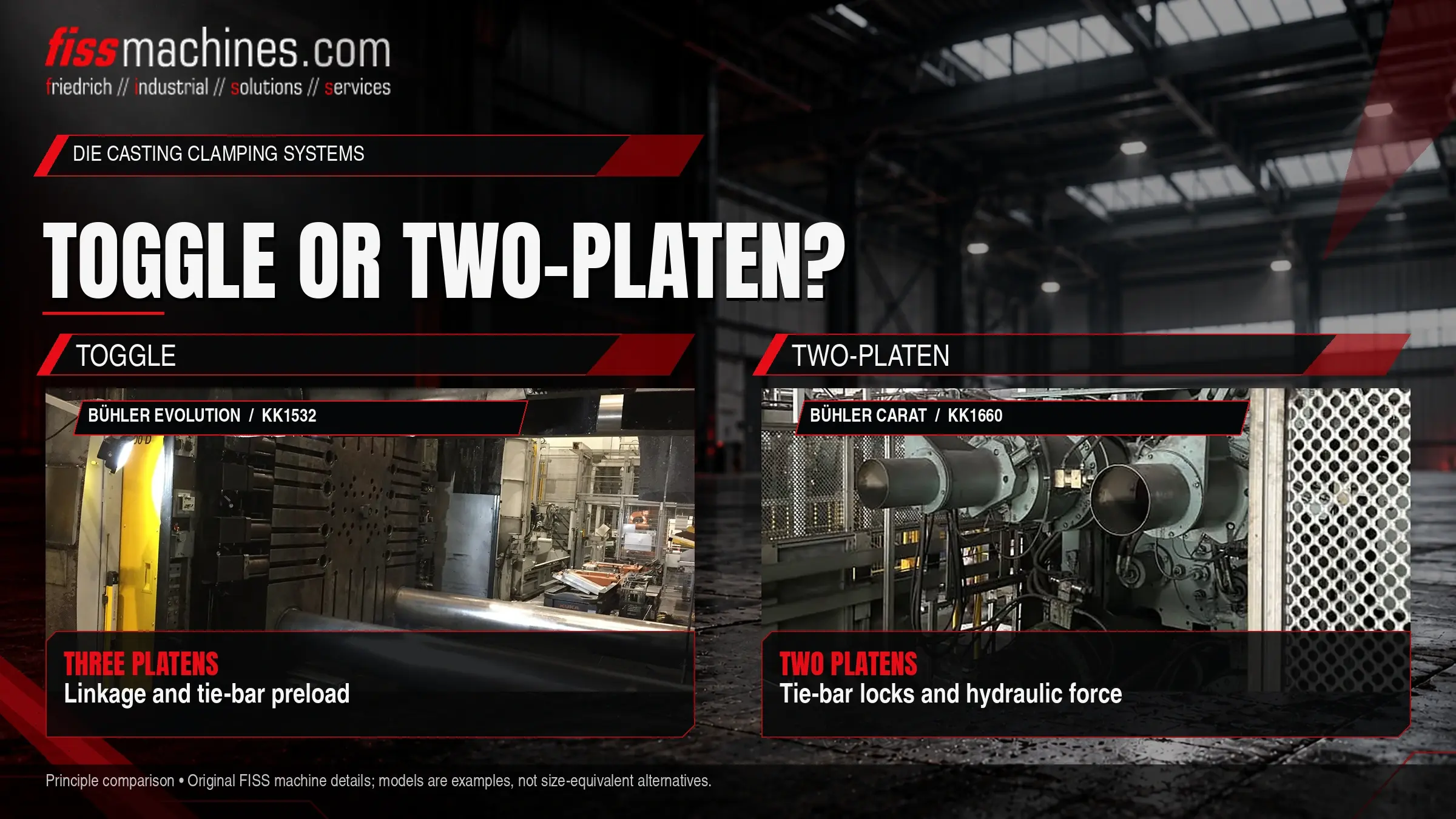
Toggle or Two-Platen Machine? Comparing Die Casting Clamping Systems
Every die casting machine must keep the die closed while metal is injected under high pressure. How it does that depends on the clamping system. Toggle machines use a mechanical linkage and the elastic stretch of the tie bars; two-platen machines lock the tie bars and build up force hydraulically. Both principles are proven, but they differ in design, footprint, setup and maintenance.
What Is the Difference Between Toggle and Two-Platen Clamping?
A toggle machine has three platens. A hydraulic cylinder stretches a linkage until it is almost fully extended; this pre-tensions the tie bars and generates the clamping force mechanically. A two-platen machine has no rear platen and no linkage. The moving platen is locked to the tie bars, and short-stroke hydraulic cylinders then build up the clamping force.
The better system depends on machine size, die dimensions, available floor space and the maintenance capabilities of the plant rather than on the principle alone.
How a Toggle Clamping Unit Works
The toggle machine consists of a fixed platen, a moving platen and a rear platen, connected by tie bars. Between the moving and rear platen sits the toggle linkage. A relatively small hydraulic cylinder moves the linkage; as it approaches its extended position, the mechanical advantage rises sharply. When the die halves meet, the linkage continues to its locked position and stretches the tie bars elastically. This stretch is what generates the clamping force.
Because the force depends on how far the tie bars are stretched, the distance between the platens must be matched to the die height. This is done by moving the rear platen along the tie bars using the die height adjustment. Thermal expansion of the die during production changes the effective preload, which is why clamping force should be monitored and readjusted when necessary.
Typical strengths
Fast closing and opening movements, a mechanically locked position and a comparatively small hydraulic volume for the clamping movement.
Typical wear points
Pins and bushings in the linkage, lubrication, the die height adjustment mechanism and uneven tie bar loading caused by wear or misalignment.
How a Two-Platen Clamping Unit Works
A two-platen machine only has the fixed and the moving platen. Traverse cylinders move the moving platen quickly to the closed position. Locking elements, such as split nuts on the moving platen, then engage in grooves on the tie bars. Finally, short-stroke clamping cylinders apply the clamping force by pulling the tie bars.
Since the force is generated hydraulically, it can be set via pressure and does not depend on a mechanical preload in the same way. Different die heights are accommodated within the locking range of the tie bars instead of by a separate die height adjustment. Without a rear platen and linkage, the machine is generally shorter than a comparable toggle design.
Typical strengths
Compact length, clamping force set directly by pressure and, depending on design, good access to the die area.
Typical wear points
Locking nuts and tie bar grooves, seals of the clamping cylinders, pressure holding behaviour and the sensors that monitor locking and position.
Toggle and Two-Platen Machines Side by Side
| Criterion | Toggle Machine | Two-Platen Machine |
|---|---|---|
| Force generation | Mechanical, via elastic tie bar stretch | Hydraulic, via clamping cylinders after locking |
| Platens | Three (fixed, moving, rear) | Two (fixed, moving) |
| Die height setting | Die height adjustment of the rear platen | Within the locking range of the tie bars |
| Machine length | Longer due to linkage and rear platen | Generally more compact |
| Force setting | Via preload; influenced by die temperature | Via hydraulic pressure |
| Main maintenance focus | Linkage, lubrication, adjustment mechanism | Locking system, cylinder seals, hydraulics |
Toggle clamping has long been widespread across many die casting machine sizes. Two-platen designs are offered by several manufacturers, often in larger machine sizes, where the reduced length and the absence of a heavy linkage are particularly noticeable. A shorter machine can also simplify the layout of periphery such as extraction robots and sprayers; our article Automation in the Die Casting Cell describes the typical equipment around the machine.
What the Clamping System Means When Buying Used
With a used machine, the clamping principle mainly changes where to look during inspection. On toggle machines, play in the linkage often shows up as uneven tie bar elongation or flash on one side of the die. On two-platen machines, the condition of the locking elements and the ability of the clamping cylinders to hold pressure are central.
In both cases, measuring tie bar strain under full clamping force gives objective information about force distribution. If wear is found, a targeted overhaul of the clamping unit can often restore it; FISS offers service and support for used die casting machines.
Inspection Points for the Clamping Unit
- Clamping principle and nominal clamping force confirmed from documentation
- Distance between tie bars and die height range compared with the die
- Tie bar strain measured on all bars under full clamping force
- Toggle: play in pins and bushings, lubrication system working
- Toggle: die height adjustment moves smoothly over the full range
- Two-platen: locking nuts and tie bar grooves free of damage
- Two-platen: clamping cylinders hold pressure without noticeable decay
- Platen parallelism measured in the closed position
- Floor space and periphery access checked for the intended layout
Frequently Asked Questions
Is one clamping system generally better?
No. Both principles are established in die casting. The suitable choice depends on machine size, die, layout and maintenance capabilities.
Why does clamping force change on a toggle machine during production?
As the die heats up, it expands and increases the tie bar stretch at the locked position. Without monitoring and readjustment, the actual force can deviate from the setpoint.
Does the clamping system affect casting quality?
Indirectly. Uneven or insufficient clamping force can cause flash and dimensional deviations. What matters is that the force is adequate and evenly distributed, regardless of the principle.
FISS Helps Find the Right Clamping Concept.
Browse the current offer of used die casting machines and let FISS help compare the available machines with your die dimensions, required clamping force and layout.
