




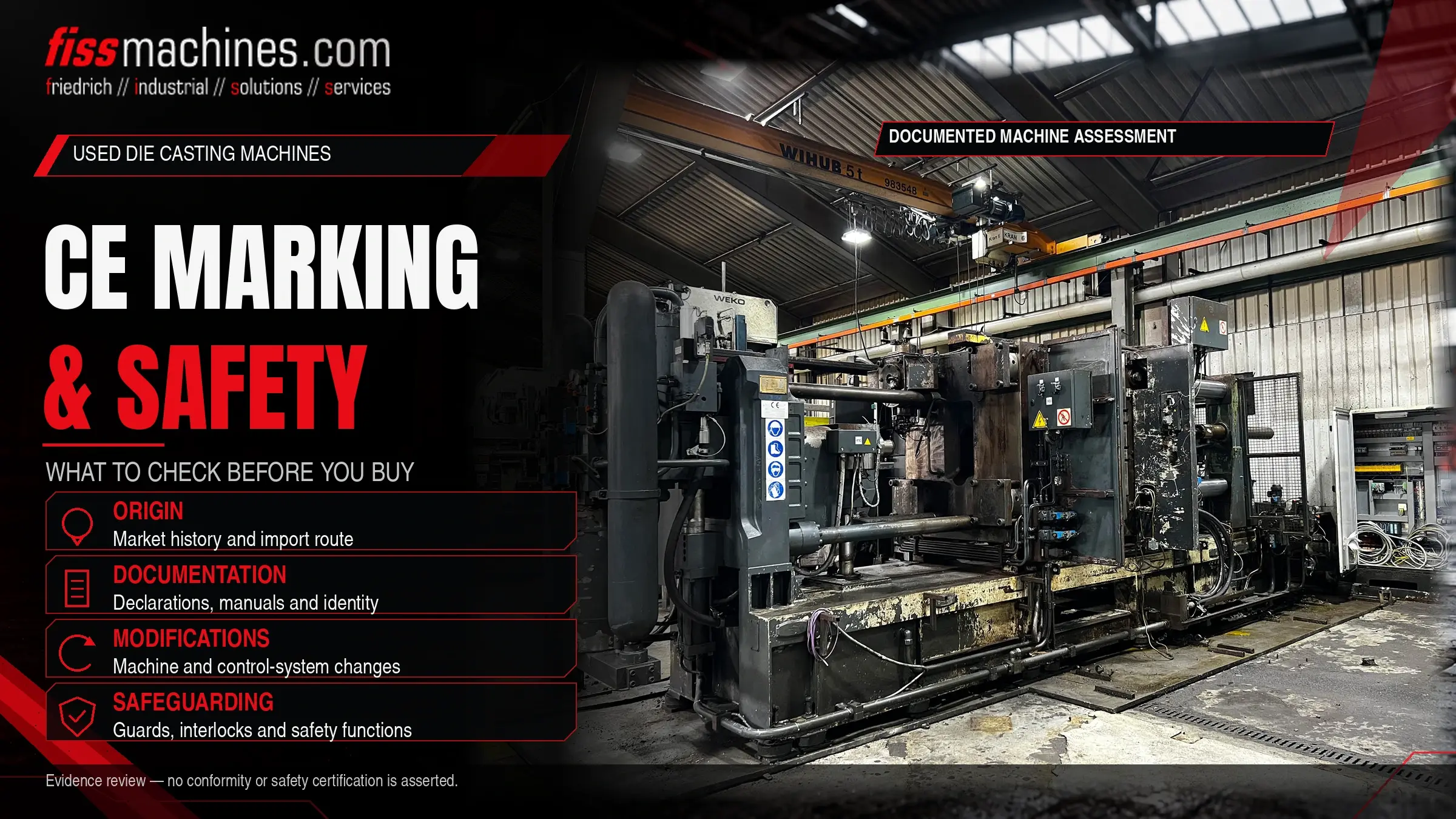
CE Marking and Safety When Buying a Used Die Casting Machine
With a used die casting machine, the buyer acquires not only technology but also responsibility. Whether a new CE marking is required, which standard applies and what changes with the EU Machinery Regulation in January 2027 depends mainly on two questions: where does the machine come from, and what will be changed on it?
Does a Used Die Casting Machine Need a New CE Marking?
A machine that was already placed on the EU market as a new machine does not need a new conformity assessment simply because it is resold. The operator must nevertheless ensure that it is safe to use at the new workplace.
It is different for machines imported from a third country outside the EU and placed on the Union market for the first time: according to the European Commission’s Blue Guide, EU product legislation then applies as for a new product – even if the machine was built before the rules came into force. A substantial modification can also trigger new manufacturer obligations.
Three Typical Situations
| Situation | What Applies | Practical Consequence |
|---|---|---|
| Machine from within the EU, resold unchanged | No new placing on the market; operator obligations for work equipment | Safety review at the new site, documentation from the seller |
| Machine imported from a third country | EU product legislation applies when it is placed on the Union market for the first time | Conformity assessment, technical documentation, declaration of conformity and CE marking required |
| Machine substantially modified | The person carrying out the modification can take on manufacturer obligations | Assess the scope of modification and plan the conformity procedure early |
Already on the EU Market: Operator Obligations Apply
EU harmonisation legislation such as the Machinery Directive applies when a product is placed on the Union market for the first time. A die casting machine that was placed on the market as a new machine in the EU does not have to undergo a new conformity assessment just because it changes owners.
However, the operator must ensure that the machine can be used safely at its workplace. The basis is Directive 2009/104/EC on the use of work equipment, implemented in national law – in Germany, for example, by the Ordinance on Industrial Safety and Health (BetrSichV). In practice, this means a risk assessment for the specific workplace, functioning safety devices and trained personnel.
Buyers should ask the seller for the original declaration of conformity, the operating manual and the circuit diagrams. If they are missing, it becomes much more difficult to assess the original safety concept.
Imported from Outside the EU: Treated Like a New Machine
The European Commission’s Blue Guide on the implementation of EU product rules (2022) states that Union harmonisation legislation also applies to used and second-hand products imported from a third country when they enter the Union market for the first time – even if they were manufactured before the legislation became applicable.
For a die casting machine from Asia or America, for example, this means: before it is placed on the market in the EU, it must meet the essential health and safety requirements of the applicable machinery legislation. This requires a risk assessment, technical documentation, an EU declaration of conformity, CE marking and instructions in the language of the country of use.
Upgrades Often Needed
Guards, interlocks, control safety functions or emergency stop concepts frequently have to be adapted to European requirements.
Documentation Effort
Diagrams, manuals and technical files are often incomplete or not available in the required language.
Part of the Calculation
The effort for the conformity procedure belongs in the purchase calculation – it can significantly change the comparison with an EU machine.
From 20 January 2027: Regulation (EU) 2023/1230
The Machinery Directive 2006/42/EC will be replaced by the Machinery Regulation (EU) 2023/1230, which applies from 20 January 2027. As a regulation, it applies directly in all member states. Machines placed on the market or put into service from that date must meet its requirements; machines lawfully placed on the market before that date do not have to be recertified.
For buyers of used machines, the explicit rule on substantial modifications is particularly relevant: a physical or digital modification that was not foreseen by the manufacturer and that creates a new hazard or increases an existing risk in such a way that new protective measures are required. Under Article 18, whoever carries out such a modification is considered a manufacturer with the corresponding obligations. Changes to control software can also be a substantial modification.
This matters for retrofits of controls and safety functions. How overhaul and retrofit differ technically is described in Overhaul or Retrofit?
EN 869 Has Been Replaced by EN ISO 23063
For decades, EN 869 was the European safety standard for pressure metal die casting units. The version EN 869:2006+A1:2009 was withdrawn in 2025 and replaced by EN ISO 23063:2025 “Foundry machinery – Safety requirements for high pressure die casting machines” (ISO 23063:2024).
EN 869 covered the die casting machine and its interfaces with die, furnaces, metal feeding, part removal, spraying equipment and die temperature control units – but not the ancillary equipment itself – and excluded low-pressure and gravity die casting machines. Its hazard areas give buyers a good orientation:
- Die area: guards, interlocks and protection against closing movements
- Molten metal: protection against metal splashes and metal escaping at the parting line
- Hydraulics: accumulators, hoses, pressure relief and fire-resistant fluids
- Interfaces: safeguarding of robots, spraying units, extraction and furnaces in the cell
- Control: safety functions, emergency stop and operating modes for setting up and maintenance
Whether and from when a standard gives a presumption of conformity depends on its citation in the Official Journal of the EU. This status should be checked for the specific project.
What Buyers Should Clarify Before Signing
- Origin of the machine: placed on the market in the EU, or import from a third country?
- Declaration of conformity, type plate with CE marking, operating manual in a suitable language
- Hydraulic and electrical diagrams, risk assessment of the manufacturer if available
- History of modifications, retrofits and control changes
- Condition of guards, interlocks, light curtains and emergency stop circuits
- Planned changes at the new site and whether they could be substantial
- Responsibilities between seller, buyer, integrator and operator – in writing
General technical points for the inspection are covered in Buying a Used Die Casting Machine: The Technical Checklist. FISS also supports buyers with consulting and safe commissioning.
Clarify Origin and Changes Early
With used die casting machines, the question of CE marking is decided less by age than by origin and changes. Machines from the EU market mainly require a safety review by the operator. Imports from third countries and substantial modifications can trigger a full conformity procedure – with the Machinery Regulation from 20 January 2027 as the new legal basis. Clarifying these questions before purchase avoids surprises in cost and schedule.
Questions About CE Marking and Used Die Casting Machines
Does a Used Die Casting Machine from Germany Need a New CE Marking?
Not if it was placed on the EU market as a new machine and is resold unchanged. The new operator must, however, ensure safe use at the workplace and carry out the required risk assessment.
What Changes on 20 January 2027?
The Machinery Regulation (EU) 2023/1230 replaces the Machinery Directive. Machines placed on the market or put into service from that date must meet the Regulation. It also defines substantial modifications explicitly.
Is EN 869 Still Valid?
EN 869:2006+A1:2009 was withdrawn in 2025 and replaced by EN ISO 23063:2025. Older machines were often built according to EN 869, which is still relevant for understanding their safety concept.
Does an Overhaul Make a Machine CE-Compliant?
No. An overhaul restores the technical condition but does not replace a conformity assessment. If safety-related functions are changed, it must be checked whether the modification is substantial.
Machine Selection with a View to Safety.
FISS supplies used die casting machines with known origin and documentation and supports buyers with consulting, transport and commissioning. Ask us early about the machine you are interested in.
Sources
European Commission: The “Blue Guide” on the implementation of EU product rules 2022, OJ C 247, 29.6.2022, sections 2.1 (Product coverage) and 2.5 (Products imported from countries outside the EU).
Regulation (EU) 2023/1230 of the European Parliament and of the Council on machinery (Machinery Regulation), application from 20 January 2027; Art. 3(16) and Art. 18 (substantial modification). Summary: Noerr, Regulation (EU) 2023/1230 on machinery.
Directive 2009/104/EC concerning the minimum safety and health requirements for the use of work equipment by workers at work.
EN 869:2006+A1:2009 Safety of machinery – Safety requirements for pressure metal diecasting units – scope (BSI Knowledge); status “withdrawn”, replaced by EN ISO 23063:2025 (Estonian Centre for Standardisation, EVS).
EN ISO 23063:2025 Foundry machinery – Safety requirements for high pressure die casting machines (ISO 23063:2024).
