




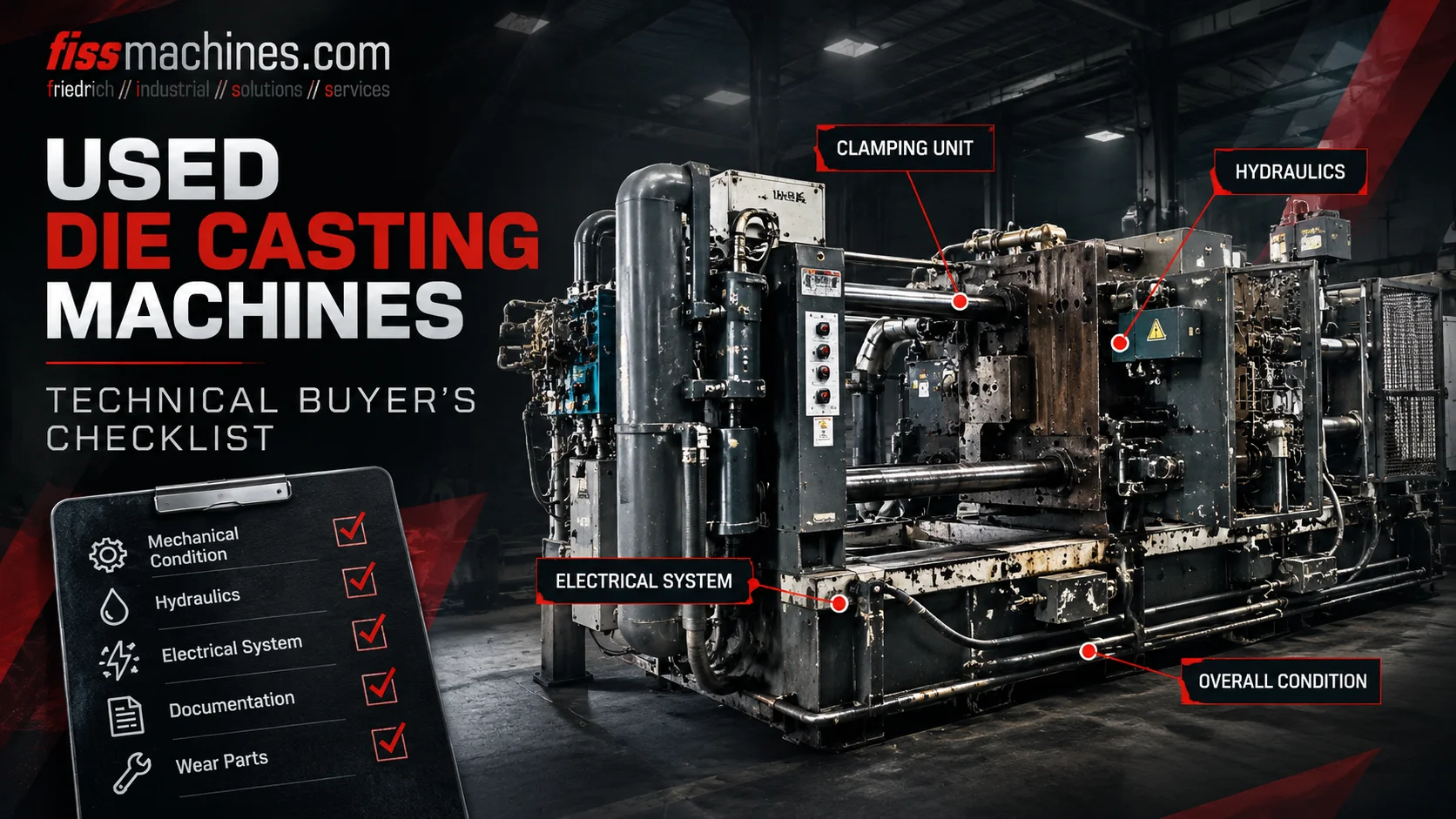
Buying a Used Die Casting Machine: The Technical Checklist
A used die casting machine can be an economical way to add capacity or replace an ageing cell. Whether it is a good purchase is decided less by the year of manufacture than by its technical condition, its fit with the intended castings and the effort required to move and recommission it. This checklist structures the inspection from requirements to test run.
What Should Be Checked Before Buying?
Start with your own requirements: alloy, part size, die dimensions, required clamping force and shot capacity. Then assess the machine in five areas: documentation and history, clamping unit, shot end, hydraulics and electrical control. Wherever possible, see the machine running under its own power and record what you observe.
Anything that cannot be verified on site should be listed as an open point and priced in, for example by planning a partial overhaul or a more detailed inspection after dismantling.
Define the Requirement Before Looking at Offers
Comparing offers only by clamping force leads to wrong decisions. A machine can have the right nominal force and still be unsuitable because the die does not fit between the tie bars, the shot end cannot deliver the required metal volume or the control cannot reproduce the shot profile the process needs.
The first decision is the machine principle. Aluminium is cast on cold chamber machines, while zinc and many smaller magnesium parts are typically produced on hot chamber machines. Our article Cold Chamber or Hot Chamber? explains the differences in detail.
| Parameter | Why It Matters | Source |
|---|---|---|
| Alloy | Determines cold or hot chamber process and the melt equipment. | Part drawing, customer specification |
| Projected area and casting pressure | Basis for the required clamping force including a safety margin. | Die design, process engineer |
| Shot weight | Castings plus runners, gates, overflows and biscuit must fit the shot end. | Die design, existing process data |
| Die dimensions | Width, height and die height must fit between tie bars and within the die height range. | Die drawing |
| Cell periphery | Ladling, spraying, extraction, trimming and interfaces to the machine control. | Existing or planned layout |
Documentation and Machine History
Good documentation shortens recommissioning and reduces risk. Ask for the type plate data, operating manual, hydraulic and electrical diagrams, parts lists and, if available, maintenance records. A shot counter reading is useful context but not a measure of condition on its own: a machine with many shots and consistent maintenance can be in better shape than one that stood unused in a damp hall.
Pressure equipment such as the shot accumulator is subject to national inspection rules. Clarify which inspection records exist and what will be required at the new location. The same applies to safety equipment: guards, interlocks and light curtains must meet the requirements at the place of operation, which can mean additional work if the machine is relocated between countries.
Clamping Unit: Platens, Tie Bars and Locking Mechanism
The clamping unit must hold the die closed against the metal pressure on every shot. Damage here is expensive to repair and directly affects flash, dimensional accuracy and die life.
Platens
Inspect the die mounting surfaces for cracks, erosion from metal spitting, damaged T-slots and repaired areas. Parallelism between the fixed and moving platen should be measured, not judged by eye.
Tie Bars
Look for scoring, corrosion, thread damage and signs of previous repair. Uneven tie bar elongation under clamping force indicates misalignment or wear; strain measurement on all bars gives a clear picture if the machine can be closed under pressure.
Toggle or Locking System
On toggle machines, play in pins and bushings and the condition of the lubrication system are key points. On two-platen designs, the tie bar locking elements and clamping cylinders need attention. In both cases, check the die height adjustment over its full range.
Shot End: The Heart of the Process
The shot end determines how reproducibly the metal is accelerated, how fast the cavity is filled and how pressure is applied during solidification. On cold chamber machines, check the shot sleeve mounting, the plunger rod and coupling, the shot cylinder seals and the condition of the accumulator, including its nitrogen precharge. On hot chamber machines, the gooseneck, nozzle and plunger fit are the main wear components.
If the intended process uses vacuum or a defined three-phase shot profile, verify that the machine and its control actually support it. Our article on mold filling and vacuum describes which shot characteristics influence casting quality.
Hydraulics, Electrics and Control
Hydraulic System
Check the oil for contamination and water, the age of hoses, external leaks, pump noise, filter condition and oil temperature during operation. Leaking valves often show up as slow pressure decay or inconsistent movements rather than visible oil.
Control and Electrics
Identify the control generation, the availability of spare parts and whether software backups and parameter sets exist. An older control can work reliably, but obsolete components may make a later retrofit necessary, which belongs in the budget from the start.
Test Run, Dismantling and Recommissioning
Seeing the machine in production is the most informative option. If that is not possible, a functional test under power should at least show all movements, pressure build-up, clamping and the shot sequence as far as safely possible without metal. Record pressures, times and any fault messages.
Finally, plan the logistics: professional dismantling, marking of hydraulic and electrical connections, packaging for transport and a realistic schedule for installation, foundation work and recommissioning. These costs often decide the economics as much as the purchase price.
Checklist for the Inspection Visit
- Type plate photographed; clamping force, shot force and plunger diameters noted
- Distance between tie bars and die height range measured against the die
- Platen surfaces, T-slots and parallelism checked
- Tie bars inspected for damage; strain distribution measured if possible
- Toggle pins and bushings or two-platen locking elements checked for play
- Shot cylinder, accumulator, plunger rod and shot sleeve mounting inspected
- Hydraulic oil sample taken; leaks, hoses and filters documented
- Control type, software backup and spare part situation clarified
- Safety equipment and accumulator inspection records reviewed
- Movements and shot sequence observed under power; values recorded
- Periphery, interfaces and scope of supply listed in writing
Frequently Asked Questions
Is the year of manufacture a good indicator of condition?
Only to a limited extent. Maintenance history, operating conditions and the condition of wear parts usually say more about a used machine than its age.
Can I judge a machine without seeing it run?
A static inspection reveals mechanical damage and leaks, but not how consistently the shot end works. If no test run is possible, the remaining uncertainty should be reflected in the budget.
Should I buy a machine as-is or overhauled?
It depends on your in-house capabilities and timeline. An overhaul before delivery reduces start-up risk; buying as-is can make sense if your own maintenance team can take over the work.
Does the periphery have to be bought with the machine?
Not necessarily, but interfaces between ladle, sprayer, extractor and machine control must be compatible. Mixing equipment generations can require additional integration work.
FISS Supports Selection, Inspection and Overhaul.
FISS offers used die casting machines and complete cells and can assist with inspection, dismantling, transport and reconditioning. Share your part and process requirements, and we will check which machines fit.
