




Relocating a Die Casting Machine: Dismantling, Transport and Recommissioning
Whether a die casting machine moves to another hall, another plant or another continent, the task is the same: a machine that was precisely set up must be taken apart, moved safely and brought back to the same condition at the new site. Most problems in such projects do not arise during transport but from gaps in planning and documentation.
How Is a Die Casting Machine Relocated?
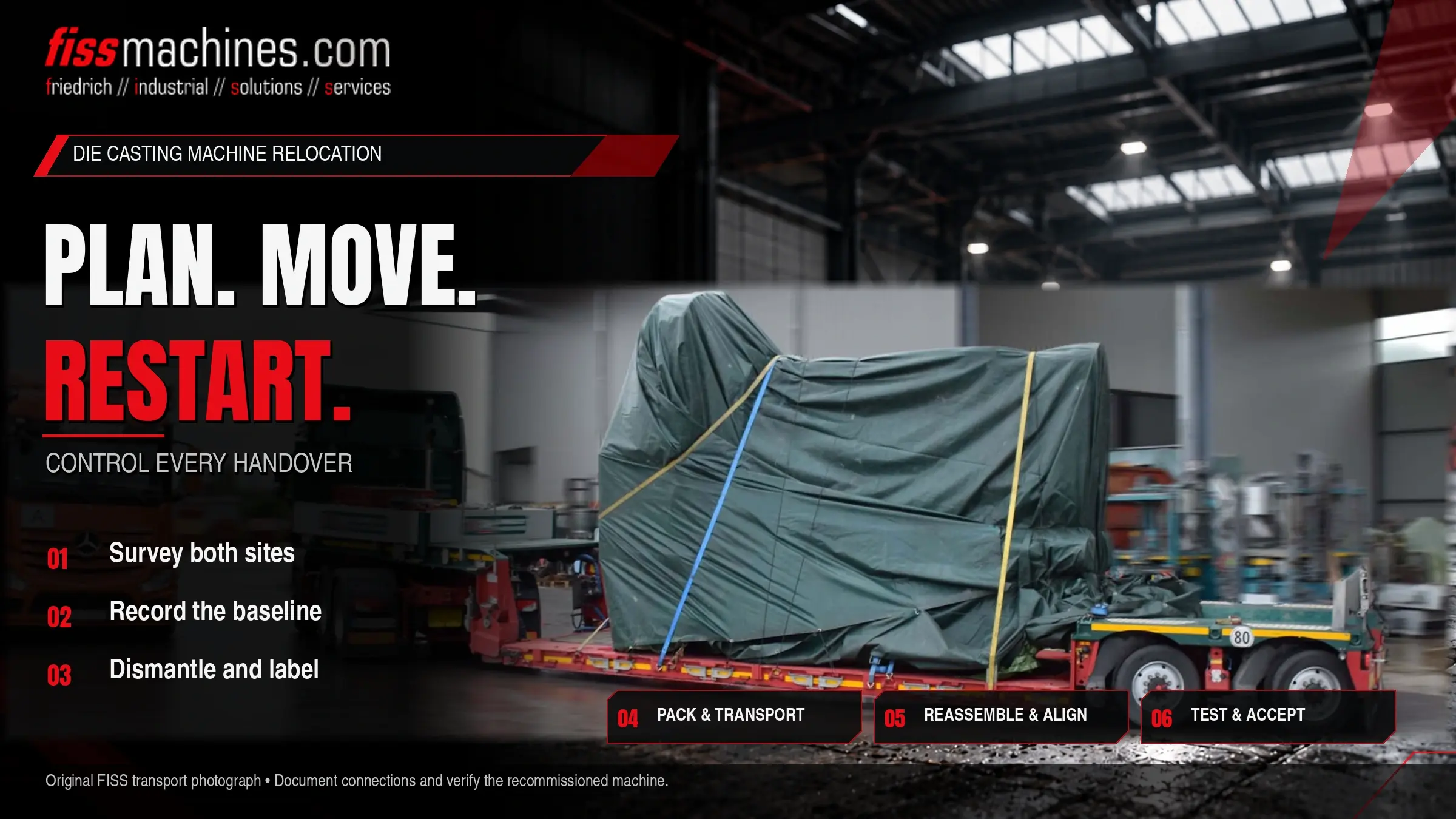
A relocation runs in six phases: planning and site survey, documentation of the current state, safe dismantling, packaging and transport, installation at the new site and recommissioning with acceptance.
The decisive work happens before the first screw is loosened: weights, dimensions, foundation requirements, media connections and machine data must be known, and the machine’s condition should be recorded in operation.
Planning Starts at Both Sites
A die casting machine is rarely moved alone. Furnace, dosing system, spraying unit, robot, temperature control units, trimming press, conveyors and extraction belong to the cell. The first step is therefore a clear scope: which units are moved, which are replaced, which remain.
Access and Lifting
Hall doors, crane capacity, floor load, space for gantries and trucks, and the order in which units can be removed.
Weights and Dimensions
Heaviest single piece, transport dimensions, required permits for heavy loads, route and, for export, customs.
Foundation and Media
Foundation according to the manufacturer’s plan, power supply, cooling water, compressed air, gas and extraction connections.
Record the Current State Before Anything Is Loosened
The new site can only reach the old performance if it is known exactly. Ideally, the machine is documented in production before dismantling:
- Test run with recorded shot curves, pressures, temperatures and cycle times
- Backup of control programs, parameters and die data sets
- Hydraulic and electrical diagrams, foundation plan and operating manual
- Photos and videos of the cell layout, cable routing and hose connections
- Consistent marking of all cables, hoses and pipes on both sides of each separation point
- List of known faults and wear parts that should be replaced during the move
This documentation also serves as a reference for the acceptance at the new site – and, when buying a used machine, as proof of the condition in which it left. More on the buyer’s perspective in Buying a Used Die Casting Machine: The Technical Checklist.
Safe Dismantling: Energy Off, Fluids Out, Units Separated
Before dismantling, all energy sources are isolated and secured: electrical power, hydraulic pressure, compressed air and gas. Particular attention is needed for hydraulic accumulators, which can still store energy after the pumps have stopped. They must be depressurised on the fluid side according to the manufacturer’s instructions before lines are opened.
Empty Furnaces and Drain Fluids
Furnaces and dosing systems are emptied of metal and cooled down. Hydraulic fluid is drained and stored or disposed of properly; fire-resistant fluids common in die casting must not be mixed with other fluid types.
Remove Die and Peripherals
Die, spraying unit, robot, extraction and other peripherals are removed first and packed separately.
Separate the Main Units
Depending on size and transport limits, clamping unit, shot unit, hydraulic unit and control cabinets are separated into transport units.
Lift and Load
Heavy units are lifted at defined lifting points with cranes or hydraulic gantries. Open ports are closed, machined surfaces protected.
FISS handles dismantling with its own specialists and equipment such as hydraulic lifting gantries, see Dismantling and Relocation.
Packaging for the Route, Not Just for the Truck
For a short road transport, securing the load and protecting sensitive parts is usually sufficient. For sea freight, machines are exposed to humidity, salt air and long storage times, so corrosion protection and seaworthy packaging become critical.
| Aspect | Road Transport | Sea Freight / Export |
|---|---|---|
| Corrosion protection | Protect bare machined surfaces | Preservation of bare surfaces, sealed packaging with corrosion inhibitors and desiccants |
| Packaging | Load securing, covers for electrics | Crates or frames suitable for container or flat rack, packed to the route |
| Wood packaging | No special requirements in most cases | Wood must meet ISPM 15 (e.g. heat treatment, marked with the IPPC mark) |
| Documents | Delivery note, load list | Packing list, customs documents, export and import formalities |
Electronics such as control cabinets and drives are especially sensitive to moisture and vibration and should be packed separately. FISS organises transport, packaging and customs handling, see Loading and Machine Transport.
From Foundation to First Good Part
At the new site, the machine is placed on the prepared foundation, aligned and levelled. Then units are reconnected using the markings and diagrams. The hydraulic system is filled with fresh or filtered fluid; filters are changed and the accumulator precharge is checked before pressure is built up.
Dry Function Test
All movements, interlocks and safety functions are checked without metal: emergency stop, guards, two-hand controls, light curtains.
Peripherals and Interfaces
Furnace, dosing, spraying, extraction and temperature control are connected and tested in interaction with the machine.
Hot Test and Comparison
First shots with metal. Shot curves, pressures and cycle times are compared with the values recorded before dismantling.
Acceptance and Training
Acceptance report, documentation of changes, handover and training of operators and maintenance staff.
The new site may bring different conditions, connected equipment and national rules, so the safety concept should be reviewed there in any case. FISS supports this phase as well, see Commissioning and Production Readiness.
A Relocation Is Also an Opportunity
A well-prepared relocation brings a die casting machine back to production with the same performance it had before. The keys are a clear scope, complete documentation of the current state, safe dismantling and a new site that is ready on time.
Because the machine is dismantled anyway, a relocation is a good moment to replace wear parts or carry out larger work. How to decide between repair, overhaul and modernisation is explained in Overhaul or Retrofit?
Questions About Relocating Die Casting Machines
How Long Does It Take to Relocate a Die Casting Machine?
It depends on the size of the cell, the transport route and, above all, on the readiness of the new site. Foundations, media connections and permits often determine the schedule more than the dismantling itself.
Does the Hydraulic Fluid Have to Be Drained?
For transport, the hydraulic fluid is usually drained to avoid leaks and contamination. The machine manufacturer’s instructions and the type of fluid determine how it is stored, reused or disposed of.
Does a Relocated Machine Need a New Foundation?
Generally, yes. The foundation must be designed according to the manufacturer’s foundation plan and the conditions at the new site. Existing foundations can only be reused if they meet these requirements.
Can a Relocation Be Combined with an Overhaul?
Yes. Since the machine is already dismantled, wear parts, seals or entire assemblies can be overhauled before reinstallation. This should be planned early so that it does not extend the downtime unexpectedly.
Dismantling, Transport and Start-up from One Source.
FISS plans and carries out the dismantling, transport and recommissioning of die casting machines, casting cells and complete foundry systems – nationally and internationally, with one contact person throughout the project.
Sources
FISS Machines: service pages Dismantling and Relocation, Loading and Machine Transport and Commissioning and Production Readiness, fiss-machines.com, accessed 29 October 2026.
IPPC / FAO: ISPM 15 – Regulation of wood packaging material in international trade (treatment and marking requirements); summary e.g. in NELMA export wood packaging guidance.
HYDAC: operating manuals for hydraulic accumulators and charging/testing units (SK 600, SB 600, FPS/FPK) – depressurising the fluid side before work, nitrogen-only charging, precharge checks.
EUROGUSS 365: Choosing between HFC and HFDU (2022) – fire-resistant hydraulic fluids in die casting.
