




Gravity Die Casting or High-Pressure Die Casting? Choosing the Right Process
Both processes pour metal into a reusable metal die, and both are called die casting. That is where the similarity ends. In gravity die casting, the metal flows into the die under its own weight; in high-pressure die casting, a plunger injects it at high speed and pressure. The choice between them shapes part design, tooling investment, achievable quality and the type of machine you need. This article compares the two and explains when each one makes sense.
What Is the Main Difference?
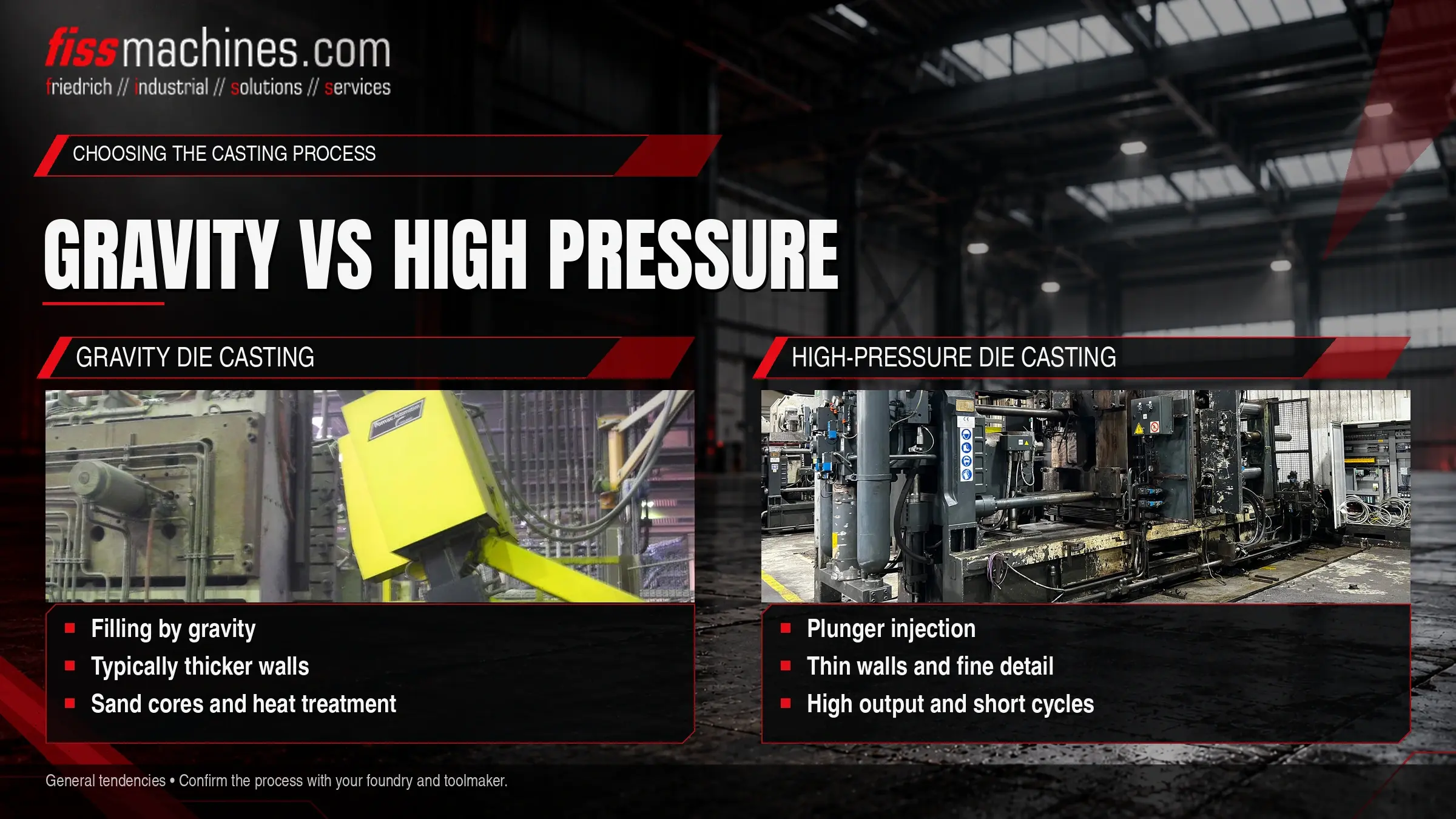
Gravity die casting (also called permanent mould casting) fills a coated metal die by pouring, often with tilting to control the flow. Filling is slow, walls are typically thicker, sand cores can be used and castings are generally suitable for heat treatment. High-pressure die casting injects metal within a very short time, allowing thin walls, fine detail and short cycles, but requires larger machines and more expensive dies.
Gravity die casting is not sand casting: the die is permanent and reused for many castings, while a sand mould is destroyed after each pour.
Sorting Out the Terms
Casting terminology varies between regions, which causes confusion in enquiries and quotations. In British usage, "die casting" without a qualifier usually means high-pressure die casting, and "gravity die casting" means permanent mould casting by gravity. In North America, the same gravity process is usually called "permanent mold casting". In German, it is "Kokillenguss".
| Process | Mould | How the metal enters |
|---|---|---|
| Sand casting | Expendable sand mould, destroyed after each casting | Poured, gravity |
| Gravity die casting | Permanent metal die, optionally with sand cores | Poured, gravity, often with tilting |
| High-pressure die casting | Permanent steel die with slides and ejectors | Injected by plunger at high speed and pressure |
Low-pressure die casting sits between them: it also uses a permanent die, but fills it from below with gas pressure. It is a separate process with its own machines and is not covered in detail here.
How Gravity Die Casting Works
The die is preheated and coated with a refractory die coating. The coating insulates the metal from the die surface, influences how fast the metal cools and helps release the casting. Molten metal is poured into a pouring cup and flows through runners and risers into the cavity. On tilting machines, the die rotates during pouring so that the metal enters more calmly and with less turbulence. After solidification the die opens and the casting is removed; any sand cores are knocked out afterwards.
Machines and equipment
Gravity die casting can be done with manually operated dies, but production is usually carried out on gravity casting machines that open and close the die halves, move cores and, in tilting versions, rotate the die. Machines are comparatively light because there is no high metal pressure to resist. Pouring can be manual or automated, for example with a robot ladle.
Typical parts
Cylinder heads, manifolds, pump and valve bodies, chassis parts and fittings are typical examples. Aluminium alloys dominate, but copper alloys such as brass are also cast in permanent dies, for example for sanitary fittings.
How High-Pressure Die Casting Differs
In HPDC, metal is forced into the die by a hydraulically driven plunger, either from a cold shot sleeve or from a hot chamber gooseneck. The die is held closed by a clamping unit dimensioned for the high metal pressure, which is why HPDC machines are much heavier. The die is sprayed with a release agent rather than coated with a refractory layer. The differences between cold chamber and hot chamber machines are explained in Cold Chamber or Hot Chamber?, and the filling physics in Mold Filling and Vacuum.
Gravity Die Casting and HPDC Side by Side
| Criterion | Gravity die casting | High-pressure die casting |
|---|---|---|
| Filling | By gravity, slow, can be tilted | Plunger injection within a very short time |
| Wall thickness | Typically thicker walls | Thin walls and fine detail possible |
| Cores | Metal and sand cores, complex cavities possible | Metal cores and slides; undercuts limited |
| Die surface treatment | Refractory die coating | Release agent sprayed every cycle |
| Heat treatment | Generally possible | Limited for conventional parts |
| Surface and tolerances | Good, coating texture may show | Very good surface, close tolerances |
| Cycle time | Comparatively long | Short |
| Machine and die investment | Lower | Higher |
| Economic batch sizes | Small to medium series | Medium to very large series |
Which Process Fits Your Part?
Gravity die casting tends to fit when
- Walls are medium to thick and sections vary
- Internal channels need sand cores
- The part must be heat treated or welded
- Annual volumes do not justify an HPDC die
- Copper alloys are required
HPDC tends to fit when
- Walls are thin and surfaces large
- High volumes and short cycles are needed
- Close tolerances reduce machining
- Zinc or magnesium alloys are planned
- Heat treatment is not required, or special process routes are used
These are tendencies, not rules. A redesign can move a part from one process to the other, for example by adapting wall thickness or replacing a sand core with a slide. Early discussion between design, foundry and toolmaker usually pays off.
Frequently Asked Questions
Is gravity die casting the same as sand casting?
No. Both rely on gravity, but sand casting uses an expendable sand mould, while gravity die casting uses a permanent metal die. Sand cores can be used in gravity dies, which sometimes causes the confusion.
Can an HPDC machine be used for gravity casting?
No. The processes need different equipment: gravity casting machines handle the die and tilting, while HPDC machines are built around the shot end and a heavy clamping unit.
Why is gravity die casting often chosen for brass?
Copper alloys have high melting temperatures, which are demanding for HPDC shot components and dies. Gravity casting in permanent dies is an established route for many brass parts.
FISS Offers Used Machines for Both Processes.
Whether your part points towards gravity casting or HPDC, FISS can help you review suitable used machines and the questions to clarify before buying.
