




Low-Pressure Die Casting Explained: Process, Machines and Applications
Low-pressure die casting (LPDC) fills a permanent metal die from below, using gas pressure on the surface of the melt instead of a fast-moving plunger. The result is a calm, controllable filling and a casting that is fed with metal while it solidifies. That makes the process a common choice for aluminium wheels and other safety-relevant or pressure-tight parts. Despite the similar name, it works very differently from high-pressure die casting, and the machines are built differently too.
How Does Low-Pressure Die Casting Work?
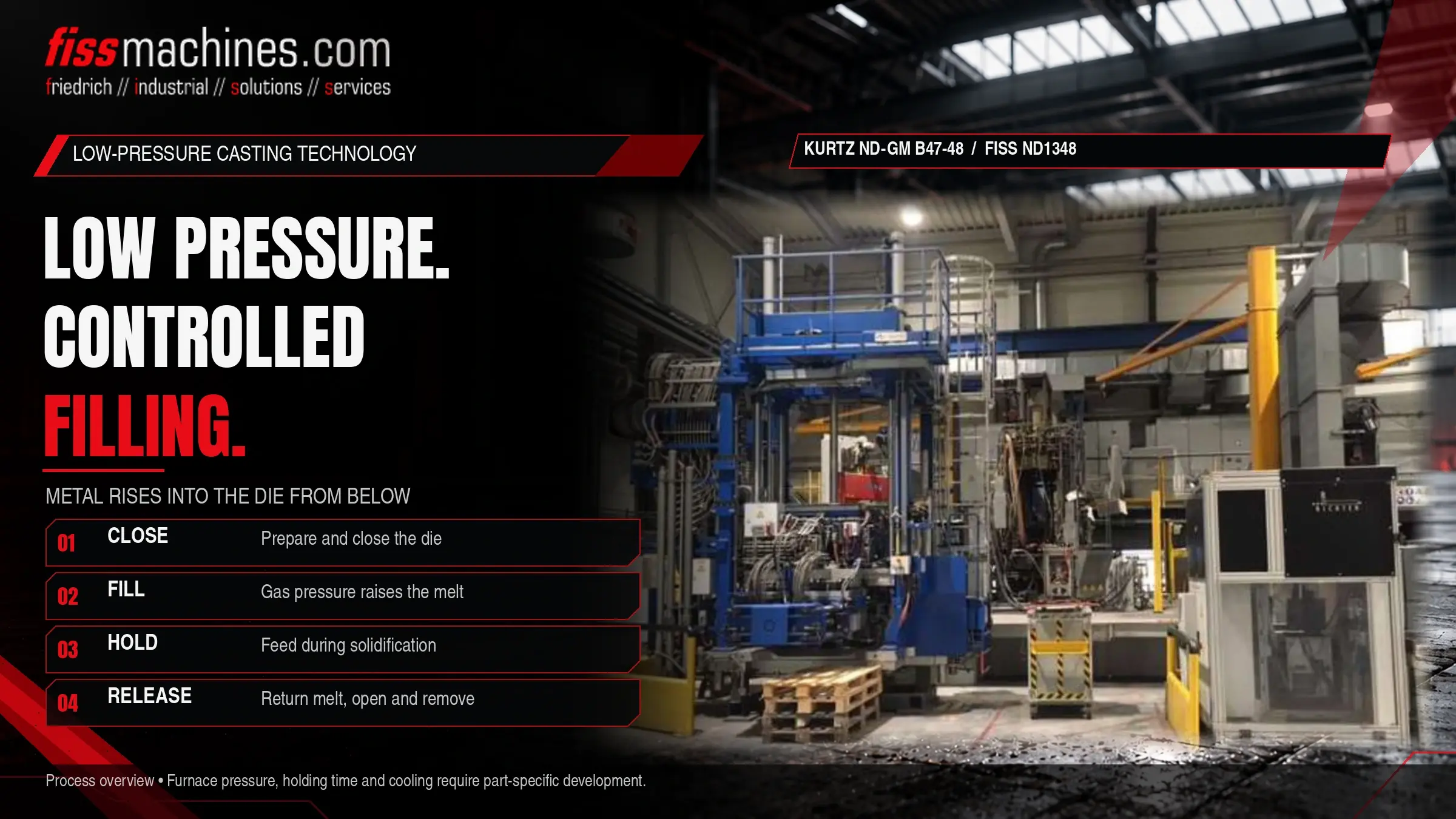
A sealed furnace holds the molten metal beneath the die. When the furnace is pressurised with dry air or an inert gas, the melt rises through a riser tube into the die cavity. The pressure is held while the casting solidifies from the top downwards, so that the riser tube keeps feeding it. After solidification the pressure is released, the liquid metal in the tube flows back into the furnace and the die opens.
Compared with high-pressure die casting, filling is much slower and the pressure much lower. LPDC therefore suits medium to thicker walls, sand cores and parts that will be heat treated, while HPDC is the choice for thin walls and very short cycles.
The Low-Pressure Cycle Step by Step
Die closing
The die, usually with metal inserts and often with sand cores for internal geometry, is closed on top of the furnace.
Rising and filling
Gas pressure in the furnace increases in a controlled curve. The metal rises through the riser tube and fills the cavity from below, displacing air towards the vents with comparatively little turbulence.
Holding pressure and solidification
The pressure is increased and held. Cooling of the die is arranged so that the casting solidifies from the regions furthest from the gate towards the gate, which is fed by the liquid metal in the riser tube.
Pressure release and removal
Once the gate area has solidified, the pressure is released and the remaining liquid metal returns to the furnace. The die opens and the casting is removed, typically by an extraction device.
In LPDC, quality is controlled through the time-pressure curve of the furnace and through die cooling. The actual pressure values depend on part height, alloy, die design and machine, and are set during process development.
Main Components of a Low-Pressure Casting Machine
Gas-tight holding furnace below the die, with lid, seals and refilling arrangement.
Connects melt and die; made of materials resistant to the molten alloy and replaced periodically.
Die halves and side slides moved by hydraulic cylinders; clamping forces far below those of HPDC machines.
Pressure control system plus air and/or water cooling circuits for directional solidification.
Many installations are built as cells with several machines, a central melting area and transport of metal to the furnaces. The holding furnace is refilled between cycles or at intervals, so melt treatment upstream is as important as in any other aluminium casting process. An overview of furnace types used in foundries can be found in our used furnace category.
Low-Pressure versus High-Pressure Die Casting
Both processes use permanent steel dies, but they fill and feed the casting in fundamentally different ways. The table compares them qualitatively; actual values depend on part and plant.
| Criterion | Low-pressure die casting | High-pressure die casting |
|---|---|---|
| Filling | From below via riser tube, slow and controlled | Injected by plunger at high speed through gates |
| Pressure on the metal | Low gas pressure on the melt surface | High hydraulic pressure transmitted by the plunger |
| Feeding during solidification | Via riser tube under holding pressure | Via intensification pressure, limited by early gate solidification |
| Wall thickness | Medium to thick walls | Thin walls possible |
| Cores | Sand cores possible for complex internal shapes | Mainly metal cores and slides |
| Heat treatment | Commonly used | Limited for conventional HPDC parts due to entrapped gas |
| Cycle time | Comparatively long | Short |
| Typical alloys | Mainly aluminium, also magnesium | Aluminium, zinc, magnesium |
A variant worth knowing is counter-pressure casting, in which the die chamber is also pressurised and filling is driven by the pressure difference. It is used where even more control over solidification is required.
Where Low-Pressure Die Casting Is Used
The best-known application is the aluminium car wheel, where symmetrical filling from the centre and the ability to heat treat are key. Other typical parts include cylinder heads with sand cores, chassis and suspension components and housings that need to be pressure-tight. In general, LPDC is considered when a part combines medium wall thickness, demands on integrity or mechanical properties and series volumes that justify permanent dies, but not necessarily the output of HPDC.
When LPDC is usually not the first choice
Very thin-walled housings with large surface area and high volumes are typically better served by high-pressure die casting. Zinc alloys are mostly processed by hot chamber die casting. Comparing HPDC machine types is covered in Cold Chamber or Hot Chamber?
What to Check on a Used Low-Pressure Machine
Many points known from other casting machines apply, such as hydraulics, guides and documentation. LPDC adds a few specific areas. The furnace must be gas-tight; leaks on the lid seal or furnace body affect the pressure curve directly. The condition of the refractory lining determines how soon a relining is due. The pressure control system should be checked for function and spare part availability. And since the furnace is a pressurised vessel, the applicable inspection requirements at the new site must be clarified before commissioning.
Checklist: Is LPDC Right for the Part, and Is the Machine Fit?
- Wall thickness and part size fit a slow, bottom-up filling process
- Need for sand cores or heat treatment evaluated
- Required output compared with achievable cycle times
- Die dimensions and height compatible with the clamping unit
- Furnace capacity and refilling method suitable for the shot sequence
- Furnace tightness, lid seals and refractory condition inspected
- Riser tube type, availability and change procedure known
- Pressure control and cooling circuits functional and documented
- Inspection requirements for the pressurised furnace clarified at the site
Frequently Asked Questions
Is low-pressure die casting a type of high-pressure die casting?
No. Both use permanent dies, but LPDC fills from below with gas pressure on the melt, while HPDC injects metal with a plunger at high speed and pressure. Machines, dies and process windows are different.
Why are LPDC castings often heat treated?
The calm filling entraps little air, so castings can usually be solution treated and aged to improve mechanical properties. With conventional HPDC, entrapped gas can cause blisters during such treatment.
What does the riser tube do, and how long does it last?
It carries the metal from the furnace into the die and feeds the casting during solidification. Its service life depends on material, alloy, temperature and handling, so it is treated as a wear part.
Can a low-pressure machine cast different alloys?
It is mainly used for aluminium. Changing alloys requires attention to furnace contamination, riser tube compatibility and die coating, and should be agreed with the process owner.
FISS Offers Used Low-Pressure Casting Machines.
Tell us about your part, alloy and output target. FISS can discuss whether low-pressure casting fits and which available machines and furnaces could suit your application.
