




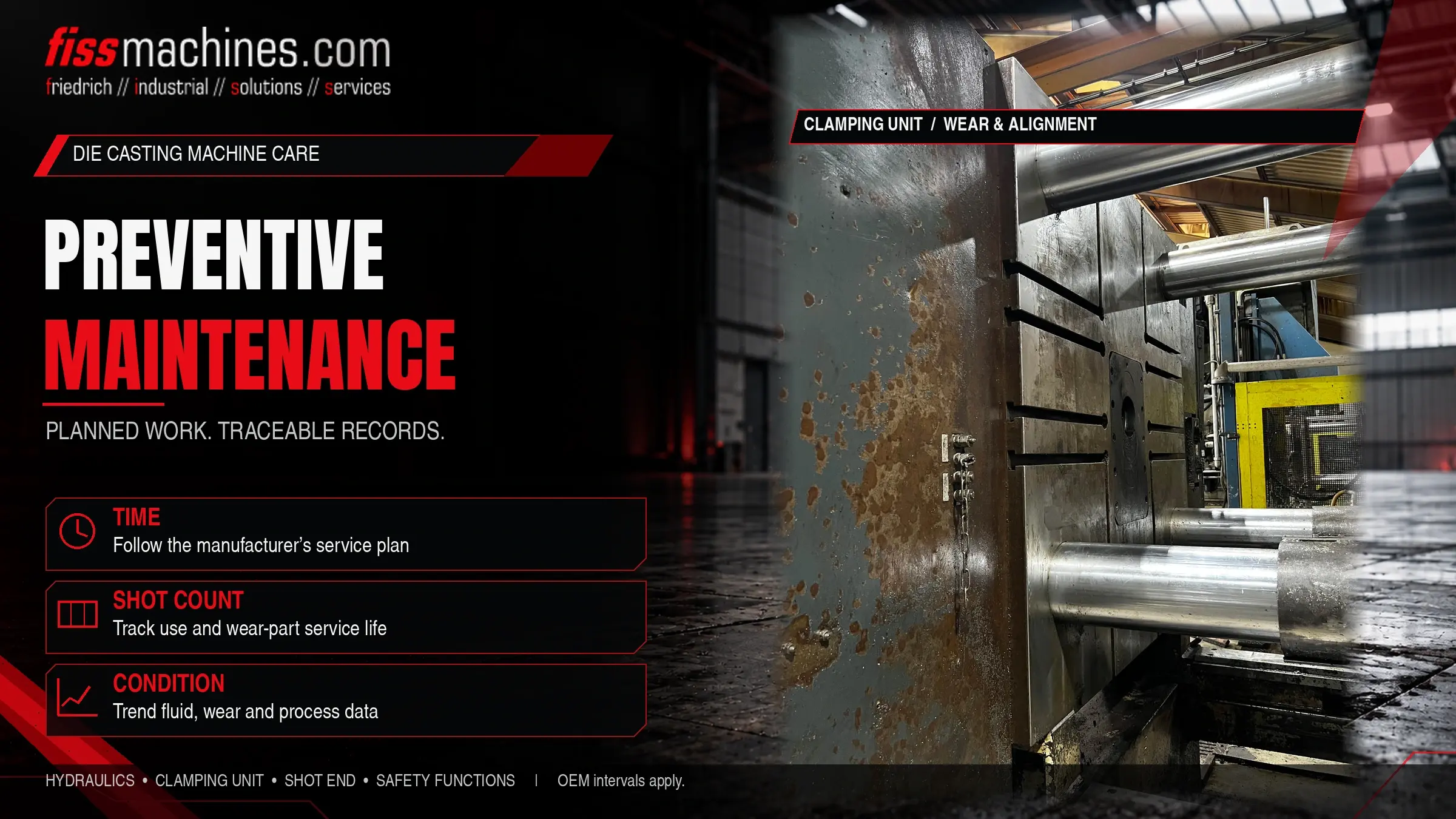
Preventive Maintenance of Die Casting Machines: Intervals, Checkpoints and Records
A die casting machine works under high pressure, high speed and high temperature – shot after shot. Wear is unavoidable, but unplanned downtime largely is not. Preventive maintenance turns wear into planned work: assemblies are checked before they fail, and changes are recognised while they are still small.
What Does Preventive Maintenance of a Die Casting Machine Include?
Preventive maintenance combines regular inspection, servicing such as lubrication and filter changes, and the timely replacement of wear parts. The focus is on the hydraulic system with its accumulators, the clamping unit with tie bars and toggle, the shot end and the safety functions.
The basis is the manufacturer’s maintenance plan, supplemented by the plant’s own records: shot counter readings, fluid analyses, shot curves and fault history show where intervals need to be adjusted.
Maintenance Is More Than Repair
The German standard DIN 31051 divides maintenance into four basic measures: inspection (determining the actual condition), servicing (delaying wear, for example by lubrication or replacing wear parts in good time), repair (restoring function) and improvement (removing weak points). Preventive maintenance focuses on the first two – so that the third is needed less often.
Repair After Failure
No planning effort, but unplanned stops, consequential damage and spare parts under time pressure.
Fixed Intervals
Tasks by time or shot count. Predictable, but intervals may be too short or too long for the actual load.
Based on Measured Values
Fluid analyses, shot curves and measurements decide when to act. Requires data and experience.
In practice, die casters combine all three. Ongoing maintenance must be distinguished from a one-off general overhaul, which is described in Overhaul or Retrofit?
A Practical Structure by Interval
The following overview shows a typical structure. The actual tasks and intervals are defined by the machine manufacturer’s documentation and should be adapted to the plant’s load and experience.
| Interval | Area | Typical Tasks |
|---|---|---|
| Every shift | Machine and cell | Visual check for leaks, fluid level and temperature, central lubrication, function of guards and emergency stop |
| Weekly | Hydraulics and shot end | Filter indicators, cooling water, condition of plunger tip and lubrication, cleanliness of the die area |
| Monthly to quarterly | Fluid and accumulators | Fluid sample and analysis, accumulator precharge, tie-bar load distribution, hoses and fittings |
| Annually | Whole machine | Comprehensive inspection: platens, toggle bearings, tie-bar nuts, electrics, safety-related tests according to national regulations |
Hydraulic Fluid: Condition Instead of Fixed Change Intervals
Because leaks near liquid metal are a fire hazard, die casting machines are often operated with fire-resistant hydraulic fluids. Water-glycol fluids (HFC) are widespread; water-free synthetic fluids (HFDU) are an alternative. Both have consequences for maintenance: HFC fluids require regular sampling and analysis, because neglected fluid can lead to corrosion and cavitation. Converting from one fluid type to another requires extensive flushing.
- Take fluid samples at defined intervals and from the same point
- Have particle contamination assessed, e.g. as a cleanliness code according to ISO 4406
- With HFC: monitor water content and other parameters specified by the fluid supplier
- Change filters according to differential pressure indication, not only by calendar
- Fix leaks promptly – they are a fire risk, a cost factor and often a sign of wear
Accumulators: Stored Energy for the Shot
The fast shot phase requires a high oil flow for a short time. This flow comes from hydraulic accumulators precharged with nitrogen. If the precharge pressure drops, less energy is available – shot speed and repeatability suffer, often gradually and unnoticed.
Accumulator manufacturers such as HYDAC recommend checking the precharge in the first week after commissioning, again after three to four months if no loss is found, and then at least once a year. The check is carried out with the fluid side depressurised; only nitrogen may be used for charging, never compressed air or oxygen. As pressure equipment, accumulators may also be subject to periodic inspections under national law.
Clamping Unit: Tie Bars, Toggle and Platens
The clamping unit holds the die closed against the metal pressure. If the force is not distributed evenly over the tie bars, the die can flash on one side, die and platens are loaded unevenly and individual tie bars are overloaded.
Measure the Load Distribution
Tie-bar strain measuring systems show how evenly the clamping force is distributed. Deviations are corrected by adjusting the tie-bar nuts or die height setting as specified by the manufacturer.
Lubrication and Bearing Play
Toggle joints need reliable lubrication. Increasing play in pins and bushings affects the locking and the platen movement.
Parallelism and Surfaces
Check platen parallelism and the condition of the clamping surfaces regularly, especially after die damage or collisions.
Guards and Interlocks
Test the function of guards, interlocks and emergency stop regularly and document the results.
FISS offers suitable equipment under tie-bar measuring systems. How clamping force is calculated is explained in Clamping Force in Die Casting.
Shot End: Where Wear Shows in the Process
On cold-chamber machines, shot sleeve and plunger tip are classic wear parts. Increased clearance lets metal pass the plunger, and damage in the sleeve affects the plunger movement. Both show up in the shot curve as changed speeds and pressure profiles. Background on the components can be found in Shot Sleeves and Plungers in Cold-Chamber Die Casting.
Shot curves from a good machine condition are valuable reference data. If fill times or pressure build-up change at unchanged settings, the cause is often found on the shot end or in the accumulators.
Records Make Maintenance Better
- Maintenance log with date, shot counter, findings and measures
- Results of fluid analyses and accumulator checks as a trend
- Reference shot curves and backups of control programs
- Spare parts list with critical parts kept in stock
- Fault history to identify recurring weak points
This documentation also increases the value of a machine: when it is sold later, a complete maintenance history is one of the most convincing proofs of its condition.
Planned Work Instead of Unplanned Stops
Preventive maintenance of a die casting machine does not require a complex system, but consistency: clear tasks per interval, attention to hydraulics, accumulators, clamping unit and shot end, and records that make trends visible. If maintenance shows that assemblies have reached the end of their life, a planned overhaul is usually more economical than a series of repairs.
Questions About Maintaining Die Casting Machines
How Often Should the Hydraulic Fluid Be Changed?
Preferably according to condition. Regular fluid analyses show whether contamination, water content or ageing require a change. The fluid supplier’s and machine manufacturer’s specifications apply.
Why Does Shot Speed Drop Over Time?
Common causes are falling accumulator precharge, wear on the shot end, internal leakage in valves or cylinders and contaminated fluid. Comparing shot curves with reference values helps narrow down the cause.
What Does Tie-Bar Strain Measurement Show?
It shows how the clamping force is distributed across the tie bars. Uneven distribution can cause flash, die damage and overloading of individual tie bars.
What Is the Difference Between Maintenance and Overhaul?
Maintenance is continuous and keeps the machine in its condition. An overhaul is a one-off project in which worn assemblies are reconditioned or replaced to restore the machine’s performance.
Overhauled Die Casting Machines from FISS.
When repairs pile up, an overhaul or a replacement machine is often the better option. FISS overhauls used die casting machines and supplies machines whose condition has been checked.
Sources
DIN 31051:2019-06 – Fundamentals of maintenance (inspection, servicing, repair, improvement); terms as summarised in the DGUV IFA lexicon.
ISO 4406 – Hydraulic fluid power: method for coding the level of contamination by solid particles.
EUROGUSS 365: R. Knecht (Quaker Houghton), Choosing between HFC and HFDU, 2022.
HYDAC: operating manuals for hydraulic accumulators and charging/testing units (SK 600, FPS/FPK) – precharge check intervals, depressurising, nitrogen-only charging.
FISS Machines: accessories category Tie Bars Measuring Systems and service Reconditioning of Die Casting Machines, fiss-machines.com, accessed 29 October 2026.
