




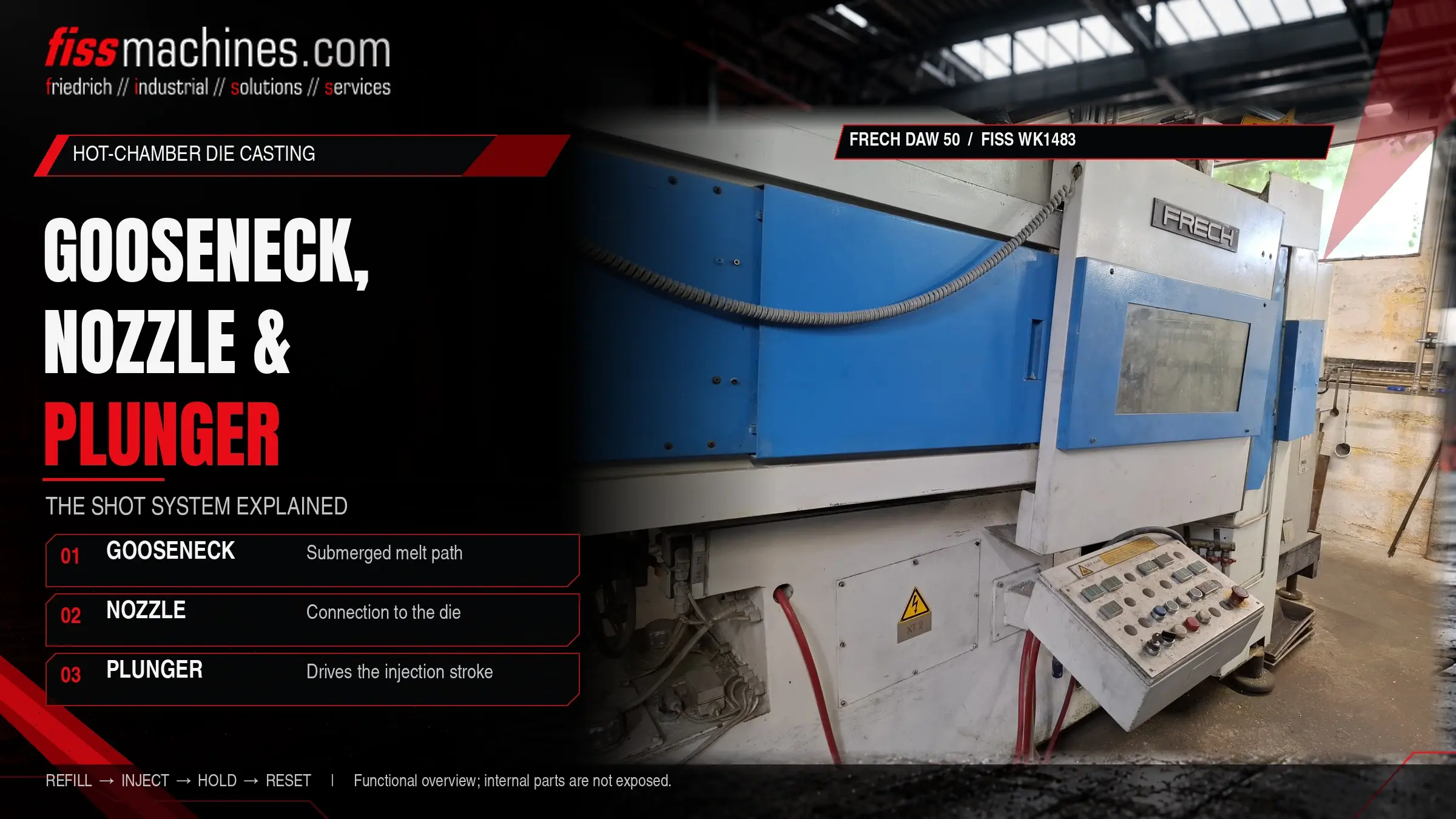
Gooseneck, Nozzle and Plunger: The Shot System of a Hot-Chamber Die Casting Machine
Every shot on a hot-chamber die casting machine depends on three components that sit directly in or next to the molten metal: the gooseneck, the plunger and the nozzle. Together they form the shot system that replaces ladling in zinc and magnesium die casting. Their condition decides whether shot speed, part weight and cycle time remain stable – and they are among the first things to check on a used machine.
What Do Gooseneck, Plunger and Nozzle Do?
The gooseneck is a cast metal body immersed in the melt. It contains the shot cylinder and a curved channel leading up to the die. The plunger moves inside the cylinder: when it retracts, melt flows in through a fill port; when it moves down, it pushes the metal through the channel. The nozzle connects the gooseneck to the sprue bushing of the die and must be kept hot so that the metal does not freeze in it.
Erosion by the melt, sliding wear between plunger and cylinder and thermal load at the nozzle are the main wear mechanisms. Typical consequences are slower fills, fluctuating part weights and metal leaking at the nozzle.
How the Hot-Chamber Shot System Works
In a hot-chamber machine, the shot system is part of the furnace. The gooseneck stands in the metal bath of the holding pot, so the shot cylinder is always filled with liquid metal at the right temperature. A separate metal transfer to the machine, as in cold-chamber die casting, is not required.
Filling
With the plunger retracted, the fill port in the cylinder wall is open and melt flows from the bath into the shot cylinder.
Injection
The plunger moves down, closes the fill port and pushes the metal through the gooseneck channel and the nozzle into the closed die. The shot is typically run in several speed phases.
Intensification and Solidification
The plunger holds pressure while the casting solidifies in the die.
Return
The plunger returns to its start position. Metal that has not solidified flows back through the nozzle and gooseneck, and the cylinder refills for the next shot.
Because filling happens automatically with every plunger return, hot-chamber machines achieve short cycle times. A basic comparison of both machine types is given in the article Cold Chamber or Hot Chamber?.
The Three Parts of the Shot System
Melt Container and Channel
Made of iron-based material. It houses the shot cylinder and the riser channel to the nozzle. Some designs use a replaceable sleeve or liner in the cylinder bore, so the body can be refurbished instead of replaced.
Shot Piston with Rings
Driven by the hydraulic shot cylinder above the bath. Piston rings seal against the cylinder wall. As rings and bore wear, more metal bypasses the plunger and less of the stroke reaches the die.
Heated Connection to the Die
Seats against the sprue bushing of the fixed die half. Depending on the design, it is heated by gas burners or electric heaters, because the metal in it must not freeze between shots.
The parts are matched to each other and to the machine: plunger diameter, cylinder bore, gooseneck geometry and nozzle length determine the available shot volume and the pressure on the metal. Changing one of them changes the process.
Where the Shot System Wears – and How It Shows
The shot system works permanently at melt temperature. Three mechanisms dominate: erosion and chemical attack of the bore and channel by the melt, sliding wear between plunger rings and cylinder, and thermal load at the nozzle, which is heated from outside and cooled at its contact with the die.
| Symptom | Possible Cause | What to Check |
|---|---|---|
| Fill time increases, shot speed drops | Worn plunger rings or cylinder bore, metal bypassing the plunger | Shot curve, ring condition, bore diameter |
| Part weight fluctuates | Leakage at the plunger, changing bath level | Ring condition, bath level control, ingot feeding |
| Metal leaks at the nozzle tip | Damaged seat at nozzle or sprue bushing, insufficient nozzle contact | Nozzle tip, sprue bushing, nozzle alignment |
| Metal freezes in the nozzle | Nozzle heating too low or failing | Burner or heater, temperature sensor, settings |
| Cold shuts or porosity increasing | Melt or nozzle temperature too low, unstable shot | Temperatures, shot profile, die temperature |
Zinc, Magnesium – and Why Aluminium Is Different
Zinc is the classic hot-chamber material. Common zinc die casting alloys melt at low temperatures – the Zamak 3 datasheet from Nyrstar gives a melting range of 381–387 °C – which keeps the thermal load on the shot system moderate.
Magnesium can also be cast in hot-chamber machines, but at clearly higher temperatures and with its own requirements for melt protection and safety. Magnesium machines are therefore built for this purpose; the FISS inventory, for example, includes dedicated Frech DAM magnesium hot-chamber machines alongside Frech DAW machines for zinc.
Aluminium attacks iron-based materials strongly at its casting temperature. Standard aluminium alloys are therefore cast on cold-chamber machines; hot-chamber processes for aluminium exist only as specialised solutions for small parts. More on the alloys in Aluminium, Zinc or Magnesium?
Keeping the Shot System Stable
Intervals for ring changes, gooseneck inspection and nozzle replacement depend on alloy, cycle rate and machine design, so the manufacturer’s documentation is the reference. In daily practice, the following points have proven useful:
- Monitor nozzle temperature and heating function continuously, not only after a fault
- Inspect nozzle tip and sprue bushing seat at every die change
- Record plunger ring changes together with shot counter readings
- Keep the bath level constant – automatic ingot feeding helps
- Remove dross regularly – contaminated melt shortens the life of cylinder, sleeve and plunger
- Keep a matched spare set (gooseneck, plunger, nozzle) to shorten downtime
- Preheat replacement parts according to the manufacturer before installing them in the bath
Peripheral equipment such as ingot feeders, extraction units and spraying systems is listed under automation for hot-chamber die casting.
What to Check on a Used Hot-Chamber Machine
With a used hot-chamber machine, the shot system says a lot about the machine’s history and about upcoming costs. Clarify the following before buying:
- Is the gooseneck included, and in what condition are bore, channel and seat?
- Plunger diameter and the available shot volume for your parts
- Which alloy did the machine run? Zinc and magnesium machines are not interchangeable without conversion.
- Type and condition of the nozzle heating
- Furnace or holding pot: type, heating, condition of the lining
- Are spare sets, drawings or part numbers for the shot system available?
Current machines are listed under used hot-chamber die casting machines. A general inspection guide is given in Buying a Used Die Casting Machine: The Technical Checklist.
Small Parts, Large Effect
Gooseneck, plunger and nozzle are compact components, but they determine how reliably a hot-chamber machine fills the die. Wear develops gradually and shows up in fill times, part weights and leaks. Monitoring these signals, keeping temperatures stable and holding a spare set reduces unplanned downtime.
When buying a used machine, the shot system is a good indicator of how the machine was operated – and a cost item that belongs in every calculation.
Questions About the Hot-Chamber Shot System
What Is a Gooseneck in Die Casting?
The gooseneck is the cast body of the hot-chamber shot system. It stands in the molten metal, contains the shot cylinder and leads the metal through a curved channel to the nozzle.
Why Does the Nozzle Need Heating?
Between shots, metal remains in the nozzle. Without heating it would freeze and block the next shot. Too much heat, on the other hand, increases wear and can cause leakage, so the temperature has to be controlled.
How Often Do Plunger Rings Need to Be Changed?
There is no universal interval. It depends on alloy, cycle rate, melt cleanliness and machine design. Manufacturer specifications, shot counter readings and trends in fill time give the most reliable guidance.
Can a Zinc Hot-Chamber Machine Cast Magnesium?
Not without further ado. Magnesium requires higher temperatures, a suitable shot system and its own safety and melt protection concept. Machines are usually designed for one of the two materials.
Hot-Chamber Machines and Spare Parts from FISS.
FISS supplies used hot-chamber die casting machines for zinc and magnesium, including peripheral equipment. If no suitable machine is in stock, FISS searches specifically according to your requirements.
Sources
Dynacast: Hot-Chamber Die Casting – process description and material range, dynacast.com.
Nyrstar: Technical Data Sheet ZAMAK (Overpelt), melting range ZAMAK 3: 381–387 °C.
Brondolin S.p.A.: hot-chamber goosenecks with replaceable linings (exhibitor information EUROGUSS).
US Patent 6,945,308 B1, Hot chamber die casting: ferrous gooseneck assembly, replaceable sleeve, influence of dross on component life.
US Patent 4,593,741, Die casting apparatus: electrically heated nozzle and gooseneck passage to keep the metal molten.
FISS Machines: inventory of used hot-chamber die casting machines (Frech DAW, Frech DAM), fiss-machines.com, accessed 29 October 2026.
