




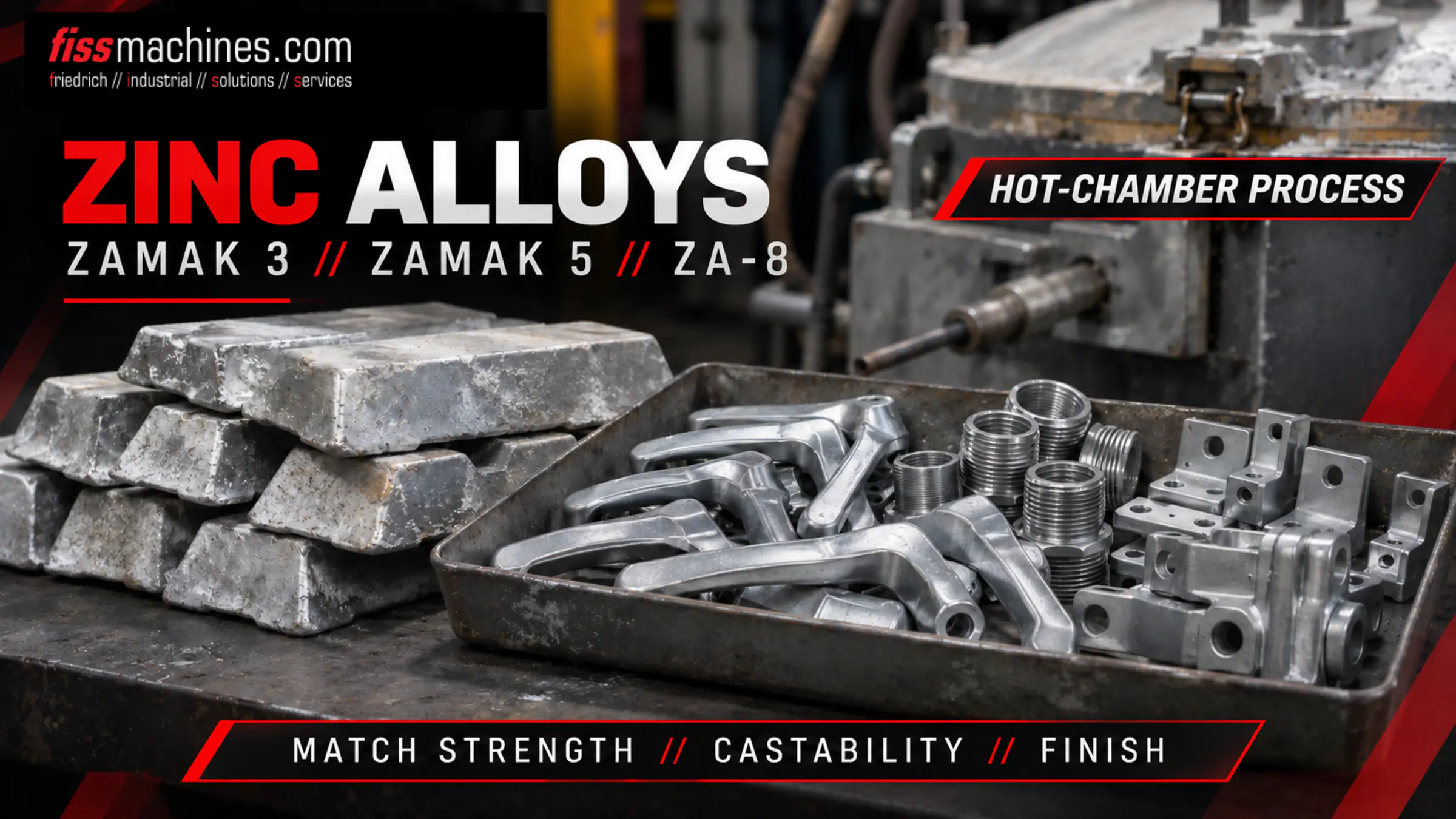
Zinc Die Casting Alloys: Zamak 3, Zamak 5, ZA-8 and Their Properties
Most zinc die castings come from a small family of zinc–aluminium alloys. A few tenths of a percent of copper or a few percent of aluminium decide strength, creep, dimensional stability and whether the part can run on a hot chamber machine.
What Are Zamak Alloys?
Zamak alloys are zinc die casting alloys with about 4 % aluminium, a small magnesium addition and, depending on the grade, up to about 3 % copper. Zamak 3 is the low-copper base alloy, Zamak 5 contains about 1 % copper, Zamak 2 about 3 %. ZA-8 belongs to the zinc–aluminium (ZA) group with about 8 % aluminium.
All four suit hot chamber machines; ZA-12 and ZA-27 need cold chamber machines. Purity matters as much as composition.
How Are Zinc Die Casting Alloys Designated?
The same alloy appears under several names. Europe distinguishes the alloy as delivered – ingot or liquid, standardised in EN 1774 with ZL designations – from the casting, standardised in EN 12844 with ZP designations. In North America, ASTM B240 covers ingot and ASTM B86 covers castings. The trade names Zamak 3, 5 and 2 are used worldwide.
| Trade Name | Ingot (EN 1774) | Casting (EN 12844) | Alloy Symbol | ASTM Designation |
|---|---|---|---|---|
| Zamak 3 | ZL3 / ZL0400 | ZP3 / ZP0400 | ZnAl4 | AG40A |
| Zamak 5 | ZL5 / ZL0410 | ZP5 / ZP0410 | ZnAl4Cu1 | AC41A |
| Zamak 2 | ZL2 / ZL0430 | ZP2 / ZP0430 | ZnAl4Cu3 | AC43A |
| ZA-8 | ZL8 / ZL0810 | ZP8 / ZP0810 | ZnAl8Cu1 | ZA-8 |
The ingot limits are tighter than the casting limits, leaving a margin for pick-up during melting. Standards shops list EN 1774:1997 and EN 12844:1998 as current; BSI marks EN 12844 as under review, so check the valid edition when ordering.
Zamak 3 vs Zamak 5: What Does Copper Change?
Copper raises strength, hardness and creep resistance, but reduces ductility and dimensional stability. Composition limits for castings and nominal values for 1.5 mm die cast test bars, tested about eight weeks after casting, according to the International Zinc Association (IZA):
| Alloy (EN 12844) | Al % | Cu % | Mg % | Tensile Strength | 0.2 % Yield Strength |
|---|---|---|---|---|---|
| ZP3 (Zamak 3) | 3.7–4.3 | ≤ 0.1 | 0.025–0.05 | ≈ 315 MPa | ≈ 276 MPa |
| ZP5 (Zamak 5) | 3.7–4.3 | 0.7–1.2 | 0.025–0.05 | ≈ 331 MPa | ≈ 295 MPa |
| ZP2 (Zamak 2) | 3.7–4.3 | 2.7–3.3 | 0.025–0.05 | ≈ 397 MPa | ≈ 360 MPa |
| ZP8 (ZA-8) | 8.0–8.8 | 0.8–1.3 | 0.015–0.03 | ≈ 387 MPa | ≈ 319 MPa |
According to the IZA, Zamak 3 and Zamak 5 are interchangeable for most applications: Zamak 5 is stronger, while Zamak 3 has better dimensional stability and remains the more ductile alloy. Dynacast describes Zamak 3 as the most widely used zinc alloy in North America and Zamak 5 as the most widely used in Europe.
ZA-8 and the Other ZA Alloys: Hot or Cold Chamber?
The ZA alloys contain more aluminium than Zamak. Only ZA-8 can be cast on a hot chamber machine; the higher-aluminium grades need a cold chamber machine with ladled metal.
Hot Chamber
About 8 % Al, stronger and more creep resistant than Zamak. The IZA notes more shot system wear and more porosity in heavy, isolated sections.
Cold Chamber
Good bearing alloy, mainly for gravity casting. Reduced plating adhesion.
Cold Chamber
High strength and wear resistance; sound castings need extra care. Not recommended for plating.
ZA-8 also has a wider melting range (375–404 °C according to the IZA) than the Zamak alloys. The basic differences between the machine principles are explained in Cold Chamber or Hot Chamber?
Why Do Lead, Cadmium and Tin Limits Matter in Zinc Die Casting Alloys?
In aluminium-containing zinc alloys, very small amounts of lead, cadmium and tin can cause intergranular corrosion, particularly in warm, humid environments. EN 12844 therefore limits lead and cadmium to 0.005 % and tin to 0.002 % in Zamak castings (ZA-8: 0.006 / 0.006 / 0.003 %). Magnesium counteracts the effect, but according to the IZA more than about 0.1 % can cause cracking from shrinkage or ejection stresses. Iron, nickel and silicon are kept low because they form hard particles or reduce impact strength.
Ageing, Dimensional Change and Creep of Zamak Alloys
Die casting chills the alloys rapidly, and the solubility of aluminium and copper in zinc changes with temperature. The castings therefore age: they shrink slightly, and their properties change slowly. IZA data for Zamak 3 show tensile strength falling from about 308 MPa after eight weeks to about 281 MPa after three years, while elongation rises. Zamak 2 gains strength but loses ductility and impact strength over time, especially around 100 °C.
For tight tolerances, a stabilising anneal anticipates most of the shrinkage: 3–6 hours at 100 °C, 5–10 hours at 85 °C or 10–20 hours at 70 °C (IZA).
Creep – time-dependent strain under constant load – is the main limitation of zinc alloys, even near room temperature. According to the IZA, Zamak 5 shows the creep behaviour of Zamak 3 at about 10 °C higher temperature; a safety factor of at least two on creep life or strain is recommended, and ageing can reduce creep strength by up to 16 %. For clamped joints, snap fits or permanently loaded parts in warm surroundings, creep often decides the alloy more than tensile strength.
Plating and Surface Finishing of Zinc Die Castings
Zamak castings are widely plated and coated, one reason why zinc is chosen for fittings and decorative parts – see Aluminium, Zinc or Magnesium? For decorative plating, the IZA calls for sufficient copper and nickel undercoats for the service conditions. Unplated parts form white corrosion products under condensation; passivation or conversion coatings are recommended for tropical transport and outdoor use.
What Do Zamak Alloys Mean for the Hot Chamber Machine?
According to the IZA, the aluminium slows the attack of molten zinc on ferrous materials below about 450 °C, so gooseneck and plunger can stay permanently in the melt. With melting ranges around 380–390 °C, the thermal load on shot system and die stays moderate. Component wear is covered in Gooseneck, Nozzle and Plunger.
- Keep melt temperature within the alloy supplier’s recommendation
- Feed ingots continuously for stable bath level and temperature
- Remove dross regularly
- Run one alloy per pot; an alloy change needs draining or dilution and an analysis
- Expect more shot system wear with ZA-8
- Plan ZA-12 and ZA-27 parts on cold chamber machines
Which Zinc Die Casting Alloy Fits the Part?
The following sequence is an illustrative guide, not a substitute for the part specification or the supplier’s data sheet.
Start With Zamak 3
Good castability, ductility and dimensional stability; suitable for most housings, fittings and plated parts.
Check Load and Temperature
Sustained load, warm surroundings or higher strength point towards Zamak 5 – accepting slightly lower ductility.
Consider ZA-8 for Higher Demands
Higher strength, hardness and creep resistance, still hot chamber. Avoid heavy isolated sections.
Use ZA-12 or ZA-27 Only When Necessary
For bearing or wear applications, with cold chamber machines and limited plating options.
Typically, a thin-walled chrome-plated handle stays with Zamak 3, while a permanently preloaded clip near a warm component is checked for Zamak 5 or ZA-8 using creep data. When buying a hot chamber machine for a given alloy range, see Buying a Used Die Casting Machine.
Small Differences in Composition, Large Differences in Service
Zamak 3 remains the standard, Zamak 5 adds strength and creep resistance through copper, and ZA-8 extends the hot chamber range. Specifying the correct designation, controlling lead, cadmium and tin, and allowing for ageing and creep prevent most alloy-related problems.
Questions About Zamak Alloys
What Is the Difference Between Zamak 3 and Zamak 5?
Zamak 5 contains about 1 % copper, Zamak 3 almost none. The copper makes Zamak 5 stronger, harder and more creep resistant, while Zamak 3 is more ductile and dimensionally more stable. For many parts both alloys are suitable.
What Is the Difference Between EN 1774 and EN 12844?
EN 1774 specifies zinc alloys as supplied for foundry use, as ingot or liquid, with ZL designations. EN 12844 specifies the castings, with ZP designations. The ingot limits are tighter to leave room for pick-up during casting.
Can ZA-8 Be Cast on a Hot Chamber Machine?
Yes. ZA-8 is the only ZA alloy that can be hot chamber die cast. ZA-12 and ZA-27 contain more aluminium and are cast on cold chamber machines.
Why Do Zinc Die Castings Change Dimensions After Casting?
The die chills the alloy rapidly, and the solubility of aluminium and copper in zinc changes with temperature, so the structure keeps changing slowly after casting. The castings shrink slightly over weeks and months. A stabilising anneal, for example 3–6 hours at 100 °C, anticipates most of this change.
Hot Chamber Machines for Zinc from FISS.
FISS lists used hot chamber die casting machines for zinc and searches for suitable equipment when nothing fits in stock. Contact us with your alloy, part and shot weight.
Sources
International Zinc Association (IZA): Zinc Diecasting – Alloy Specifications (EN 12844 designations and composition limits), diecasting.zinc.org, accessed 19 November 2026.
International Zinc Association (IZA): Mechanical Properties, Physical Properties, Corrosion Properties and Selecting the Best Zinc Alloy for the Job, diecasting.zinc.org, accessed 19 November 2026.
International Zinc Association (IZA): Alloys Tailored to Meet Your Needs (ZA-8, ZA-12, ZA-27), diecasting.zinc.org, accessed 19 November 2026.
Nyrstar: Zinc Die Casting Alloys (ZAMAK) – Technical Datasheet, Overpelt, November 2020 (EN 1774 guaranteed analysis), accessed 19 November 2026.
Dynacast: Zamak 3 and ZA-8, material information, dynacast.com, accessed 19 November 2026.
CEN: EN 1774:1997 Zinc and zinc alloys – Alloys for foundry purposes – Ingot and liquid; BSI: BS EN 12844:1998 Zinc and zinc alloys – Castings – Specifications, catalogue entries, accessed 19 November 2026.
