




Manufacturer · Mass finishing and shot blasting · Germany
Used Rösler mass finishing and shot blasting machines Circular vibrators, troughed belt, hanger, wire mesh belt
Rösler Oberflächentechnik GmbH, based in Untermerzbach in Upper Franconia, builds mass finishing and shot blasting machines and makes its own media, compounds and abrasives. The family-owned company has developed vibratory finishing machines since 1974 and moved into shot blasting in 1998. Foundries and die casters mainly use Rösler equipment for deburring, desanding and descaling. This page lists the used Rösler machines currently at FISS and explains how to assess them.
- 1933Company origins
- since 1998Shot blasting
- 15 locationsaround 1,600 employees
Machine you need not listed? Send FISS a search request
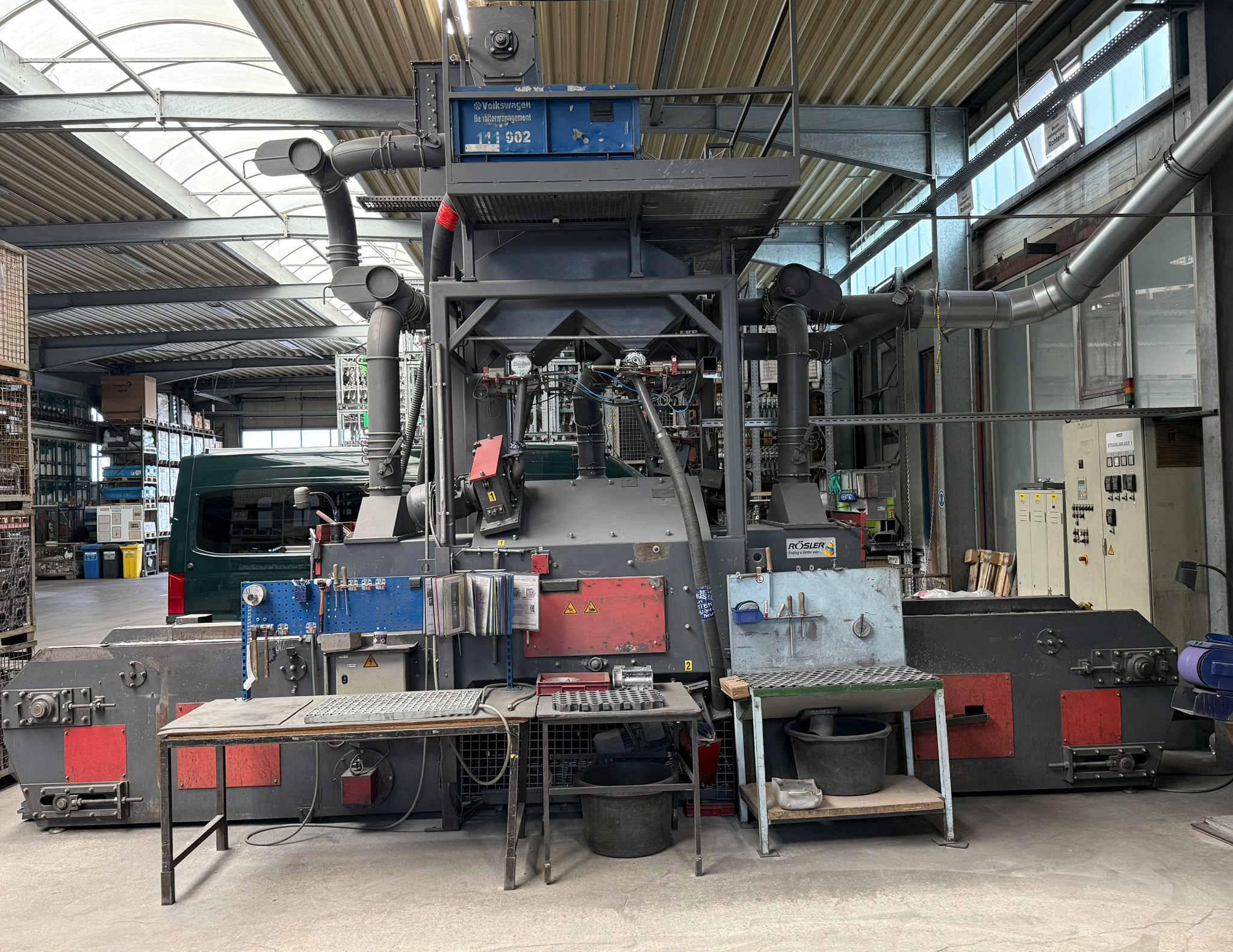
Rösler RDGE 800-4 Durchlaufstrahlanlage SA2136 (offer SA2136) · Photo: FISS

 Details
Knowledge · Rösler
Buying used Rösler: process and machine type first, condition second
Two quite different kinds of machine carry the Rösler name on the used market. Mass finishing machines process parts in a bed of media with water and compound; wheel blast machines use steel shot to desand or deburr castings. In both cases the type code tells you the size and equipment, and the condition depends on a handful of wear assemblies. This overview places the Rösler series using manufacturer data and lists what to check before you buy.
01 · Overview
Rösler at a glance
- Manufacturer
- Rösler Oberflächentechnik GmbH, Vorstadt 1, 96190 Untermerzbach, Germany; further Upper Franconian sites include Memmelsdorf and Bad Staffelstein
- Origins
- 1933 porcelain business founded by Richard Stephan Rösler in Desná (Dessendorf), re-established in Tettau-Schauberg in 1948; the first abrasive media were made from ceramic breakage
- Mass finishing
- compounds and machines developed since 1974, built in Untermerzbach from 1980: circular and tub vibrators, centrifugal disc and continuous systems, dryers, centrifuges
- Shot blasting
- since 1998, partly through the purchase of Hunziker Industriestrahltechnik; the Belgian turbine maker RUTTEN Wheels followed in 2011
- Consumables
- around 15,000 media, compounds and abrasives developed and produced in-house
- Foundry and die casting
- according to Rösler, around a third of its new shot blasting machine business; processing of aluminium, zinc and magnesium castings
- Company
- family business in its third generation, around 1,600 employees at 15 locations worldwide
How to read Rösler type codes
On current circular vibrators the number gives the total volume in litres: an R 420 EC holds 420 l, an R 3500 holds 3,500 l. The letters identify the series (EC, Euro, A, DL). Older designations such as R 470/3000 do not necessarily follow this pattern, so go by the machine's own data sheet.
On the RDGE wire mesh belt machine the current data sheet uses the first number for the belt width in mm and the second for the number of turbines: an RDGE 1000-8 has a 1,000 mm belt and 8 turbines. On the RHBE hanger machine the figures give door width and height in decimetres, so RHBE 22/27 means 2,200 × 2,700 mm.
Suffixes -L, -HD and -F stand for the standard, heavy-duty and foundry versions. Types seen on the used market include the RDGE 800-4, the R 470/3000 circular vibrator and the Z 1000 centrifuge.
02 · Series
Rösler equipment: mass finishing and shot blasting
Rösler's range is wide, but four groups matter most to foundries and die casters. Mass finishing machines deburr and smooth castings in a bed of media; wheel blast machines desand, descale and deburr. Used machines are listed under vibratory finishing machines and shot blasting machines.
Mass finishing · batch
Circular vibrators R, EC, Euro, A, DL
125–3,500 l total volume
- R
- EC
- Euro
- A
- DL
- Special unbalance motor mounted in the centre of the bowl, two speeds as standard (1,500 and 1,000 rpm)
- EC and Euro with built-in separation, R with a flat bowl floor for bulky or delicate parts, A with magnetic separator
- Domeless DL version for very large parts clamped to the machine
Connected loads of 0.75–22 kW according to the data sheet
Mass finishing · special and peripheral
Tub, centrifugal and continuous systems
- Tub vibrators for long and large parts, processed singly or in batches
- Centrifugal disc machines with up to 15 times the output of vibratory machines, according to Rösler
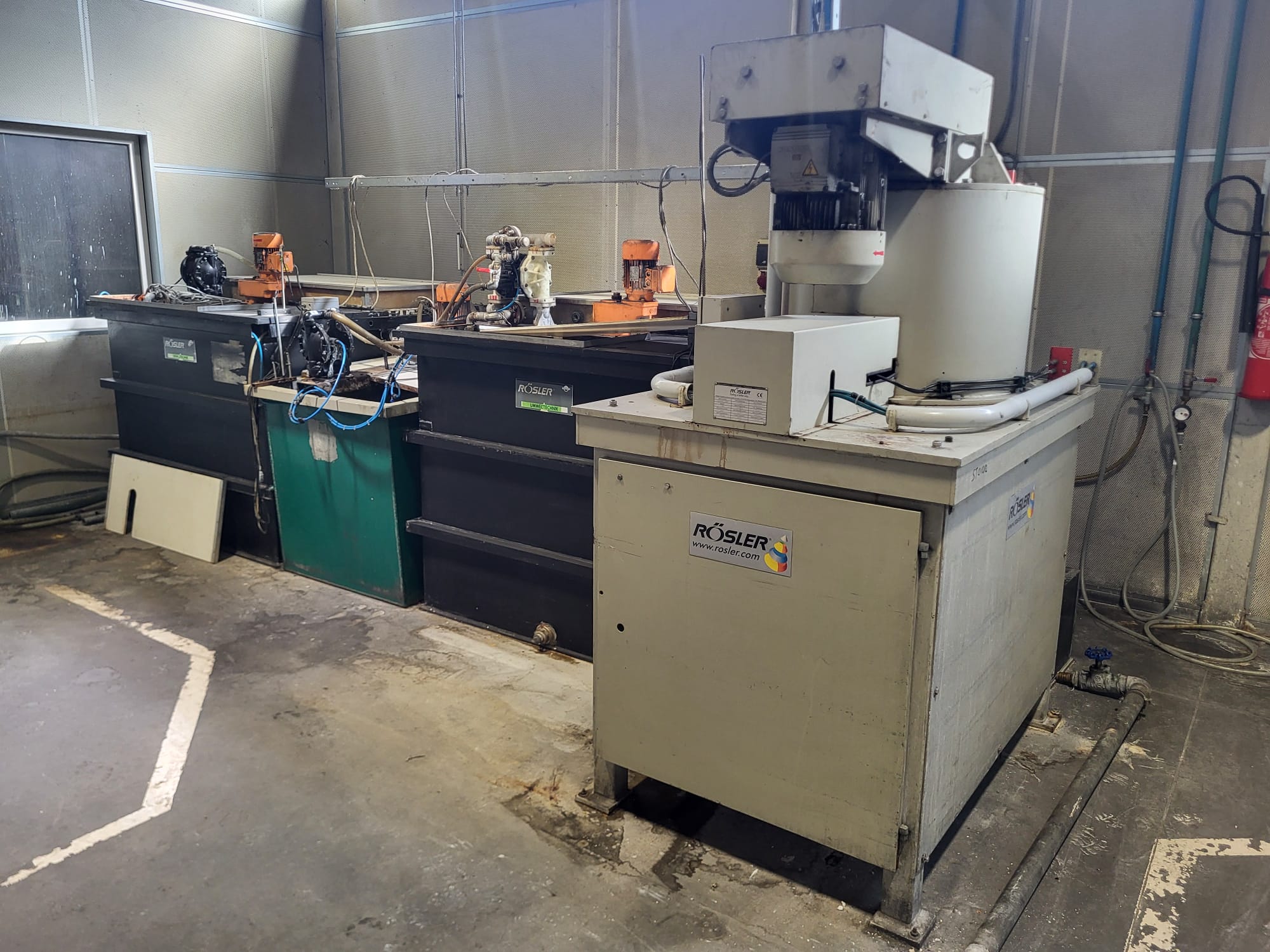
- Centrifuges such as the Z 1000 ASS-II clean the process water for recirculation
Continuous systems integrate mass finishing into linked production lines
Shot blasting · bulk parts
Troughed belt RMBC/RMBD, Multi-Tumbler RMT
90–1,000 dm³ RMBC batch volume
- RMBC
- RMBD
- RMT
- SBM
- For castings that can be tumbled: RMBC in batches, RMBD and SBM in continuous flow
- RMBC with rubber or steel slat belt, 1–3 Gamma 300G/400G turbines, batch weights of 400–3,000 kg
- Blast housing in solid manganese steel, abrasive cleaned by a cascade air-wash separator
Foundry "-F" package with magnetic separator and vibrating screen conveyor
Shot blasting · single parts and continuous
Hanger RHBE, wire mesh belt RDGE, turntable RDT
600–1,600 mm RDGE belt width
- RHBE
- RHBD-T
- RDGE
- RDT
- RWK
- RHBE/RHBD-T for heavy parts that cannot be tumbled; hook load of 500–5,000 kg depending on type
- RDGE with 4 or 8 turbines, belt speed 0.6–6 m/min, part height up to 500 mm
- RDT turntable from 1,000 to 3,000 mm diameter, suitable even for fragile parts
Engine block (RMBS) and crankshaft (RKWS) machines are engineered around the part
Circular vibrators: total volume by series
Source: Rösler circular vibrator data sheet, April 2023. Older machines may differ.
03 · Comparison
Rösler RMBC troughed belt vs RHBE hanger machine
| Feature | Troughed belt RMBC | Hanger RHBE |
|---|---|---|
| Parts | Troughed belt RMBCrobust parts that can be tumbled, processed in bulk | Hanger RHBEheavy, large or impact-sensitive parts that cannot be tumbled |
| Part handling | Troughed belt RMBCrotating rubber or steel slat belt | Hanger RHBEhangers on hooks, rotating and oscillating |
| Capacity | Troughed belt RMBCbatch of 90–1,000 dm³, 400–3,000 kg | Hanger RHBEhook load of 500–5,000 kg each |
| Turbines (standard) | Troughed belt RMBC1–3 × Gamma 300G/400G | Hanger RHBE2–6 × Gamma 300G/400G |
| Blast chamber | Troughed belt RMBCsolid manganese steel | Hanger RHBE8 mm solid manganese steel, 10 mm on foundry version F |
| Filter capacity | Troughed belt RMBC2,000–10,000 m³/h | Hanger RHBE2,000–20,000 m³/h |
Source: Rösler brochure for foundries and forges (no. 270). The rating plate and documents of each machine take precedence.
04 · Buying guide
Checklist: inspecting a used Rösler machine
On mass finishing machines the lining, drive and process water decide the condition; on shot blasters it is the turbines, wear protection and abrasive circuit. Clarify these points before you buy.
- Type, series and version
Read the rating plate and data sheet: volume and series on a circular vibrator, belt width and number of turbines on an RDGE, door size and L, HD or F version on an RHBE. Ask whether the foundry package with magnetic separator, screen conveyor and desanding cartridges is fitted.
- Bowl lining
Rösler lines its bowls with cast hot polyurethane, sprayed PU or rubber and PU sheet. Check thickness, cracks and delamination in the pressure zone at the bowl floor. Rösler can reline worn bowls, so factor this into your budget.
- Unbalance motor and springs
The special unbalance motor sits in the centre of a circular vibrator. Listen for bearing noise, check lubrication, the setting on the scale disc and any added weights. Inspect the spring elements and base frame for cracks.
- Separation and media
Test the separation flap and screen, and the magnetic separator on A-series machines. Ask which media were used and whether undersize screening works: on aluminium and zinc die castings, worn media otherwise lodge in holes and undercuts.
- Process water and compound
Check water and compound dosing and whether the machine ran on fresh water or recirculation. If a centrifuge such as the Z 1000 ASS-II is included, inspect the rotor, peeling knife, imbalance monitor and automatic sludge discharge.
- Blast turbines
Note turbine type and rating (for example Gamma 300G or 400G, 5.5–22 kW). Inspect blades, impeller, control cage and turbine housing. Gamma turbine blades can be used on both sides, so ask whether they have already been turned.
- Blast chamber and wear protection
Check the manganese plates facing the turbines and on the roof, and on an RHBE the roof seal with lips and brushes. On RMBC and RDGE machines the troughed belt or wire mesh belt is one of the costly wear parts.
- Abrasive circuit and dust extraction
Inspect the screw conveyor, bucket elevator, cascade air-wash separator and magnetic separator, plus the cartridge filter and its differential pressure. When blasting aluminium or magnesium castings, confirm whether an explosion-protected filter is fitted. Rösler offers retrofits under its TuneUp brand.
05 · Services
Services for used Rösler machines
FISS supports the purchase and sale of used Rösler mass finishing and shot blasting machines: choosing the right machine, dismantling including filter and abrasive circuit, transport and recommissioning at the new site.
Practical guide to relocation: Relocation: dismantling and transport
06 · FAQ
Frequently asked questions about used Rösler machines
Where is Rösler based and how long has it built machines?
Rösler Oberflächentechnik GmbH is based in Untermerzbach, Upper Franconia. The company traces its origins to a porcelain business founded in 1933. Rösler has developed vibratory finishing machines since 1974 and built them in Untermerzbach since 1980; shot blasting was added in 1998.
Which Rösler machine suits desanding and deburring castings?
Parts that can be tumbled go into RMBC troughed belt machines or the RMT Multi-Tumbler; large or delicate parts go into the RHBE hanger machine. Flat and bulky parts run through the RDGE wire mesh belt machine. For die casting, Rösler also lists a vibrating screen conveyor that removes flash and sand.
What does RDGE 800-4 mean?
On current RDGE types the first number is the wire mesh belt width in mm and the second the number of turbines. The data sheet lists belt widths from 600 to 1,600 mm with 4 or 8 turbines. An RDGE 800-4 fits this pattern, but confirm belt width and turbines on the rating plate.
Can a worn Rösler circular vibrator be relined?
Yes. Rösler makes its polyurethane wear linings in-house and, according to its brochure, offers a relining service for worn bowls. On a used circular vibrator the state of the lining is therefore mainly a cost question.
Why does a mass finishing line need a centrifuge?
The centrifuge removes fines and solids from the process water so it can be reused in a closed loop. Rösler quotes up to 2,000 g and up to 6,000 l/h, separating particles larger than 2.0 µm. The Z 1000 peeler centrifuge is one type found on the used market.
Can I sell my Rösler machine to FISS?
Yes. Send the type, year of manufacture, equipment such as separator, centrifuge or filter unit, and photos via the selling page. FISS assesses single machines as well as complete mass finishing or shot blasting lines with peripherals.
07 · Read more
More manufacturers and surface finishing know-how
Contact
Looking for a Rösler machine, or selling one?
Tell us the machine type, size and equipment. We will come back with suitable machines or an assessment of your Rösler equipment.
As of November 2026. Technical data from public information published by Rösler Oberflächentechnik GmbH (website, brochures and data sheets, 2023) and EUROGUSS 365; the rating plate and documents of each individual machine take precedence. Sources:
- Rösler: Meilensteine der Unternehmensgeschichte
- EUROGUSS 365: Rösler Oberflächentechnik – Hidden Champion from Upper Franconia (17.04.2025)
- Rösler: Gießereien – Schmieden, Strahlanlagen für die Gießerei- und Schmiedeindustrie (Prospekt 270)
- Rösler: Rundvibratoren, Prospekt DE.145 (Stand 04/2023)
- Rösler: Datenblatt Rundvibratoren (Stand 04/2023)
- Rösler: Zentrifugentechnik (Prozesswasserreinigung)
- Rösler: Gleitschlifftechnik, Produktübersicht
- Rösler: Strahltechnik, Produktübersicht
