




Manufacturer · Trimming presses for die casting · Italy
Used Diesse trimming presses Four-column NG+ and C-frame C+
Diesse Presse S.r.l. is based in Calcinato, in the province of Brescia, and has built trimming presses for foundries for more than twenty years. Fitted with a matching die, its presses remove runners and overflows from die-cast parts, either operator-fed or robot-loaded. The range covers the four-column NG+ from 150 to 1,450 kN and the C-frame C+ up to 650 kN. Below are the used Diesse presses FISS currently offers.
- 150–1,450 kNNG+ · four-column trimming press
- 150–650 kNC+ · column-free, open for robots
- Calcinato (BS)Presses built for foundries
Machine you need not listed? Send FISS a search request
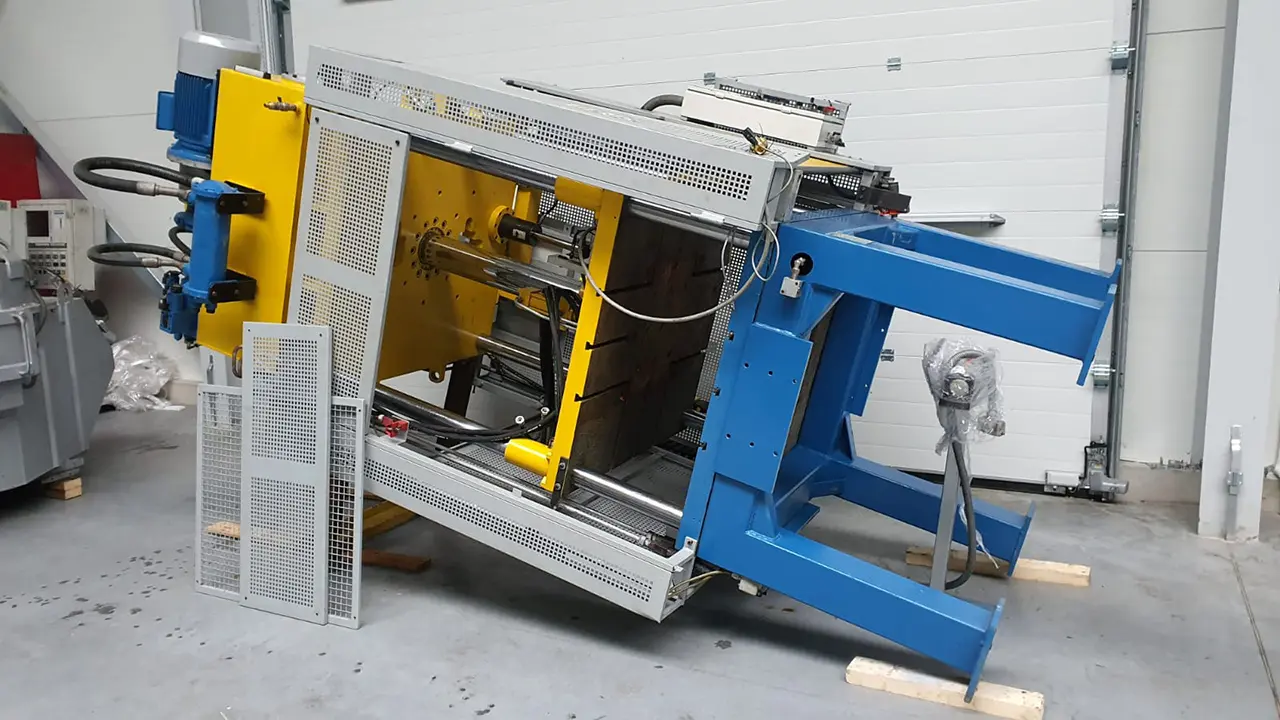
Diesse T35NG+ (offer EP1981) · Photo: FISS
Knowledge · Diesse
Used Diesse trimming presses: models, equipment and inspection points
In a die casting cell, the trimming press sits right after the casting machine and helps decide whether the cell keeps its cycle. Diesse model codes are simple: the number is the force in tonnes and the suffix the frame type. For a used purchase, the equipment and its condition matter far more, from sliding or rotary table and unloader to control system and guarding. This page sets out the maker's data and what to inspect on a used Diesse.
01 · Overview
Diesse Presse at a glance
- Manufacturer
- Diesse Presse S.r.l., Via Industria 17, 25011 Calcinato (Brescia), Italy
- Business
- Design and manufacture of trimming presses for foundries, for more than twenty years according to the company
- Series
- NG+ (vertical four-column press) and C+ (C-frame without columns), plus unloading devices and special systems
- Trimming force
- 150 kN (T15) to 1,450 kN (T145) on the NG+, up to 650 kN (T65) on the C+
- Stroke
- 700 to 1,200 mm on the NG+, 700 to 900 mm on the C+
- Operating modes
- manual, semi-automatic and automatic, with cycle start from an external robot signal
- Compliance
- built to Machinery Directive 2006/42/EC
- Energy
- SAVING EVOLUTION line with brushless motor, pump and inverter; the maker quotes roughly 60–70% lower power consumption
Reading the model code
The figure after the “T” is the force in tonnes. The datasheet uses 10 kN per tonne, so a T35 delivers 350 kN and a T45 450 kN.
The suffix gives the frame: NG+ is the four-column press, C+ the C-frame version. Models found on the used market include the T35NG+ and T45NG+.
The datasheet notes that special sizes are available on request. If platen size or stroke differ from the table, go by the nameplate of the actual machine.
02 · Series
Diesse NG+ and C+ series
Up to 650 kN both series share the same sizes and speed ratings. What sets them apart is the frame: the NG+ guides the ram on four columns, while the C+ has no columns and leaves the working area open at the front. Tables, unloaders and cell equipment complete both ranges.
Vertical · four columns
Diesse NG+
150–1,450 kN Trimming force
- T15
- T25
- T35
- T45
- T55
- T65
- T85
- T105
- T125
- T145
- Platens from 850 × 850 mm (T15) to 2,100 × 2,100 mm (T145)
- Clearance between columns 700 × 700 to 1,600 × 1,600 mm
- Stroke 700–1,200 mm, maximum opening 1,000–1,700 mm
- Option: one column retracts hydraulically to fit large dies
Example: T45NG+ = 450 kN, 1,250 × 1,250 mm platens, 800 mm stroke
C-frame · no columns
Diesse C+
150–650 kN Trimming force
- T15
- T25
- T35
- T45
- T55
- T65
- Platens from 900 × 600 mm (T15) to 1,400 × 1,100 mm (T65)
- Stroke 700–900 mm, maximum opening 1,000–1,400 mm
- No columns, so robots and operators have more room to load and unload
- Small footprint and a clear view of the trimming process
Equipment and peripherals
Tables and unloading
- Electric sliding table, which the maker says needs no pneumatics or hydraulics
- Sliding table with 0–180° rotation and a patented 0–180° rotary table inside the press
- Die lubrication, blow-off and connections for drilling and cutting units
- Unloading devices that carry the casting out of the press
Equipment varies from machine to machine: always check the actual unit
Trimming force ranges in the Diesse datasheets
Linear scale. Figures from the Diesse Presse NG+ and C+ technical tables; special sizes available on request according to the maker.
03 · Comparison
NG+ and C+ side by side
| Feature | NG+ (four columns) | C+ (C-frame) |
|---|---|---|
| Frame | NG+ (four columns)vertical, four columns | C+ (C-frame)C-shaped, no columns |
| Trimming force | NG+ (four columns)150–1,450 kN (T15–T145) | C+ (C-frame)150–650 kN (T15–T65) |
| Platen size, T35 | NG+ (four columns)1,130 × 1,130 mm | C+ (C-frame)1,100 × 800 mm |
| Stroke | NG+ (four columns)700–1,200 mm | C+ (C-frame)700–900 mm |
| Min. / max. opening | NG+ (four columns)300–500 mm / 1,000–1,700 mm | C+ (C-frame)300–500 mm / 1,000–1,400 mm |
| Speeds | NG+ (four columns)fast closing ±500 to ±300 mm/s, trimming 10–40 mm/s | C+ (C-frame)fast closing ±500 to ±450 mm/s, trimming 10–40 mm/s |
| Best suited to | NG+ (four columns)large dies and higher forces | C+ (C-frame)open access for robots and operators |
Sources: Diesse Presse NG+ and C+ technical tables and product pages. Speeds vary by size.
04 · Buying guide
Inspecting a used Diesse trimming press
A trimming press looks simple, but wear concentrates in a few places that are easy to check. These points help you judge condition and fit with your dies.
- Nameplate and frame type
Record model, year and serial number, for example “T45NG+”. Compare platen size, stroke and opening with the datasheet, as Diesse also builds special sizes on request.
- Main cylinder and hydraulics
Look for leaks at the main cylinder seals and rod, check pressure build-up under load and oil temperature over a longer run. On SAVING EVOLUTION machines, include the inverter and the brushless pump drive.
- Columns, guides and parallelism
Measure play in the ram guides on the columns and the parallelism of ram and bed across the full stroke. Scoring on the columns or one-sided wear points to off-centre loading from the die.
- Sliding or rotary table
Cycle the sliding table and any 0–180° rotation several times: positioning accuracy, end stops, drive and locking. If the column retraction option is fitted, the column must extend and lock again cleanly.
- Die mounting and ejector
Check T-slots, clamping faces and locating features on bed and ram plate. Do the ejector, auxiliary circuits for side punches and connections suit your existing trim dies?
- Control and robot interface
Establish PLC generation, operator panel and software version. One listing for a T35NG+ mentions a Siemens S7-300 with touch-screen HMI. For automatic mode, cycle start from the robot signal must work.
- Guarding and safety
Fencing, doors, light curtains, two-hand controls and safety sensors must be complete and suit the future cell. More in CE marking of used machines.
- Cycle time and unloading
Measure fast closing, trimming and return speeds against the datasheet (trimming 10–40 mm/s) and test the unloader. The press has to keep pace with the casting machine, see Die casting cycle time bottlenecks.
05 · Services
Services for used Diesse presses
Whether you are buying a Diesse trimming press or selling one out of a die casting cell, FISS helps with appraisal, dismantling, transport and recommissioning, including the link to casting machine and robot.
Practical guide to relocation: Relocation: dismantling and transport
06 · FAQ
Diesse FAQ
Who makes Diesse trimming presses?
Diesse Presse S.r.l. in Calcinato (Ponte San Marco) in the province of Brescia. The company says it has designed and built trimming presses for foundries for more than twenty years.
What does “T45NG+” mean?
“45” stands for 45 tonnes of force, 450 kN according to the datasheet. “NG+” denotes the four-column frame. The T45NG+ has 1,250 × 1,250 mm platens and an 800 mm stroke.
What forces does Diesse offer?
The NG+ runs from 150 kN (T15) to 1,450 kN (T145), the C+ from 150 kN to 650 kN. The maker states that special sizes are available on request.
When is a C+ a better choice than an NG+?
The C+ has no columns, giving robots and operators free access from the front. For large dies and forces above 650 kN, the NG+ is the right frame.
What is the sliding table for?
It moves the lower die out of the press so parts and tooling are easier to load and unload. Diesse offers it with electric drive, also combined with 0–180° rotation.
Can a used Diesse be integrated into a robot cell?
Diesse provides an automatic mode in which an external robot signal starts the cycle. On a used machine, the control, interface and guarding must match the new cell.
07 · Read more
More manufacturers and know-how
Contact
Looking for a Diesse, or selling one?
Tell us the model, force and equipment such as sliding table or unloader. We will come back with matching machines or an offer for your Diesse.
As of November 2026. Technical data based on public information from Diesse Presse and the trade press; for a used machine, its nameplate and records take precedence. Sources:
- Diesse Presse: Startseite
- Diesse Presse: Presse di tranciatura (Entgratpressen)
- Diesse Presse: Tabella tecnica NG+ (PDF)
- Diesse Presse: Tabella tecnica C+ (PDF)
- Diesse Presse: Optional
- Meccanica e Fonderia: Firmenprofil Diesse Presse
- Die Cast Machinery: Inserat Diesse Presse T35NG+ (verkauft)
- FISS Machines: Diesse-Produktliste
