




Manufacturer · Hydraulic trimming presses · Italy
Used Tecnopres trimming presses KZP four-column and KZ C-frame series
Tecnopres, based in Chieri near Turin, designs and builds hydraulic presses, chiefly trimming presses for die casting. Its best-known product is the four-column KZP series for trimming aluminium, zamak and magnesium castings, which the data sheet lists from 15 to 160 t pressing force. The range also includes the KZ C-frame press plus assembly and special presses. The listing above shows the Tecnopres presses FISS currently offers; below you will find series, dimensions and inspection points.
- since 1980Chieri (Turin), Italy
- 15–160 tKZP pressing force
- approx. 4,500presses built, per Tecnopres
Machine you need not listed? Send FISS a search request
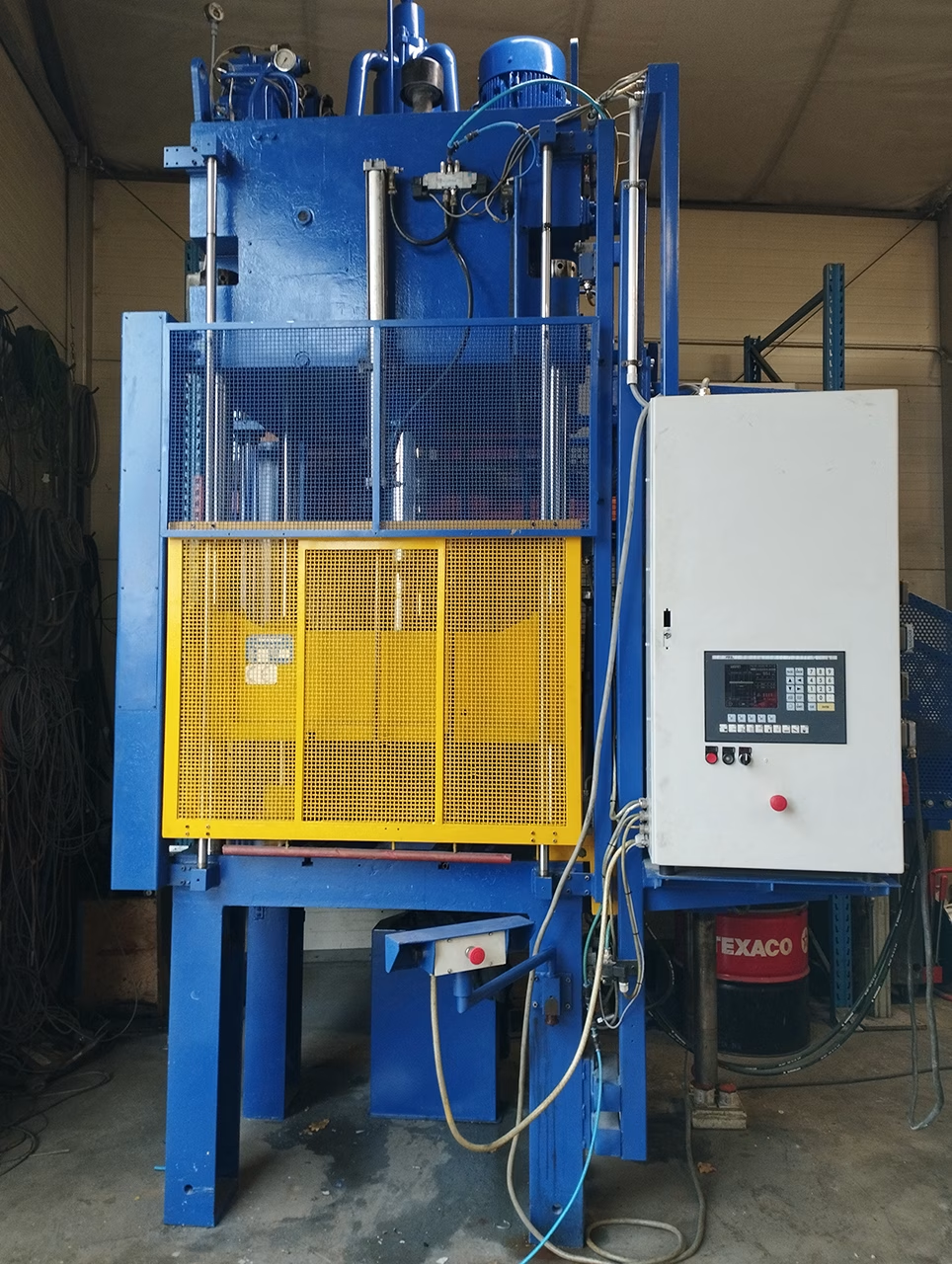

 Details
Knowledge · Tecnopres
Buying a used Tecnopres KZP: series, dimensions, checks
After a part leaves the die casting machine, a trimming press shears off runners, overflows and flash. Tecnopres concentrates on exactly this job. According to the company, design, machining, hydraulics and control software are all done in-house, and every press is configured to order. On the used market you mostly meet KZP presses in sizes 30 and 40, some built around 1990. This page explains the series, lists data sheet dimensions and covers what to inspect on a second-hand press.
01 · Overview
Tecnopres at a glance
- Manufacturer
- Tecnopres, Via Fratelli Gambino 6, Fontaneto industrial area, 10023 Chieri (Turin), Italy
- History
- Founded in 1980 ‘with the heritage of Brosi / Atrema’; the company traces its press building back to 1955
- Plant
- 2,400 m² production and 800 m² offices; turning, milling, boring, painting and assembly in-house
- Output
- About 4,500 presses built for customers in 35 countries, roughly 100 presses a year (company figures)
- Trimming presses
- KZP (four-column, also three-column), KZP-TR with sliding and tilting table, KZP-S for large parts, KZ C-frame
- Other presses
- Assembly and straightening presses types K, KO, KS, KBG, KT and KTB, plus special machines
- Materials
- Aluminium, zamak, magnesium and light alloys from high- and low-pressure casting; KZP up to 120 t also for cast iron
- Certification
- ISO 9001:2015 and ISO 14001:2015
Decoding the type designation
The number after KZP or KZ is the pressing force in metric tonnes, so a KZP 40 delivers 40 t, or roughly 392 kN. On the data sheet the KZP 30 and KZP 40 share one frame with 950 × 950 to 1,250 × 1,250 mm between columns.
Suffixes mark variants: TR means sliding and tilting table, S the large-format version. Tecnopres does not publish what letters such as ‘NC’ in used listings (e.g. KZP 30 NC) stand for, so rely on the nameplate and machine documents.
02 · Series
Tecnopres trimming press series
Tecnopres trimming presses come in two frame types: the four-column KZP family and the KZ C-frame. Two variants derive from the KZP: the KZP-TR with a sliding and tilting table and the large-format KZP-S. The 2016 KZP data sheet states that every press ships with safety devices and CE certification, and special builds or different dimensions were available on request. Presses from other makers are listed under trimming presses.
Four-column · core series
Tecnopres KZP
15–160 t Pressing force
- 15
- 20
- 25
- 30
- 40
- 50
- 60
- 70
- 80
- 100
- 120
- 150
- 160
- 620 × 620 to 2,500 × 1,900 mm between columns, daylight up to 2,500 mm, stroke up to 1,600 mm
- Proportional valves for force, pressure and speed; stroke set via absolute transducer
- Operator panel storing tool cycles, with diagnostics; controls for hydraulic or pneumatic side cylinders
2016 data sheet; the product page quotes 15 to 120 t, including three-column versions
Four-column · sliding/tilting table
Tecnopres KZP-TR
20–60 t Pressing force
- 20 TR
- 40 TR
- 60 TR
- Table slides out for loading and tilts through 0–180° so the tool can be cleaned
- Central hole in the table drops the runner; unloading by robot or standard unloader
- Tilting table from 600 × 520 mm (KZP 20 TR) to 1,220 × 1,100 mm (KZP 60 TR)
620 × 620 to 1,100 × 1,350 mm between columns
Four-column · large format
Tecnopres KZP-S
70–120 t Pressing force
- 70
- 80
- 120
- Derived from the KZP with wider column spacing, more daylight and longer stroke
- Up to 2,300 mm between columns, daylight 1,600 to 2,300 mm, stroke 800 to 1,500 mm
- Designed for automated cells handling large, heavy castings
C-frame · single column
Tecnopres KZ
15–50 t Pressing force
- 15
- 30
- 50
- Small footprint and easy access to the platens, useful where tools change often
- Daylight 700 to 1,200 mm, stroke 400 to 800 mm, return force 2.5 to 6 t
- Options include sliding table, sliding and rotating table, part unloader and robot interface
Guarding directs flash and scrap into collection bins
Pressing force by Tecnopres series
Linear scale in metric tonnes (1 t ≈ 9.81 kN). Figures from the Tecnopres KZ, KZP-TR, KZP-S and KZP (2016) data sheets. Special builds differ; for a used press the nameplate is what counts.
03 · Comparison
Four-column KZP versus C-frame KZ
| Feature | Tecnopres KZP | Tecnopres KZ |
|---|---|---|
| Frame | Tecnopres KZPfour columns, also three-column | Tecnopres KZC-frame, single column |
| Pressing force | Tecnopres KZP15–160 t | Tecnopres KZ15–50 t |
| Daylight | Tecnopres KZP700–2,500 mm | Tecnopres KZ700–1,200 mm |
| Stroke | Tecnopres KZP400–1,600 mm | Tecnopres KZ400–800 mm |
| Tool access | Tecnopres KZPguards on three sides, pneumatic front gate, optional removable column | Tecnopres KZcompact, open access to the platens |
| Typical use | Tecnopres KZProbot cells and manual work; variants for large parts (KZP-S) and tilting table (KZP-TR) | Tecnopres KZsmaller parts, frequent tool changes |
Sources: Tecnopres KZP (2016) and KZ data sheets and Type KZP product page, accessed 6 November 2026. Manufacturer data; individual used presses may differ.
04 · Buying guide
Inspecting a used Tecnopres trimming press
A trimming press works hand in hand with its tool, the robot and the scrap conveyor. Check these points with the press running, ideally using your own tool or a comparable one.
- Type, year and tonnage
Match the nameplate against series, tonnage and year of build. KZP 30 and KZP 40 share a frame, so the force rating decides how much headroom you have for thick gates and overflows.
- Working envelope versus tool
Compare column spacing, table size, daylight and stroke with your trim tool. Extra daylight and stroke were options, so a given press may not match the standard data sheet.
- Hydraulics and oil
Listen to the pump, and check proportional valves and heat exchanger for leaks and temperature behaviour. Where oil temperature and level monitoring is fitted, watch its messages during operation.
- Columns and guide bushes
Look for scoring and wear tracks on the columns, check bush play and confirm the centralised column lubrication works. On a removable column, test the locking and alignment after refitting.
- Position sensing and controls
Have the absolute-transducer stroke setting, intermediate stops and stored tool cycles demonstrated on the panel. For presses built around 1990, find out whether the control and its spare parts can still be sourced.
- Side cylinders, ejector, part holder
Count the hydraulic and pneumatic circuits for side cylinders, slides, drilling or sawing units, ejector and part holder. Adding missing valve stations later is costly.
- Guarding and CE
Make sure guards, the pneumatic front gate with safety edge and the light curtain are all present. Presses built before CE marking need assessing against current requirements; see CE marking of used machines.
- Table, unloader and cell interface
On a KZP-TR, run the sliding and tilting motion through its full angle. Check that the part unloader, scrap conveyor control, quick tool change with roller brackets and Rollbloc inserts, and robot interface are complete.
05 · Services
FISS services for Tecnopres presses
A trimming press usually sits right next to the die casting machine, linked to a robot and scrap conveyor. For dismantling, loading and reinstallation at the new site, FISS provides these services:
Practical guide to relocation: Relocation: dismantling and transport
06 · FAQ
Tecnopres trimming presses: frequently asked questions
Where is Tecnopres based?
In Italy, in the Fontaneto industrial area of Chieri near Turin. According to its company page, Tecnopres was founded in 1980 with the heritage of Brosi / Atrema, and it dates its hydraulic press building back to 1955.
What does the number in KZP 30 or KZP 40 mean?
Pressing force in metric tonnes: 30 t or 40 t, roughly 294 or 392 kN. Per the data sheet both sizes use the same frame, with 900 to 1,800 mm daylight and 500 to 1,300 mm stroke.
How much pressing force do I need for trimming?
It follows from the casting and the tool, mainly the cutting length and the cross-section at gates and overflows. Tecnopres covers 15 to 160 t with the KZP and 15 to 50 t with the KZ. Allow some headroom if larger parts may follow.
Can a used KZP be integrated into a robot cell?
Tecnopres offered a robot interface, part unloader, scrap conveyor control and quick tool change as options. Whether a particular press has them shows in its control cabinet, valve block and documents. On matching the press to the casting cell, see die casting cycle time bottlenecks.
How does the KZP-TR differ from the KZP?
The KZP-TR is a KZP fitted with a sliding and tilting table. Parts are loaded outside the press, the table tilts up to 180° for tool cleaning, and a central hole drops the runner. Data sheets cover 20, 40 and 60 t.
Are Tecnopres presses used for cast iron as well?
Yes: the company says KZP models up to 120 t are also used for cast-iron parts. The main application remains trimming aluminium, zamak and magnesium parts from high- and low-pressure casting.
07 · Read more
Related manufacturers and categories
Contact
Looking for a Tecnopres press, or selling one?
Tell us the series, tonnage and the dimensions of your trim tool. FISS will come back with suitable presses or take up your machine for purchase.
As of November 2026. Technical data from the Tecnopres website and the data sheets published there; types taken from used listings are not manufacturer data. The details of a specific press are given in its listing. Sources:
