




Manufacturer · Magnesium Thixomolding · Japan
Used JSW Thixomolding Machines Magnesium injection moulding with the JLM-MG range
Tokyo-based The Japan Steel Works (JSW) builds magnesium injection moulding machines that use the Thixomolding process. Magnesium alloy chips are heated to a semi-solid state inside the barrel and the screw injects them into the mould, with no melting furnace involved. Since the first JLM450-MG of 1994, JSW has released three machine generations; current models reach 29,400 kN clamping force. The product list shows the used JSW machines FISS currently offers.
- since 1907Head office Tokyo, Japan
- since 1994Thixomolding machines (JLM)
- up to 29,400 kNClamping force JLM3000-MGIIeL
Machine you need not listed? Send FISS a search request
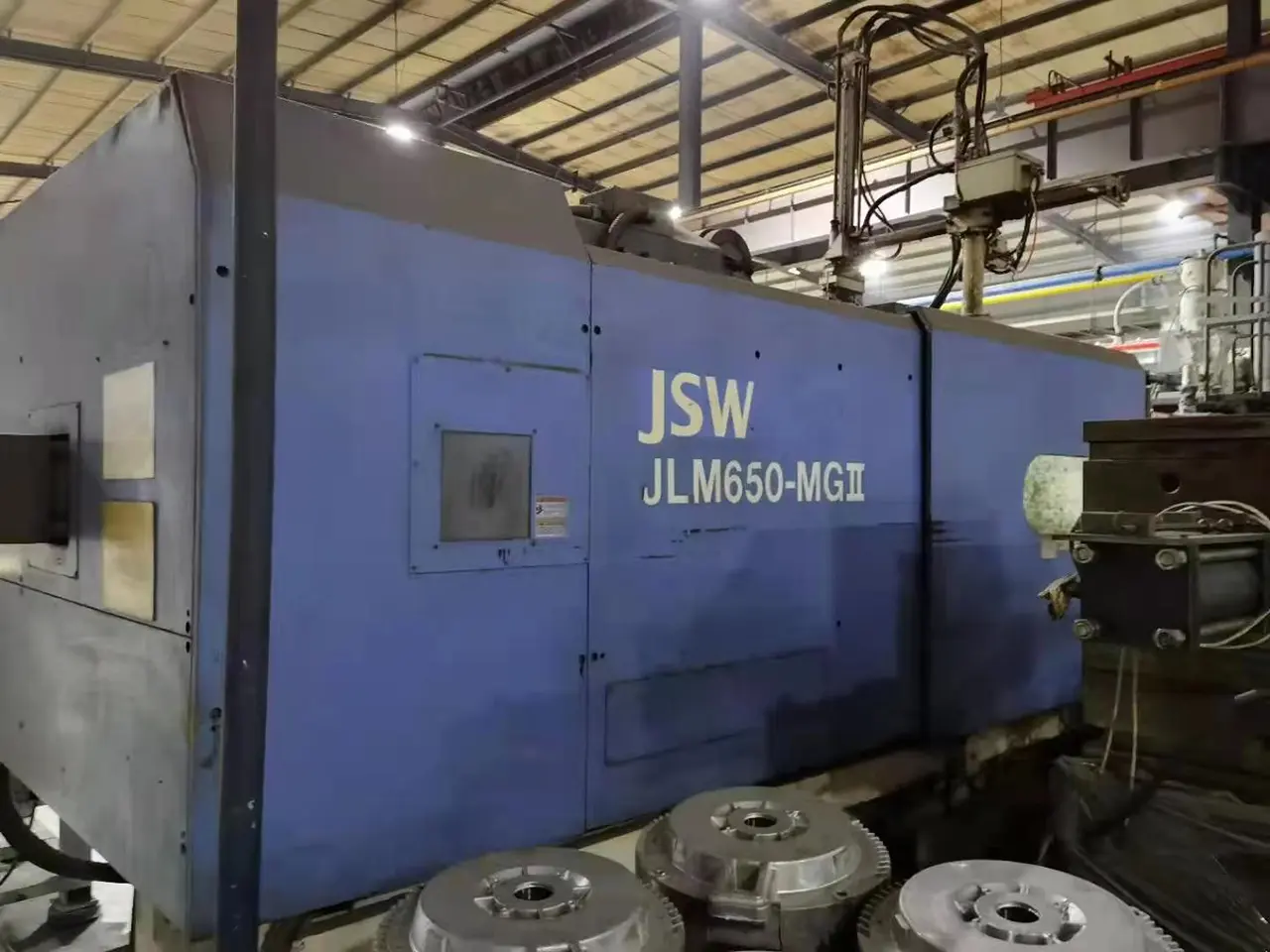
JSW JLM 650-MGII Magnesium Thixomolding Maschine WK1452 (offer WK1452) · Photo: FISS
Knowledge · JSW
Buying a used JSW Thixomolding machine: process, generations, inspection
Thixomolding was developed by Dow Chemical; JSW took up the technology in 1992 and has built its JLM machines around it ever since. In design terms a JLM has more in common with a plastics injection moulding machine than with a die casting machine. So a buyer looks at different assemblies: barrel and screw, barrel heating, and chip feeding under argon. This page explains the process, sorts the machine generations and lists what to check before you buy.
01 · Overview
JSW at a glance
- Manufacturer
- The Japan Steel Works, Ltd. (JSW), head office in Tokyo, Japan; founded in 1907 in Muroran, Hokkaido
- Business unit
- Molding Machines: plastics injection moulding, blow moulding and magnesium injection moulding machines
- Process
- Thixomolding, originally developed by Dow Chemical; introduced at JSW in 1992 under licence
- First machine
- JLM450-MG with 4,410 kN clamping force, shipped in 1994 as JSW's first commercial unit
- Generations
- JLM-MG (from 1995), JLM-MGII (from 2002), JLM-MGIIe (from 2006), plus the large JLM-MGIIeL models
- Current range
- JLM280-, JLM650- and JLM850-MGIIe; JLM1300-, JLM1800- and JLM3000-MGIIeL
- Installed base
- close to 510 machines sold, according to JSW Technical Review No. 20
- Typical parts
- housings for notebooks, cameras and mobile phones; in vehicles, display frames, ECU cases and seat-back frames
Decoding the model name
The number after JLM is the clamping force class in tonnes. JSW's own figures confirm the pattern: JLM450-MG = 4,410 kN, JLM850-MGIIe = 8,330 kN, JLM1800-MGIIeL = 17,700 kN, JLM3000-MGIIeL = 29,400 kN.
The suffix gives the generation: MG is the first, MGII the second and MGIIe the third; the large models from 1,300 t carry MGIIeL. A JLM 850-MG and a JLM850-MGIIe therefore share a clamping force but are years apart in design.
Types you will meet on the used market include the JLM 100-MG II, JLM 220-MG, JLM 650-MGII and JLM 850-MG. Have the generation and year confirmed from the serial number.
02 · Comparison
Thixomolding versus magnesium die casting
| Feature | Thixomolding (JSW JLM) | Magnesium die casting |
|---|---|---|
| Feedstock | Thixomolding (JSW JLM)magnesium alloy chips fed at room temperature | Magnesium die castingingots melted in a furnace |
| Melting furnace | Thixomolding (JSW JLM)none; the alloy is molten or semi-solid only inside the barrel | Magnesium die castinga furnace keeps a large volume of melt ready at all times |
| Protection against oxidation | Thixomolding (JSW JLM)closed barrel under argon, no contact with air | Magnesium die castingcover gas over an open melt, historically often SF6 |
| State of the metal | Thixomolding (JSW JLM)semi-solid (thixotropic); with AZ91D about 25–30 % solid at 580 °C, close to zero above 595 °C | Magnesium die castingfully liquid |
| Preparation and shot | Thixomolding (JSW JLM)a rotating screw conveys, heats and shears the alloy, then moves forward to inject | Magnesium die castingplunger in a shot sleeve (cold chamber) or gooseneck (hot chamber) |
| Changing alloy | Thixomolding (JSW JLM)relatively simple according to JSW, as there is no furnace to switch over | Magnesium die castingtied to the furnace contents |
Sources: JSW product page and JSW Technical Review No. 20; solid fraction from trials by NMF Fürth (2003) on a JSW JLM-220MG; argon after Midson et al., as cited in Wikipedia.
03 · Series
JSW machine generations: the JLM family
JSW has developed the JLM in distinct generations, and used machines come from all three. The generation determines injection performance, chip feeding and hydraulics, and so also which spare parts you will need.
1st generation · from 1995
JSW JLM-MG
735–8,330 kN Clamping force
- JLM 220-MG
- JLM450-MG
- JLM 850-MG
- First series with six models, preceded by the 4,410 kN JLM450-MG of 1994
- Injection speed up to 3.8 m/s; chip supply set at the feeder
- The 8,330 kN JLM850-MG long remained JSW's largest production machine, used for seat-back frames among other parts
Seen on the used market as, for example, the JLM 220-MG and JLM 850-MG
2nd generation · from 2002
JSW JLM-MGII
- Large-capacity servo valves raise injection speed from 3.8 to 5.0 m/s
- Flood feed (FF) screw removes the need to adjust supply at the feeder and shortens recovery time
- Platens redesigned by FEM, about 40 % stiffer; variable-pump switch-over for fast mould opening and closing
Seen on the used market as, for example, the JLM 100-MG II and JLM 650-MGII
3rd generation · from 2006
JSW JLM-MGIIe
280–850 t Clamping force
- JLM280-MGIIe
- JLM650-MGIIe
- JLM850-MGIIe
- More compact than the MGII: lighter injection pistons, simpler hydraulic piping, modular injection and clamping units
- Screw and barrel in a JSW-developed material for continuous operation at 630 °C
- Injection speed up to 5 m/s (dry run); JLM850-MGIIe rated at 8,330 kN
Large machines
JSW JLM-MGIIeL
1,300–3,000 t Clamping force
- JLM1300-MGIIeL
- JLM1800-MGIIeL
- JLM3000-MGIIeL
- JLM3000-MGIIeL (since 12/2022): 29,400 kN, tie-bar spacing 2,050 × 1,820 mm, shot weight of 5 kg or more
- JLM1800-MGIIeL (since 01/2026): 17,700 kN, 130 mm screw, tie-bar spacing 1,620 × 1,850 mm
- Both use an electric clamping unit; for the JLM3000, JSW calculates roughly 20 % lower power consumption than a hydraulic clamp
Designed for large frames and supports in vehicle displays
Clamping force ranges of the JLM generations
Linear scale, manufacturer data. Tonnes converted at 9.8 kN per tonne, as JSW does (3,000 t = 29,400 kN). JSW gives no overall range for the JLM-MGII. The rating plate of the individual machine is what counts.
04 · Buying guide
Buying a used JSW Thixomolding machine: what to check
A JLM is inspected differently from a die casting machine. There is no furnace and no shot sleeve; instead, a barrel runs continuously at around 600 °C with a screw working in semi-solid magnesium. Clear up these points before you buy.
- Rating plate, generation and year
Record the full designation (e.g. JLM 650-MGII), clamping force in kN, year and serial number. The generation determines injection performance, chip feeding and hydraulics; the serial number identifies the actual specification.
- Barrel and screw
These are the main wear parts: the barrel runs at 600–630 °C in direct contact with the magnesium alloy. Ask for operating hours since the last replacement, measurements of barrel bore and screw diameter, and the condition of the screw tip and non-return valve.
- Barrel heating and temperature control
Barrel temperature sets the solid fraction and so flow behaviour and porosity. Check the heater bands and thermocouples in every heating zone, the heating components in the control cabinet, and whether each zone holds its set point steadily.
- Chip feeding and argon
Inspect the hopper, the feeder or FF screw (from MGII onwards) and the argon supply, including pressure regulator, flow measurement and tight lines. If air gets into the barrel, the magnesium oxidises.
- Injection unit and test shots
Have test shots run with speed and pressure traces recorded, and compare them with the data sheet (MG up to 3.8 m/s, MGII onwards up to 5.0 m/s). Check servo valves, accumulators and their inspection records. Background: Shot curves and process monitoring.
- Clamping unit and mould dimensions
On hydraulic models look at oil condition, leaks and pumps; on the JLM1800- and JLM3000-MGIIeL, at the electric clamping unit. Match tie-bar spacing, platen size and mould height against your tools.
- Peripherals and finishing
Confirm whether the take-out robot, release-agent sprayer, mould temperature control and trimming press belong to the cell. Thixomolded parts usually need deburring and further finishing.
- Magnesium safety and relocation
Chips, fine dust and burrs can ignite. Plan for dry chip storage, wet dust collection and metal-fire extinguishing agents; JSW prohibits water, CO2 and ABC extinguishers. For moving the machine, see Relocation: dismantling and transport.
05 · Services
Services for your used JSW
FISS supports the purchase and sale of used JSW Thixomolding machines, from choosing the right model through dismantling and transport to recommissioning.
Practical guide to relocation: Relocation: dismantling and transport
06 · FAQ
Frequently asked questions about JSW
What is Thixomolding?
Thixomolding is injection moulding of magnesium in a semi-solid state. Alloy chips are heated in a barrel kept under argon, and the rotating screw shears them into a flowable slurry of rounded solid particles, which it then injects into the mould.
How does a JSW JLM differ from a magnesium die casting machine?
A JLM needs no melting furnace: the metal is molten or semi-solid only inside the closed barrel and never touches the air. According to JSW, this also removes the need for SF6 cover gas. Layout and operation resemble a plastics injection moulding machine.
What does JLM 650-MGII stand for?
650 is the clamping force class in tonnes, and MGII the second machine generation, introduced in 2002. The exact kN figure is on the rating plate; JSW converts at 9.8 kN per tonne.
Which JSW models are currently built?
The product page lists six models: JLM280-, JLM650- and JLM850-MGIIe, plus the large JLM1300-, JLM1800- and JLM3000-MGIIeL. The JLM1800-MGIIeL was added in January 2026 and has 17,700 kN clamping force.
Which alloys run on JSW machines?
According to the JSW Technical Review, AZ91D (JIS MD1D) is by far the most common, with AM60B also in use. On a used machine, check which alloy the temperature settings and process data were set up for.
Can I sell my JSW machine to FISS?
Yes. Send the model designation, year, clamping force, operating hours and photos via the purchase page. FISS reviews the details and gets back to you about the next steps.
07 · Read more
More manufacturers and knowledge
Contact
Looking for a specific JSW?
Tell us the model, generation, clamping force and part you want to produce. We will come back to you with suitable machines from our network.
As of November 2026. Technical data from public information by The Japan Steel Works (product page, press releases, JSW Technical Review) and technical literature; clamping forces as stated by the manufacturer. For any specific machine, the rating plate and data sheet apply. Sources:
- JSW: Magnesium injection molding machine (Produktseite)
- JSW: Launch of JLM3000-MGIIeL (News, 26.04.2023)
- JSW Technical Review No. 20: Technical Development of Thixomolding Machine and its Future Prospects (Maehara, Kari, Toyoshima, Butani)
- JSW Corporate Guide (englisch, Ausgabe 2026)
- MONOist: Neues Modell JLM1800-MGIIeL (03.02.2026)
- Lohmüller et al. (NMF Fürth): Injection Molding of Magnesium Alloys, Magnesium Alloys and Their Applications, Wiley-VCH 2003
- Wikipedia: Semi-solid metal casting (Abschnitt Thixomolding)
- JSW: Safe handling of magnesium
