




Manufacturer · Cold chamber die casting · Italy
Used Italpresse die casting machines IP toggle and TF toggle-free
Founded in 1969 and based in Capriano del Colle near Brescia, Italpresse now trades as ItalPresseGauss. It builds cold chamber die casting machines for aluminium on two principles: the three-platen IP with a toggle and the toggle-free two-platen TF. The current datasheet spans 3,925 to 88,290 kN of locking force. Below you will find the used Italpresse machines FISS is currently offering.
- 3,925–43,164 kNIP · three-platen toggle
- 16,186–88,290 kNTF and TFs · two-platen
- since 1969Die casting from Brescia province
Machine you need not listed? Send FISS a search request

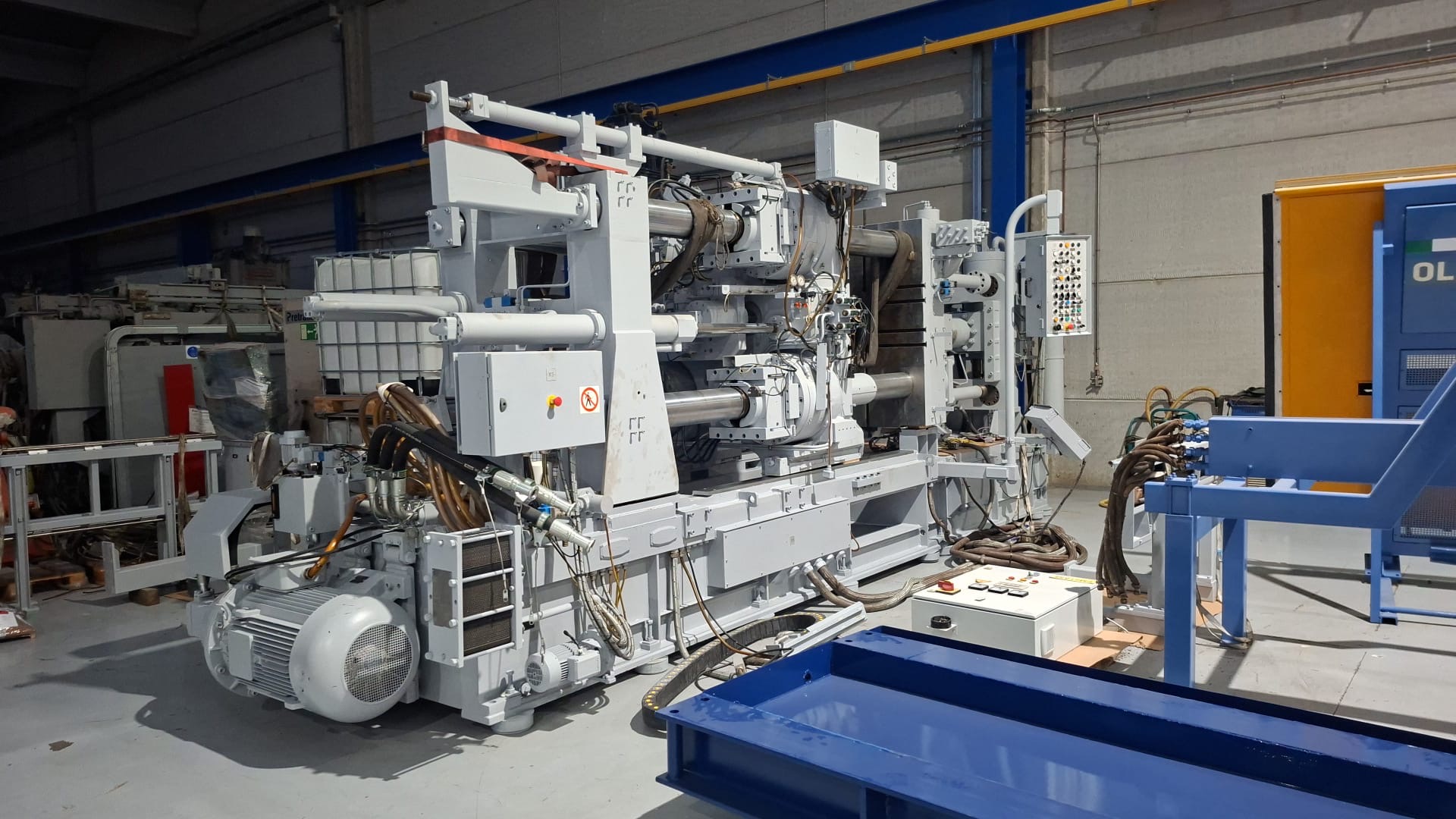
Italpresse IP 500 (offer KK1711) · Photo: FISS


 Details



Knowledge · Italpresse
Buying a used Italpresse: IP, TF and the points that matter
Most used Italpresse machines belong to one of two families: the toggle-type IP or the toggle-free TF. Both are cold chamber machines for aluminium, yet they differ clearly in clamping principle, overall length and where wear shows up. On top of that come several generations of shot end and HMe control. This page sets out what the manufacturer documents, decodes the model names and lists what to inspect on an Italpresse before you commit.
01 · Overview
Italpresse at a glance
- Manufacturer
- ItalPresseGauss S.r.l., Via Trento 178, Capriano del Colle (Brescia), Italy
- Founded
- 1969 as Italpresse Industrie, focused on light-alloy die casting and gravity casting from the outset
- Ownership
- Part of Norican Group from 2017 to 2025; owned since 30 March 2026 by LEO III Fund, advised by DUBAG
- Processes
- Cold chamber high pressure die casting (HPDC) for aluminium, plus gravity and low-pressure casting and automated cells
- Current series
- IP (three-platen toggle), TF and TFs (two-platen, toggle-free)
- Locking force
- 3,925 kN (IP 400 SC) to 88,290 kN (TFs 9000 SC4.6) per the 2026 datasheet
- Shot end and control
- SC (“Separate Circuit”) shot end with real-time control; HMe control software, analytics via HMe LENS
- Typical castings
- Engine blocks, gearboxes, oil sumps, battery housings and other structural parts, radiators, escalator steps, electronics housings
Decoding the model name
The number is the locking force in tonnes; the datasheet converts at 9.81 kN per tonne. An IP 400 SC delivers 3,925 kN, a TF 1850 SC3.0 18,148 kN.
The suffix identifies the shot end: SC on small IP sizes, SC3.0 from 750 t and on the TF, SC4.3 to SC4.6 on the large TFs machines. Used listings also show codes such as “IP 550 TC”; their meaning is not publicly documented, so confirm it from the machine’s own records.
Older sizes such as the TF 800 or IP 200 no longer appear in the current datasheet. An earlier company profile gives 200 to 4,400 t for the IP and 800 to 4,400 t for the TF.
02 · Series
Italpresse IP, TF and TFs series
Italpresse covers cold chamber die casting with two clamping concepts that overlap between roughly 16,000 and 43,000 kN. The IP locks mechanically through a toggle; the TF locks hydraulically and does without a third platen. For the general pros and cons of each system, see our article Toggle vs. two-platen clamping systems.
Three-platen · toggle
Italpresse IP
3,925–43,164 kN locking force
- 400
- 550
- 750
- 900
- 1100
- 1650
- 1850
- 2150
- 2700
- 3300
- 3700
- 4400
- Toggle technology in use since the 1970s, according to the manufacturer
- Coated forged-steel platens, alloy-steel tie bars
- SC shot end, SC3.0 from 750 t upwards
- Maximum aluminium shot weight from 4.3 kg (IP 400) to 86.6 kg (IP 4400)
Example: IP 1100 SC3.0 = 10,790 kN, 945 mm between tie bars
Two-platen · toggle-free
Italpresse TF
16,186–58,860 kN locking force
- 1650
- 1850
- 2300
- 2700
- 3000
- 6000
- TF stands for “Toggle Free”; first introduced in 2005
- Hydraulic locking that, per the maker, compensates for die geometry errors and thermal expansion
- SC3.0 with real-time control, line pressure up to 180 bar, dry shot speed up to 12 m/s
- Maximum aluminium shot weight from 23.6 kg (TF 1650) to 110 kg (TF 6000)
Found on the used market: older sizes from TF 800 upwards
Two-platen · large castings
Italpresse TFs
36,297–88,290 kN locking force
- 3700
- 4500
- 5200
- 9000
- SC4.3, SC4.4 and SC4.6 shot ends
- TFs 9000: 5,000 mm platens, 2,500 mm between tie bars, up to 268.1 kg aluminium shot weight
- Target parts named by the maker: battery housings, roofs, shock towers, pillars
TFs shot sleeve position: 0 / –600 or –800 mm
Locking force ranges in the 2026 Italpresse datasheet
Linear scale. Figures from ItalPresseGauss Technical Specifications 2026. For a used machine, its own nameplate and datasheet take precedence.
03 · Comparison
IP versus TF
| Feature | IP (toggle) | TF / TFs (toggle-free) |
|---|---|---|
| Clamping system | IP (toggle)three platens, mechanical toggle | TF / TFs (toggle-free)two platens, hydraulic locking |
| Locking force | IP (toggle)3,925–43,164 kN | TF / TFs (toggle-free)16,186–88,290 kN |
| On the market since | IP (toggle)toggle design since the 1970s | TF / TFs (toggle-free)TF since 2005 |
| Shot end | IP (toggle)SC, SC3.0 from 750 t | TF / TFs (toggle-free)SC3.0 (TF), SC4.3–SC4.6 (TFs) |
| Same force, 16,186 kN | IP (toggle)IP 1650 SC3.0: 1,780 mm platens, 11,206 mm long | TF / TFs (toggle-free)TF 1650 SC3.0: 1,960 mm platens, 9,667 mm long |
| Largest model | IP (toggle)IP 4400: 86.6 kg Al, 18,125 × 6,010 × 5,225 mm | TF / TFs (toggle-free)TFs 9000: 268.1 kg Al, 19,700 × 7,700 × 7,900 mm |
| Shot sleeve positions | IP (toggle)several, e.g. 0-200-400 mm (IP 1100) | TF / TFs (toggle-free)several on TF; 0 / –600 or –800 mm on TFs |
Sources: ItalPresseGauss Technical Specifications 2026 and the Toggle and Toggle Free product pages. Lengths are overall machine dimensions.
04 · Buying guide
Inspecting a used Italpresse
Italpresse has built its machines across several decades and shot end generations. Use these points to pin down exactly what you are looking at.
- Nameplate and shot end
Record the full designation, for example “IP 900 SC3.0” or “TF 800 SC”. The suffix tells you the shot end generation, which governs control behaviour and spare parts. Check unfamiliar codes such as “TC” against the documentation.
- HMe control and PC
According to an earlier company profile, older HMe systems run on an industrial PC with Windows 7, a Wonderware interface, a Siemens PLC and Pilz safety relays over Profibus. Check the software version, backups and whether the PC or operator panel needs replacing.
- IP toggle linkage
Look for play in pins and bushes, the state of the central lubrication and smooth closing through the full stroke. A toggle readjusted to reach end position can hide wear.
- TF locking system
On the toggle-free TF, hydraulic cylinders generate the locking force. Check the clamping cylinders for leaks, the tie-bar locking for correct function and the pressure build-up under load.
- Tie bars and platens
The maker highlights balanced tie-bar loads and certified platens. Measure tie-bar strain and platen parallelism, and look for cracks at tie-bar threads and platen corners.
- Shot sleeve position and die space
Tie-bar spacing, die height (425–1,040 mm on the IP 1100, for instance) and the available shot sleeve positions must suit your dies. On TFs machines the position is fixed at 0 / –600 or –800 mm.
- Shot curves and hydraulics
Run shots with curve recording: dry shot speed, pressure rise and intensification. Background in our article Shot curves and process monitoring.
- Cell, records and CE
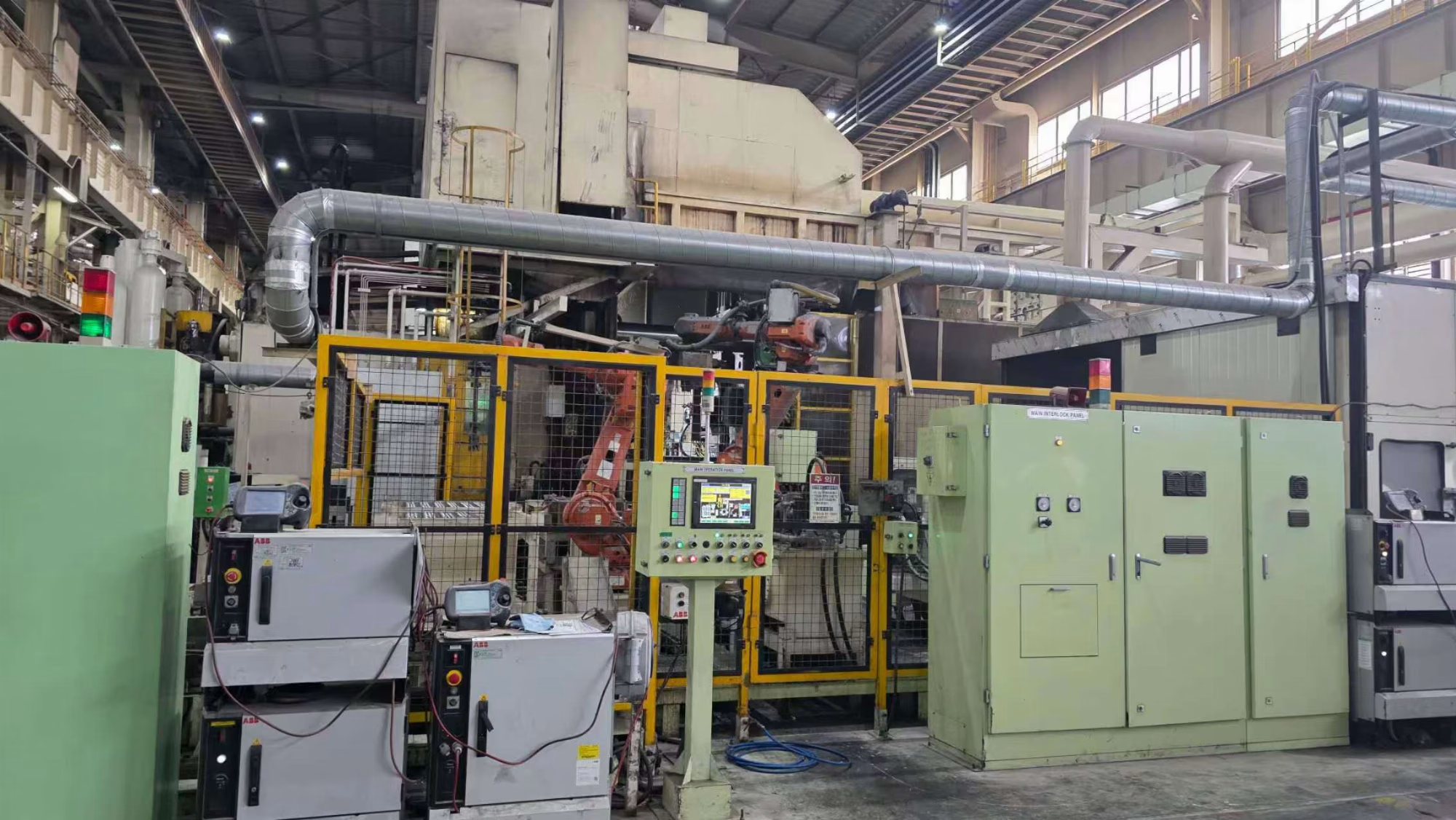
Italpresse machines often sit in cells with spraying, extraction and trimming. Clarify which peripherals are included and whether wiring diagrams and safety documents exist. See CE marking of used machines.
05 · Services
Services for used Italpresse machines
Whether you are buying or selling an Italpresse, FISS handles appraisal, dismantling, transport and recommissioning, including large TF machines that ship in several loads.
Practical guide to relocation: Relocation: dismantling and transport
06 · FAQ
Italpresse FAQ
Who makes Italpresse machines today?
ItalPresseGauss S.r.l. in Capriano del Colle (Brescia). The company joined Norican Group in 2017, became independent through a management buy-out in 2025 and has been owned by LEO III Fund since 30 March 2026.
What does the number in “IP 1650” or “TF 2300” mean?
It is the locking force in tonnes. The datasheet lists 16,186 kN for the IP 1650 SC3.0 and 22,563 kN for the TF 2300 SC3.0.
How do the IP and TF differ?
The IP is a three-platen toggle machine; the TF is a two-platen machine with hydraulic locking. At the same force the TF is shorter: 9,667 mm for the TF 1650 against 11,206 mm for the IP 1650.
Does Italpresse build hot chamber machines?
The current range and the 2026 datasheet list cold chamber machines for aluminium only. For an older machine with a different designation, rely on that machine’s own documentation.
Can older Italpresse machines still be serviced?
ItalPresseGauss names service, lifetime customer support and spare parts as part of its business. With older control generations, confirm the availability of specific components before you buy.
Are Italpresse machines suited to large structural castings?
The maker positions the TFs for large parts such as battery housings and roofs. The biggest size in the datasheet, the TFs 9000, provides 88,290 kN and up to 268.1 kg of aluminium shot weight.
07 · Read more
More manufacturers and know-how
Contact
Looking for an Italpresse, or selling one?
Tell us the series, locking force and shot end. We will come back with matching machines or an offer for your Italpresse.
As of November 2026. Technical data based on public information from ItalPresseGauss and the trade press; for a used machine, its nameplate and records take precedence. Sources:
- ItalPresseGauss: HPDC Technical Specifications 2026 (PDF)
- ItalPresseGauss: Toggle Free Die Casting Machines
- ItalPresseGauss: Toggle Die Casting Machines
- Gießerei-Lexikon: Firmenprofil Italpresse Industrie S.p.A.
- Foundry-Planet: Italpresse Gauss now part of Norican Group (29.09.2017)
- Foundry-Planet: Norican announces management buy-out at ItalPresseGauss (16.04.2025)
- Foundry-Planet: LEO III Fund completes the acquisition of ItalPresseGauss from Altor (14.04.2026)
- FISS Machines: Italpresse-Produktliste
