




Manufacturer · Cold chamber die casting · Germany · division with Frech since 2007
Used Müller Weingarten die casting machines GDK cold chamber types
Müller Weingarten AG was a German press and machine builder headquartered in Weingarten, Württemberg. Its die casting division, based in Esslingen, built cold chamber machines with 500 to 5,000 t clamping force for aluminium and magnesium parts. Frech took over that division on 1 December 2007, and the rest of the company was merged into Schuler Pressen GmbH in 2011. This page lists used Müller Weingarten machines at FISS and explains how to identify them.
- 500–5,000 tcold chamber range (2007)
- 1 Dec 2007die casting division to Frech
- GDKtype code on the used market
Machine you need not listed? Send FISS a search request
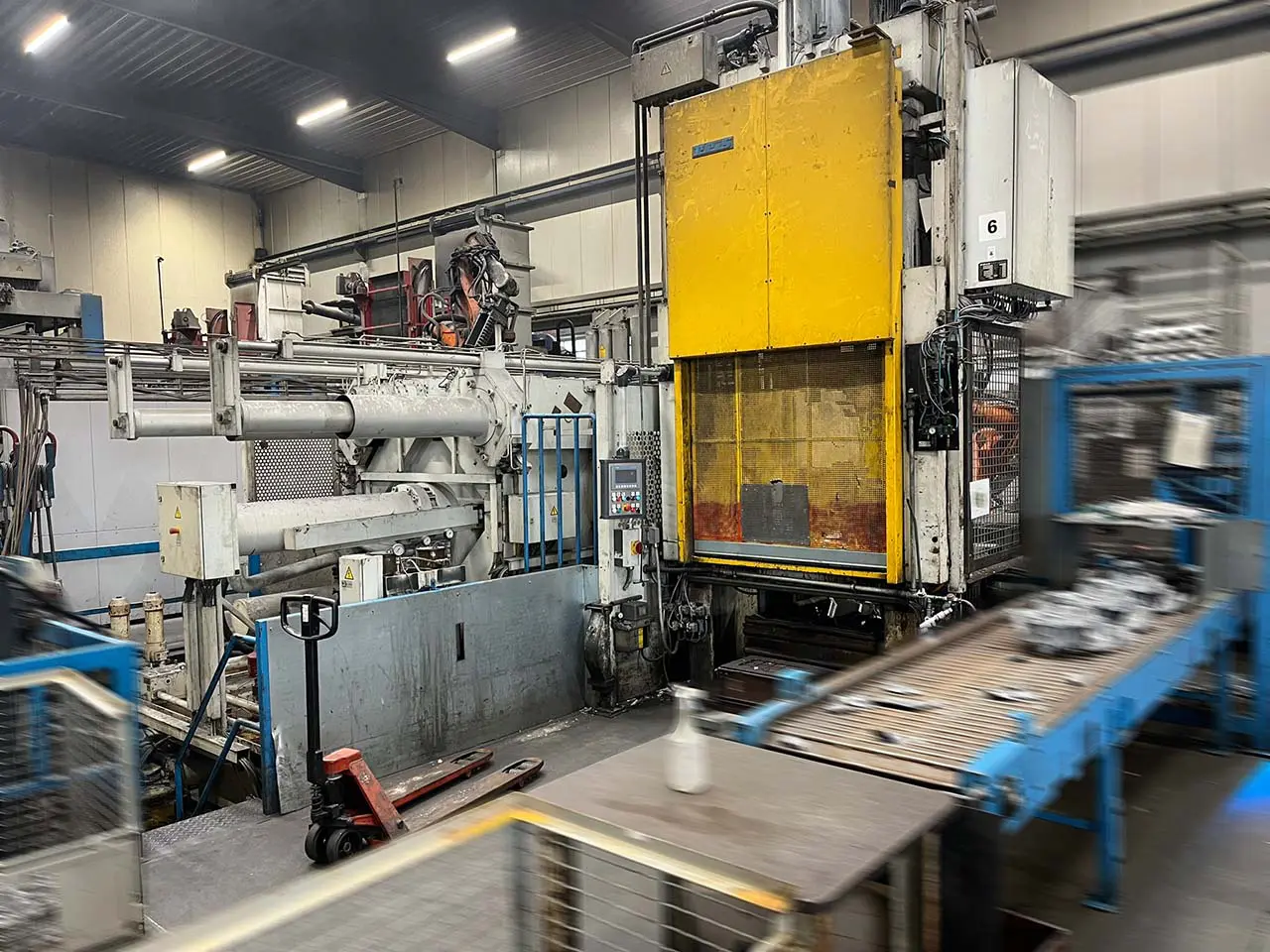
Müller Weingarten GDK 2000 / 130 Opticast (offer KK1670) · Photo: FISS
Knowledge · Müller Weingarten
A brand without a maker: how to place Müller Weingarten
Buying a Müller Weingarten die casting machine today means buying from a company that no longer exists under that name. Die casting passed to Frech in 2007, press building to Schuler. On the used market these machines are usually listed as "Weingarten GDK" plus a number, and often come as a complete cell with dosing furnace, spray unit, robot and trimming press. Build year, rated clamping force, control status and a documented overhaul history therefore matter more than the badge.
01 · Overview
Müller Weingarten at a glance
- Company
- Müller Weingarten AG, Weingarten (Baden-Württemberg); Maschinenfabrik Müller Weingarten AG until 1994
- Origins
- workshop in Weingarten from 1866; merged in 1981/82 with Müller Pressen- und Maschinenfabrik of Esslingen (founded 1863)
- Die casting
- separate division based in Esslingen; cold chamber machines with 500–5,000 t clamping force (as of 2007)
- Typical castings
- aluminium and magnesium parts, from small components to engine blocks, gearbox housings, chassis and body parts
- Since 1 Dec 2007
- die casting division owned by Oskar Frech GmbH + Co. KG, Schorndorf (Frech)
- Press building
- acquired by Schuler in 2007 and merged into Schuler Pressen GmbH in 2011, which ended the Müller Weingarten brand
- Frech today
- large cold chamber machines offered as the GDK Series, 22,000–48,000 kN locking force (data sheet, December 2024)
"Weingarten" on the rating plate
Auction and dealer listings often give the make simply as Weingarten, for example a GDK 400 built in 1985 or a GDK 550/55 OC built in 2004. Both dates fall within the era of Maschinenfabrik Müller Weingarten AG and its successor name Müller Weingarten AG.
On older Weingarten machines the number is a size name rather than a force rating: the GDK 400 was listed with 480 t and the GDK 550/55 OC with 530 t. On today's Frech GDK Series the number does equal locking force in units of 10 kN (GDK 3200 = 32,000 kN).
02 · Series
Types and successors: from the Weingarten GDK to the Frech GDK Series
In die casting, Müller Weingarten focused on the cold chamber process. Used machines are listed in our cold chamber die casting machines category. Frech has run the business since 2007 and builds its large cold chamber machines with a mechanical three-platen clamping unit; for background see Toggle vs. two-platen clamping systems.
Cold chamber · up to 2007
Weingarten GDK (Müller Weingarten era)
500–5,000 t Clamping force, 2007 range
- GDK 400
- GDK 550/55 OC
- Cold chamber machines for aluminium and magnesium, built by the die casting division in Esslingen
- According to the trade press, used for anything from small parts to engine blocks, gearbox housings, chassis and body components
- Type number is a size name: GDK 400 with 480 t, GDK 550/55 OC with 530 t clamping force according to auction data
Examples from the used market: GDK 400 (built 1985), GDK 550/55 OC (built 2004, overhauled 2016)
Cold chamber · Frech today
Frech GDK Series
22,000–48,000 kN Locking force
- 2200
- 2600
- 2800
- 3200
- 3500
- 4100
- 4400
- 4800
- Eight sizes with 1,400–1,800 mm closing stroke and 1,400–1,750 mm between tie bars
- Up to two shot end options per size, max. casting force 1,350–3,200 kN, plunger diameter 90–240 mm
- Frech states that taking over the Müller Weingarten division extended its range to large cold chamber machines of up to 48,000 kN
Type code: GDK 3200-185 = 32,000 kN locking force, shot end with max. 1,850 kN
Casting cell · peripherals
Weingarten machines as complete cells
- Aluminium cell with GDK 400: Westofen W65S dosing furnace, Gerlieva spray unit, ABB robot, Weco trimming press, Fondarex vacuum
- Magnesium cell with GDK 550/55 OC: Rauch MDO 250 dosing furnace rated at 109 kW, ABB IRB 4600, Fondarex HV Multi C
- Peripherals are often newer than the machine, such as a 2017 robot serving a 2004 machine
Details taken from auction descriptions; ask for documentation on every cell
03 · Comparison
Weingarten GDK and Frech GDK Series compared
| Feature | Weingarten GDK (up to 2007) | Frech GDK Series (today) |
|---|---|---|
| Supplier | Weingarten GDK (up to 2007)Müller Weingarten AG, die casting division in Esslingen | Frech GDK Series (today)Oskar Frech GmbH + Co. KG, Schorndorf |
| Clamping force | Weingarten GDK (up to 2007)500–5,000 t range (2007) | Frech GDK Series (today)22,000–48,000 kN in eight sizes |
| Type number | Weingarten GDK (up to 2007)size name, e.g. GDK 400 = 480 t | Frech GDK Series (today)locking force in 10 kN, e.g. GDK 2200 = 22,000 kN |
| Shot end | Weingarten GDK (up to 2007)check the machine's own data sheet | Frech GDK Series (today)up to two options per size, max. 1,350–3,200 kN |
| Control (examples) | Weingarten GDK (up to 2007)Siemens S7, Beckhoff OptiCast according to auction data | Frech GDK Series (today)Frech control with hydraulic diagrams, scopes and diagnostic texts |
| Data basis | Weingarten GDK (up to 2007)2007 trade press, individual machine listings | Frech GDK Series (today)Frech data sheet to DIN 24480, December 2024 |
Sources: Industrieanzeiger (19 Nov 2007), NetBid auction data, Frech cold chamber technical data (December 2024) and FRECH Group brochure.
04 · Buying guide
Checklist: inspecting a used Müller Weingarten die casting machine
Even the youngest machines from the Müller Weingarten era are now close to 20 years old, so the documented condition of the individual machine counts for far more than the name.
- Make, serial number, build year
Record type, machine number and build year from the rating plate. "Weingarten" or "Müller Weingarten" with a build year up to 2007 points to the pre-Frech era; you will need the machine number for any parts enquiry.
- Do not read force from the type number
On older GDK types the clamping force differs from the number (GDK 400: 480 t). Take clamping force, casting force and tie-bar spacing only from the rating plate or the machine's data sheet.
- Control: original or retrofitted?
Listings show both Siemens S7 and Beckhoff OptiCast controls. Find out who supplied the control, whether program backups, wiring and hydraulic diagrams exist, and who can support it today.
- Overhaul claims need a scope
"Overhauled 2016" means little without a work list. Ask for reports on hydraulics, shot end, clamping unit and electrics, and for a list of replaced assemblies.
- Clamping unit and platens
Check the mechanical clamping unit for play in links and pins, the tie bars for cracks and wear, and platen parallelism under clamping force.
- Shot end and shot curves
Accumulators, valves and plunger guidance govern mould filling, an area in which Müller Weingarten filed its own patent in 1983. Ask for current shot curves; see Shot curves and process monitoring.
- Aluminium or magnesium
Weingarten cells ran on aluminium as well as magnesium. Confirm which alloy the machine, dosing furnace and peripherals were set up for before planning the cell for another material.
- Safety and documentation
Machines from the 1980s and 1990s often lack current guarding or paperwork. Plan the assessment early; see CE marking of used machines.
05 · Services
Services for used Müller Weingarten machines
FISS helps you buy or sell used Weingarten die casting machines and complete cells, from assessing type and condition to dismantling at the current site, transport and recommissioning.
Practical guide to relocation: Relocation: dismantling and transport
06 · FAQ
Müller Weingarten FAQ
Does Müller Weingarten still exist?
Not as an independent company. Schuler acquired Müller Weingarten AG in 2007 and merged it into Schuler Pressen GmbH in 2011, which ended the brand. The die casting division had already passed to Oskar Frech GmbH + Co. KG on 1 December 2007.
Who should I contact about spare parts?
For die casting technology the contact is Frech, which took over the division in 2007 and offers spare and wear parts as well as overhauls. Whether parts are obtainable for a particular older machine is best checked with Frech using the type and machine number. Many hydraulic and electrical components are standard parts from third-party suppliers.
What clamping force does a Weingarten GDK 400 have?
A GDK 400 built in 1985 and sold at auction was listed with 480 t; a GDK 550/55 OC from 2004 with 530 t. The number is therefore only a size name, and the rating plate of the individual machine is what counts.
Is the Frech GDK Series the old Weingarten machine?
Frech says that acquiring the Müller Weingarten division extended its range to large cold chamber machines of up to 48,000 kN, and its current GDK data sheet covers 22,000 to 48,000 kN. A present-day Frech GDK is a current design, however, so its data cannot be applied to an older Weingarten machine.
Where were the machines built?
Müller Weingarten AG was headquartered in Weingarten, but according to the trade press the die casting division that Frech acquired in 2007 was based in Esslingen, home of the former Müller press works.
What parts can these machines cast?
The 2007 trade press names aluminium and magnesium parts from small components up to engine blocks, gearbox housings, chassis and body parts. What a specific machine can handle depends on its clamping force, platen size and shot end.
07 · Read more
More manufacturers and die casting know-how
Contact
Looking for a Weingarten machine, or selling one?
Send us the type, build year, clamping force and alloy. We will come back with suitable machines or an assessment of your Müller Weingarten equipment.
As of November 2026. Information from the trade press, company information published by Schuler and Frech (data sheet dated December 2024) and auction descriptions of individual machines; the rating plate and documents of each machine take precedence. Sources:
- Industrieanzeiger: Schuler verkauft Druckgießtechnik an Frech (19.11.2007)
- Wikipedia: Müller Weingarten
- Schuler Group: Unternehmensgeschichte
- FRECH Group: Unternehmensbroschüre Die Casting Technology (2025)
- FRECH: Technische Daten Kaltkammer, K-Series und GDK-Series (Stand 12.2024)
- NetBid: Druckgießzelle Weingarten GDK 400 (Al-Legierung)
- NetBid: Druckgießzelle Weingarten GDK 550/55 OC (Mg-Legierung)
- Google Patents: DE3320643C1, Verfahren zur Beeinflussung der Formfüllphase einer Druckgießmaschine
